The Sexual Disability of Red Algae

by Jennifer Frazer on January 10, 2010

For those who would like to know more about your friendly blogger, I have been interviewed by the community blog at The Reef Tank, a web site for home saltwater aquarists. In the interview, I talk about some of the peculiarities of aquatic plants and algae (including an explanation of the title of this post), what some of my formative aquatic experiences were, why I started this blog, and how an aquarium is like a hot tub. There’s more than enough to read there, so in that spirit, I’ll end this short post with an interesting picture of a red alga. Yay algae!

In spite of its sexual disability, this red alga is still very happy to see you. Close-up of Laurencia sp., a seaweed from Hawaii. Photographed by Eric Guinther. Creative Commons Attribution ShareAlike 3.0 License. Click image for link.

p.s. Speaking of algae, I just painted my hall a color I’m calling “kelp green”, but which has been less charitably described by some interloping visitors as “baby poop green”. It’s kelp! Kelp, dang it!

{ 2 comments }

. . . And we’re back. Apologies for the long delay, but after I returned from my vacation, I almost immediately plunged into the logistics of painting my entire home, and I’ve been otherwise engaged each night. But I wanted to be (among the) first to wish you a Happy International Year of Biodiversity!

Save Biodiversity And to celebrate this milestone, I now present you the fabulous solution to a mystery we all pondered last year. Remember the Unidentified Feathery Object (aka the Ninja Seaweed)? Well, I just saw a video post on the Echinoblog today (which also includes video of the infamous sea pig!) that explains everything. Though it be still ninja, that’s no seaweed. It’s a space station! Wait. . . let me check my notes . . .

Ahem. For your viewing pleasure, I present . . . the hairy sea cucumber!

Hmmm. . . hairy sea cucumbers. I see nothing suggestive in that name at all. Nope.

It’s also quite apparent no one taught these sea cucumbers table manners. I mean, come on: shoving your whole tentacle into your mouth at once and slowly licking it clean? Sakes alive!

Sea cucumbers (even hairy ones) are echinoderms, which means they’re most closely related to sea stars, brittle stars, basket stars, and sea urchins. This sea cucumber is clearly a filter feeder, catching tiny animals and plants on its tentacles, though I can’t seem to find out if it uses glue, or stinging cells, or poison, or dumb luck. For the sea cucumber (aka holothurian) family . . . er, . . tree, see here. Follow “Holothuroidea” down to see the different sorts. And just for the record, I’d never heard of hairy sea cucumbers either.

{ 0 comments }

The Sublime Dance of the Weedy Sea Dragon

by Jennifer Frazer on December 26, 2009

Snowed in and still wired  . . . so I’d like to close the year with something beautiful for you to contemplate. BBC keeps releasing short clips of “Life” on YouTube, and here is another (Dang you BBC! When will you release this in full in the states? When? When?!). Hit the resize button second-to-right in the lower right-hand corner to super-awesome-ify it, and the HD button too if you have the bandwidth.

Sigh. I’ll never forget the first time I saw leafy sea dragons (a relative of these weedy sea dragons) at the Tennessee Aquarium in Chattanooga. My mom practically had to drag me out of the room.

Sea dragons are not true seahorses, belonging instead to the seahorse sister taxon (most closely related group), the pipefish. The proper name of the group is Syngnathinae, which means fused-jaw (syn-gnath), and if you look at their beaks, you can see that their jaws are indeed sealed shut. Here’s a short BBC article discussing the Life clip you just watched.

And with that, we conclude our programming for 2009. I look forward to sharing the tiny, slimy, tentacled and beautiful with you in the next decade too. Cheers, all, and stay safe this holiday season. : ) Jen

{ 2 comments }

Give the Gift of Slime

by Jennifer Frazer on December 24, 2009

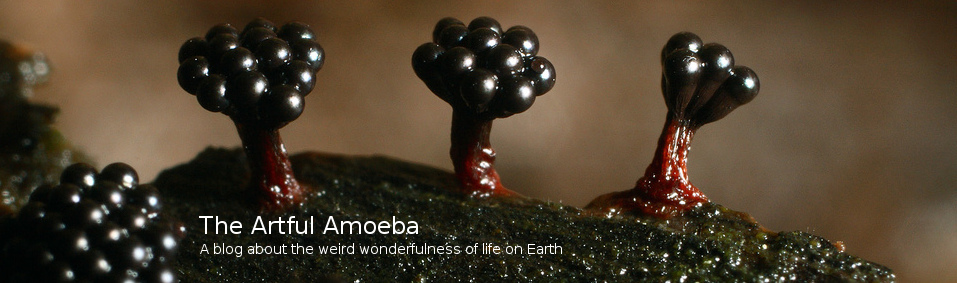
Earth: Where Wonders Never Cease. A study of three slime molds by the amazing Kim Fleming, photographer of this blog's masthead. Used with permission. http://www.flickr.com/photos/myriorama/ / CC BY-NC-SA 2.0

If you’re a reader of this blog, you’re probably like me: you love life on Earth. If you’re still struggling for a gift for someone and know they feel the same, consider a donation in their name to a conservation organization. The Nature Conservancy or the relatively new charity Oceana are two large conservation organizations with high Charity Navigator ratings.

We all know these sorts of places market themselves with photos of polar bears and whales, but the fact is that preserving land and sea for these charismatic megafauna (and this is the reason they use this term — because the public likes and tends to relate to them) also protects our charismatic microfauna — slime molds, sea cucumbers, ciliates, etc. — and the organizers of these charities know this and use them thusly. That’s fine with me if people need cute and cuddly in order to justify saving something, but as you know, the raison d’etre of this blog is to show you why the weird and wonderful provide every bit as much reason, if not more.

If you don’t have any more gifts to buy, consider making a gift of your own this holiday season to one of these two charities or the conservation organization of your choice — there are many. There are other low-cost, free, or money-saving ways you can help the crazy creatures of the planet in the coming year, too, and I here suggest only a few: conserve the resources you use; lower your carbon footprint; volunteer for a citizen science project (like a backyard bird count or bioblitz); eat less meat (chopping down the rainforest to grow soybeans for animal feed is a major cause of rainforest loss, and my slime mold buddies love to hang out in rainforest. Cows make lots of greenhouse gases too); use a Seafood Watch wallet card to make good choices when you do buy seafood in restaurants or markets; have fewer children (notice I’m not saying have *no* children, although that’s perfectly fine for those so-inclined. However, I do believe humans are very much part of the weird wonderfulness of the planet and that having a few children (and teaching them about life!) is a good thing for those so-inclined); buy less new stuff; take a child (or a friend!) to an aquarium or zoo; and talk to other people about amazing, celebrity-shy creatures of the planet in a non-obnoxious, engaging way. In my opinion, the carrot is a much more effective way to influence behavior than the guilt-trip-based stick.

I’m going out of town in a few days and will be out of web contact for about a week or so. I wish you all a joyous holiday season!

{ 2 comments }

The van Leeuwenhoek is in the Gallery Just Down the Hall . . .

by Jennifer Frazer on December 23, 2009

An Antony van Leeuwenhoek original: Portrait of the Ash Tree as a Young Cross Section.

When it has a Water Flea Circus, a Rotifer Room, and a Radiolaria Lounge you know this blogger is going to love it, and the Micropolitan Museum of Microscopic Art Forms is home to all these things. The website, proudly presented by the Institute for the Promotion of the Less Than One Millimetre, is the labor of love of Dutch artist Wim van Egmond.

If you just want the highlights, here’s a nice slide show by Wired Magazine.

Following in the steps (or perhaps slides) of his famous countryman and father of microbiology Antony van Leeuwenhoek, Wim has not only produced a great collection of microscopic photos, he’s got a great collection of microscopic photos in 3D, a technology sadly not available to the great microscopist. And as we know from our Avatar experience, everything’s better in 3D . . . .

You’ll need a cheap pair of red-blue glasses in order to experience the 3D. I highly recommend investing or procuring such, since there’s a lot of great 3D space images also getting tossed around the internet lately.

Antony (Antonie) van Leeuwenhoek (Lee-oo-ven-hoke Lay’-oon-hook — I think. Please correct me if I’m wrong, Jasper) is a guy you should know about if you read this blog. He was a Dutch cloth merchant who took up microscopy in the mid-1600s; met Peter the Great and may have known Johannes Vermeer (my favorite painter); and may have been the first human ever to see and draw microorganisms, which he called (delightfully) “animalcules”. He lived to be 90 — no small feat in the 17th century, and a reminder of how rugged humans can be even in the absence of antibiotics, toothpaste, text messages, etc., etc. He mastered a technique for making a small and optically excellent microscope that is essentially a melted bead of glass. It is so simple you can teach schoolchildren to make them in a few minutes, as protistologist Patrick Keeling has figured out how to do. Yet van Leeuwenhoek wanted to maintain his microbial monopoly so he could get the glory for his accomplishment (understandable but rather stifling to science, it must be said). So he seems to have let on like he spent hours in the kitchen grinding lenses to get his beautiful pictures. Hours. [Wipes dewy brow while letting out long-suffering sigh]

Above you see one of Van Leeuwenhoek’s actual drawings. It’s remarkably accurate (he certainly spent hours on that) and shows the cross section of a one-year old ash tree. The big holes are the vessel elements and the small holes are tracheids, the two chief cell types of wood (which is mostly xylem (zy’-lem)) in flowering plants. These cells move water and minerals when they are new, and once defunct, provide structural support. Thus, when you hold a piece of wood, you’re the holding the lignin and cellulose skeletons of tracheids and vessels.

You can see that early in the year, the tree made lots of big vessels for pumping water into swelling leaves, while later in the year the flow slowed. This annual variation in vessel/tracheid size is responsible for the growth rings you see in angiosperm (flowering) trees. Those big vessels are a flowering plant innovation that conifers lack, and may be partly responsible for their evolutionary success. It should also be said that vessel elements and tracheids are among the most beautiful (and abundant) tissue-class cells on the planet, thanks to their lignin-thickened decorations. See some more here and here and I believe in Fig. 1(?) in van Leeuwenhoek’s drawing above. Way cool!

Must get on top of getting a microscope. Must. Must.

{ 1 comment }

The Biodiversity of Other Worlds

by Jennifer Frazer on December 19, 2009

Warning: This post contains mild Avatar spoilers.

I want to show you something. Pull the slider bar across to 1:37 in this clip of the Jim Henson masterpiece and my favorite childhood film, “The Dark Crystal,” and watch until about 2:33.

Amazing, huh? It’s made even more amazing by the fact that all these creatures were real tangible things dreamed up and manufactured by the Jim Henson studio. In the making-of documentary, you can see them assembling them by hand like traditional European craftsmen (many of whose skills they used). This was a movie I watched over and over whenever I could on the gigantic early VCR owned by our neighbors down the road in rural Tennessee when I was 5 or 6. I absolutely loved it, even though the first 5 minutes of the were missing because my neighbors were slow on hitting “record”.  Even little Jen(me) was fascinated by the diversity of life – even imagined life.

Last night I saw Avatar on opening night in 3D on an IMAX screen in Denver, and I got to live this experience all over again.

Avatar is not a movie that is long on brains or wit, even by the standards of other James Cameron films. I wish they’d spent half the time on the script they spent on the visuals. You could also compile a list 20 or 25 items long of elements this movie shares with other Cameron films, from big things like a strong female lead (all films), to a soulless corporation driving evil in the name of profits (Aliens, The Abyss, Titanic; which, by the way, is a major reason yours truly has all her money in “socially responsible” investments) down to really subtle details like a supporting female character who’s really good at operating an unusual vehicle (One Night in the Abyss) or a bad guy fighting the good guy toward the end of the movie in an unbreathable environment in a machine that gets its front window cracked, thus admitting some of the deadly medium (Michael Biehn’s character in the Abyss).

But James Cameron films have their virtues, and they are a passionate attention to detail, a high sense of adventure, protagonists you want to love, and really deadly/exotic/fantastically beautiful aliens. In this film, he’s taken this latter theme, one he started with the fantastic ctenophore-inspired aliens from “The Abyss” (still my favorite Cameron film) and used it to imagine the biodiversity of another world. For those of us fascinated by life, there is a lot to see and wonder at in this film. It provides, as Manohla Dargis of the New York Times says in her review, the big WOW.

Because it’s such a magical experience, I’m not going to give much of it away, except to say it’s obvious these creatures were inspired at least in part by computer geeks, given that they all have USB ports. But Cameron takes the modus operandi of people trying to re-imagine life on other worlds – putting sea creatures on land or making plants animals, ones which Henson and legendary conceptual artist Brian Froud drew on heavily to imagine the world of the Dark Crystal – and takes it up a notch. In one of my first posts I told you the parasite Giardia resembles the love child of a squid and a kernel of corn. In Avatar, you get to find out what happens when a jellyfish and a dandelion make sweet, sweet love.

As has been pointed out by many reviewers, Cameron’s narrative breaks no new ground and simply retells some of America’s classic, and not always proud stories (Pocahontas, Dances With Wolves) with lesser dialogue and characters. Even the facial structure and ears of the blue alien Na’vi strongly recall those of gelflings, above. But oh, what a world in which to retell our stories. For people who are not biodiversity-philes, this movie takes a bit of the wonder that I easily feel crawling around the Colorado forest floor after a good rain or watching D.A. ramble on in his adorable, thick British accent about marine worms and dumps it right in their laps. Cameron was so attentive to detail there are things in “Avatar” for even lichenologists and bryophiles to love. I won’t give it away, but when you first see the rainforest of the forest moon Pandora (wait a minute . . . Endor? Pandora? ) through the avatars’ eyes there is a tiny 3D detail that will take your breath away. Though sadly, this biodiversity afficianado has never been to a real rainforest (it’s up there on my list of dreams along with traveling to the deep sea in a submersible), Avatar puts me as close as I’m likely to get for a while, and it does so in glorious 3D. I’ve never heard so many audible “wows” from an audience, myself included. Thank you, Mr. Cameron.

{ 6 comments }

On the Origin of Flowers

by Jennifer Frazer on December 15, 2009

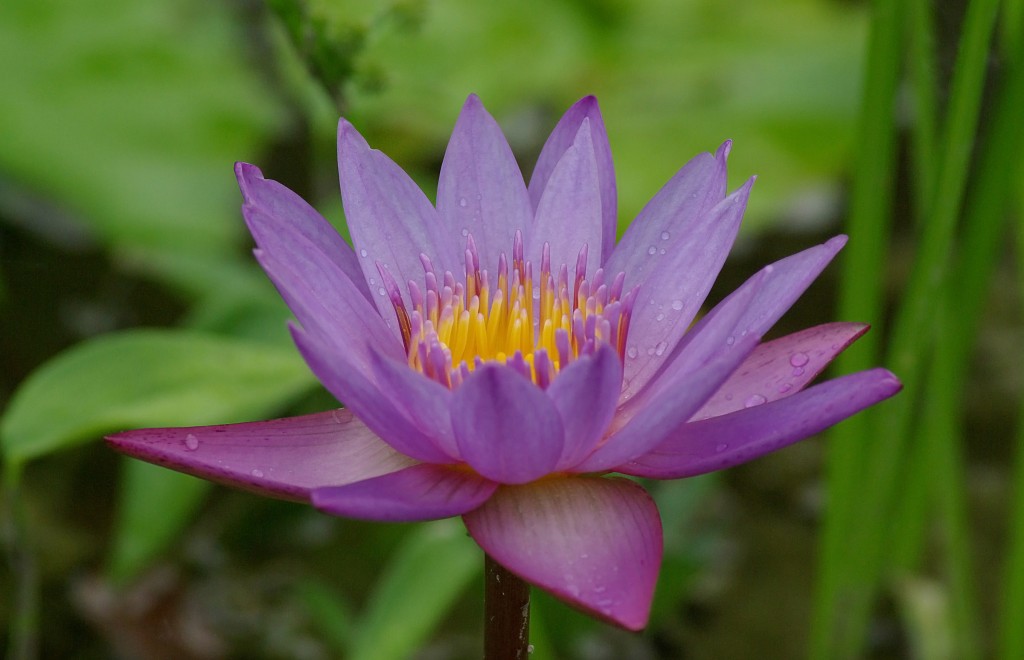
A water lily. There is an evolutionary secret staring right at you in this picture. Can't see it? Read on to find out what it is, then come back here and click on the photo as many times as you can to see it in extreme-close-up-o-vision.

A few posts ago, I told you that star anise is interesting because it belongs to a group of plants that split from the rest of the other flowering plants early on, and that for a long time, scientists felt plants like these retained a lot of the features of the first flowers.

Scientists think that long ago, petals, carpels (the girl bits), and stamens (the boy bits) evolved from leaves. In other words, the leaves were the raw material upon which evolution acted to create a specialized cluster of sexual structures we now call flowers. By this reasoning, a flower is essentially a bunch of colored, modified leaves that the plant has packed together with its gonads at the end of a stem (a pedicel (ped’-i-sell)) for the purposes of luring insects to move pollen from flower to flower, i.e., reproduction. So yes, when you stick your nose in to inhale the perfume of a delicate flower, you are essentially shoving your sniffing nose – doggy-greeting style — into the flowers’ unmentionables.

The 3% of plants that are basal angiosperms (the group in which star anise fits) seem to have a lot of the characteristics we’d expect in first flowers. Their flower parts are usually physically separate and little changed from each other,  like magnolias or star anise or the water lily above – as if each one evolved from an individual leaf. This is not true of highly derived (changed a lot) flowers like orchids,

Wiki_lady_slipper_orchid

wiki_Nep_northiana_pitcheror this crazy pitcher plant, Nepenthes northiana, with the digital camo in the back of the pitcher and a convoluted and unified structure. Although not a flower, the pitcher is, believe it or not, a modified leaf.

Thus petals are essentially colored leaves, and the stamens of many of these groups, particularly water lilies, are essentially petals/leaves with pollen-making chambers on the ends. Some seem to defy classification as either petal or stamen. Click on the picture at the top of the page and keep clicking on it to magnify it. Look carefully at the stamens at the very edge of the bunch — they are more like purple petals with pollen making slits half way down them than true stamens.

In this photo, notice the transitional stamens toward the outside of the center – they also look like a cross between a petal and a stamen, although in this case, the pollen-making chambers (anthers) are at the tip of the petal rather than halfway down.

Wiki_Nymphaea_alba_water_lily

For a while, some scientists felt the first flowers looked very much like magnolias, hence an early term for the basal angiosperms, magnoliids. But that view is changing. Showy magnolias were probably a very early specialization.

Wiki_Amborella_budsScientists have compared plant DNA the same way they compare flower and plant body parts and have concluded the living flower lineage that split the earliest from the rest of the living flowering plants is the diminutive (and threatened) Amborella, pictured here.

Very closely related to Amborella at the base of the tree are the water lily family, Nymphaceae (nymf-a’-see-ay), and the Austrobaileyales, the group that includes star anise (see the tree here). Plants in these groups often possess characteristics of both the two major flowering plant groups that comprise the other 97% of plants, the monocots (grasses, grains, lillies, orchids, etc.) and the eudicots (roses, apples, poppies, maples, etc.), giving scientists more confidence that they inhabit a special place at the base of the flowering plant tree.

Now scientists believe the first flower was likely to have been small, green, simple, and inconspicuous – not unlike Amborella. Nova did a special on one Chinese aquatic fossil candidate for “the world’s oldest flower” in 2007 (see a great short slide show on it here). Though it’s interesting that water lilies, also at the base of the tree (look for Nymphaeales), are also aquatic, the status of the fossil — Archaefructus, or “ancient fruit” — as “oldest flower” has been challenged. There have been other “most ancient flowers” (Bevhalstia pebja) in the past and will surely be new contenders in the future.

So, four weeks and three posts later, it may finally be becoming clear why star anise is such a surprising plant! In addition to the gorgeous and pungent whorled fruits you can use to flavor stir fry pork or decoupage your 70’s hippie bus, it is a member of one of the most ancient flowering plant lineages on Earth and could save you from one of the planet’s newest viruses.
{ 6 comments }

Bad Taxonomy Kills

by Jennifer Frazer on December 12, 2009

The common skate, Dipturus batis. Image by Misjel Decleer, published under a Creative Commons Attribution Non-Commercial 3.0 license. Click image for link.

The common skate, Dipturus batis. This, obviously, is the not-up side, referred to by zoologists as "ventral" (the opposite of "dorsal"). Botanists would call it "abaxial". Image by Misjel Decleer, published under a Creative Commons Attribution Non-Commercial Share-Alike 3.0 license. Click image for link.

Just in case you thought taxonomy was a strictly useless pursuit . . .

. . . and you can see how skates fit into the rest of the cartilaginous fish (fish with cartilage skeletons like sharks) here.

{ 0 comments }

Giant Predatory Marine Nemertine Worms Ate My Homework

by Jennifer Frazer on December 9, 2009

If you think this is bad, wait till you see the video. A voracious predatory nemertine worm, cousin of the famed "screaming eels".

If you think this is bad, wait till you see the video. A scavenging nemertine worm, cousin of the famed "screaming eels". That fish on the left looks like it has suddenly realized it's headed for the fish stick factory. Photo by Henry Kaiser, National Science Foundation

In case you missed it in the last few weeks, BBC’s new “Life” series (narrated by the great D.A.!) released an amazing clip of a starfish and marine nemertine (aka ribbon) worm feeding frenzy in McMurdo Sound, Antarctica. They won’t allow video embedding, but go here for the superlarge youtube video in all its glory. Be warned that the seal noshing is a bit . . . graphic. If you imagine the seal made from the same stuff as gummy bears or laffy taffy, that might help a bit.

Here is another BBC article describing the video. When will we in the United States get to see “Life” in its full glory? Come on BBC, throw us a frickin’ bone. We still haven’t got “Creation” yet either, though word is it’s coming in January.

A brief perusal of the wikipedia article on nemertines reveals some compelling details; these worms have probosci that may have poisonous stylets used to attack and kill their prey. This little detail was a particular gem:

The proboscis is wrapped around the prey, which is normally other invertebrates such as crustaceans and annelids and can be many times larger than the nemertean itself, and the prey is then stabbed repeatedly with the stylet until dead.

Awwwwww. The article also sedately notes the worms are documented to reach 30 meters; some reports have indicated they may reach 50 or 60 meters. Ladies and gentlemen, that’s almost 180 feet. A blue whale reaches about 90 feet.

It seems these worms used to be thought of as closely related flatworms, like the cross-eyed Planaria of biology lab fame. Now scientists understand these worms are more complex than once thought, and more closely related to the annelid worms (which I’ve written about here before) and mollusks. Here’s a nice tree showing the relationship. And just look at all the weird, wonderful life on that tree! Have you even heard of half of those?

Finally, just to recap, I [heart] David Attenborough.

The man himself! How can I lure him to Colorado? Sadly, we have no birds-of-paradise. We have do have birds-of-ridiculous-mating-displays, though, aka sage grouse. Wildscreen's photograph of David Attenborough at ARKive's launch in Bristol, England © May 2003. Creative Commons Attribution License 2.5, click image for link.

The man himself! How can I lure him to Colorado? Sadly, we have no birds-of-paradise. We have do have birds-of-ridiculous-mating-displays, though, aka sage grouse. Wildscreen's photograph of David Attenborough at ARKive's launch in Bristol, England © May 2003. Creative Commons Attribution License 2.5, click image for link.

I just watched the first half of Attenborough in Paradise the other night, and his seeming ability to casually drop Alfred Russel Wallace quotes and ad lib arresting narration is astounding. David, I salute you.

{ 5 comments }

Weird, Wonderful Benthic Squid

by Jennifer Frazer on December 4, 2009

The sort of things we find when we just start looking . . .

I really, really, really, wanted to finish up my posts on paleodicots tonight, but it isn’t going to happen as I’m leaving town early tomorrow morning for the weekend and still have to pack. So instead, I wanted to give you a taste of all that’s out there still waiting for us to stumble upon. The above beauty was apparently found in 2003. Judging by the scientists’ reactions, it’d probably never been seen before. What is that thing on its head? I have no idea. Sexually selected cephalopod plumage? A squid spoiler?An HD antenna?

Here’s a different, identified species (Magnapinna) captured on camera by an oil company (go to youtube for the details). Dear God. if I happened to be underwater and see this live . . . let’s just say it’d have a sphincter factor of 9.0. Note the depth in feet.

There is so much cool stuff left to discover right in our own back yard.

Two other pieces of good/bad biodiversity news today:

Biodiversity loss can increase infectious disease in humans

and

Elevated carbon dioxide may mitigate losses of biodiversity from nitrogen pollution

We’ll get back to your regularly scheduled programming next time. Happy weekend!

{ 0 comments }