The Seafaring Killer Bacterium

by Jennifer Frazer on February 14, 2010

Vibrio cholerae

Still Life with Vienna Sausages with Tails: A Choleric Work in the Style of Pollack. Photo courtesy CDC Public Health Image Library, Image #1034.

Vibrio cholerae is a bacterium of surprising adaptability, tenacity, and Olympic-class swimming ability. Cholera bacteria can swim in both freshwater and saltwater (a feat most fish cannot manage), and somehow also manage to do the backstroke through stomach acid without kicking the bucket. The historic killer has just popped up again in Papua New Guinea for the first time in 50 years, killing 40. Officials are worried that it may once again become endemic there, taking up residence in the locals’ water supply.

And this is despite our knowing exactly how to prevent the disease for well over 150 years, ever since British physician John Snow famously helped halt a London cholera epidemic by persuading the authorities to abscond with the handle to the Broad Street Pump, preventing people from drawing its lethal waters. There’s only so much science can do. Money and competency are also required.

King Cholera

Cholera is a disease you have probably at least read about if you did any of the required 19th-century high-school lit reading. That’s because it was a newly famous and successful killer that century, decimating millions globally and hundreds of thousands in the United States, as the bacteria spread along coasts and up and down rivers. It was a swift death, too, and until mid-century, no one knew the cause.

A few years ago I visited some old graves out on the lonely prairie of Nebraska near the inland-sea-sized Lake McConaughy at Ash Hollow State Park. Buried there was Rachel Warren Pattison, a young woman who traveled the Oregon Trail in perfect health one day and was dead of cholera the next. Her party, including her 23-year-old husband of two months, Nathan, had only a few hours to carve a marker for her before the wagons moved on, and miraculously, in an uneven but serviceable hand on a rough stone, they did. I stared at that marker a long time. Sometimes I think modern, first-world citizens greatly take for granted the fact that most of us will not randomly keel over tomorrow from some fatal and unpreventable disease. Before the 20th century, people everywhere lived with that fear (and reality). Imagine how your life would be different if you lived with that reality now.

Cholera, Bringer of Death

In any case, Rachel was but one of the 6,000-12,000 killed along the Oregon, California, and Mormon Trails between 1849, the year of the gold rush, when cholera was spread along the trail by prospectors and settlers, and 1855, when the pandemic ended. And that epidemic was just one tiny sliver of the half dozen major pandemics that covered the world that century, a product of globalization and colonialism. Before 1816, cholera seems to have been a local disease restricted to India. But with people increasingly traveling between east and west, it swiftly leached into waterways around the globe. In the UK, where the disease claimed tens of thousands of lives in the first wave in 1831-32 alone, it began to be called “King Cholera”.

What made and still makes cholera such a frightening disease was the speed with which it could (and can) kill. Death can come as quickly as 3 hours after the onset of symptoms, but more commonly within 24 hours. Its most famous symptom — thin diarrhea descriptively called “rice-water” stool — accurately indicates the cause of death. You die from lack of fluids. That’s it.

Cholera bacteria use their tails (flagella) to propel themselves into the walls of your intestinal cells, where they secrete a toxin that causes cells to expel chloride ions. This, in turn, creates ionic pressure that keeps sodium from entering cells. That causes osmotic pressure to build on the outside of the cell, drawing massive amounts of fluid into the intestine. Building reliable sewage and water treatment plants prevents deaths, as does simply keeping cholera victims hydrated with a simple electrolyte solution. That we can’t manage even that that in many parts of the world is as discouraging as it is laughable.

Ancestors in the Deep

But here’s the really interesting thing about cholera, at least from my perspective: scientists are discovering that cholera seems to be an inherently aquatic and previously deep-sea bacterium that evolved to peacefully colonize copepod shells and mollusc interiors, and only accidentally turned out to be good at violently colonizing human small intestines. Wow!

In 1999, the submersibles Alvin and Nautile visited hydrothermal vents at the East Pacific Rise and sampled sulfide chimneys there. Vibrio species were identified there with “significant similarity” to V. cholerae, according to past NSF-director Rita Colwell, who has studied cholera since the beginning of her career.

Modern V. cholerae colonize the outside of copepod shells (Remember copepods from here and here?) and the insides of shellfish and must compete for space there in the life-sustaining biofilm. It turns out that those that are best at attaching to copoped shells also happen to be most pathogenic in humans. And a mucinase (enzyme that breaks down intestinal mucus) that helps them attach your intestines is greatly aided in its work by the addition of an extract made from mussels. That is, eating shellfish contaminated with cholera make make matters way worse than simply drinking the bacteria.
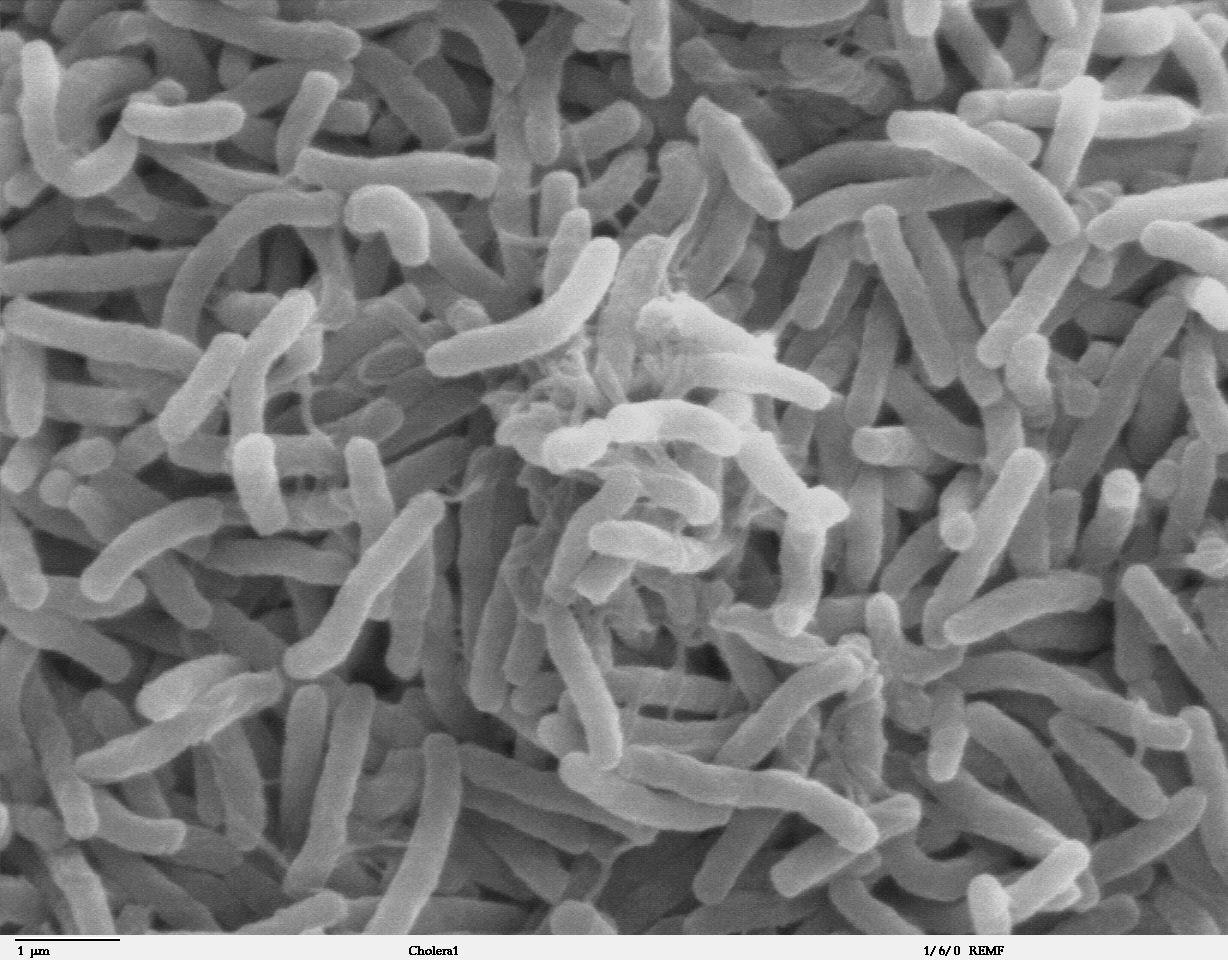
Vibrio cholerae

Deadly cheetohs -- the rod-shaped bacteria V. cholerae. Courtesy Dartmouth Electron Microscope Facility.

Living with Vibrio

Cholera is probably not an eradicable disease, according to Colwell, since we seem to be only accidental victims, while copepods and cholera are the real story. Since they’re ubiquitious and may be providing some important ecological function, we must instead rely on ingenuity and engineering to keep us safe. Basic sewage and clean water systems for all people of Earth does not seem like an unreasonable demand.

Two interesting human genetic notes regarding cholera: you may already know that Sickle Cell Anemia is widely considered to be a by-product of the genetic advantage that having one copy of the harmful gene provides during malaria infection. With one copy, you get malaria protection; with two copies, you get sickle cell anemia. Some have speculated that cystic fibrosis is a two-copy gene problem produced by a single copy that confers resistance to cholera. As well, blood types seem to confer various protections (though not immunities) from cholera: AB blood is most resistant, followed by A, then B, then O.

Vibrio is in the gamma-proteobacteria, a group you can find on the tree of life here (click on Proteobacteria to drill it down a bit). Gamma-proteobacteria contain many human pathogens, including Yersinia pestis (the cause of plague), Salmonella, Escherichia coli, and Pseudomonas aeruginosa, a cause of lung infections in (ironically) cystic fibrosis patients and other ill people.

But don’t get the idea that gamma-proteobacteria are mostly human pathogens. My gut(!) tells me they’re probably the exception, rather than the rule. We just happen to know more about them because there’s money to study human pathogens. The rest of the (probably amazingly interesting) group languish in obscurity. Don’t believe me? Look at all the families here.

{ 1 comment }

Can there be too many jellyfish at one biology blog? No. No, there can’t. This is the famous Jellyfish Lake on the island of Palau, where jellyfish cut off from the sea 12,000 years ago have evolved into docile migratory creatures that live off the food produced by their symbiotic algae. That shot downward into the depths is my favorite.

I post it here to celebrate the fact your blogger has decided to take the plunge and become a certified diver. Though I live in landlocked Colorado, life is too short not to experience ocean life the way I experience land life — particularly for a person with a passion for biodiversity. If I’m ever going to achieve my dream of swimming with whales, it’s a fairly necessary step. Plus I found out about an incredible dive in Hawaii where they take you out at night in 7,000 feet of water, drop you down on a tether 40 feet, and let you watch the nightly ascent of the crazy-cool pelagic (deep ocean) bioluminescent organisms — jellies, ctenophores, crustaceans, etc. Something about the thought of floating out in the Pacific Ocean in the dark with 7,000 feet of water below and glowing organisms all around sends shivers up my spine. It’s the best possible sort of ocean documentary — the one you’re starring in.  As soon as I discovered it, I knew I must do it before I die, and the only way to get there is to get SCUBA certified. Q.E.D. (although we’ll see if I’m still singing that tune when I get my credit card bill this month. : ) )

In other news, I have just re-upped on the web address for this site and purchased a few more for good measure. Hence theartfulmaoeba.com has now divided into artfulamoeba.com, theartfulamoeba.net, theartfulamoeba.org, and theartfulamoeba.info. You can reach me by any one you choose. Knock yourself out.

At some point I will also move this blog to my own host service. You may have noticed it is currently hosted at frazer.northerncoloradogrotto.com. That is because the webmasters at my caving club and kindly agreed to lend me some of their unused space. But it would be nice for the domain names for this site to be consistent, so one day soon I’ll move it over and all the frazer.northerncolorado.com links will break. I want to tell you now (and will remind you frequently) so anyone who has linked here has plenty of warning. If you are linking to the blog as a whole, theartfulamoeba.com will always work.

Happy Friday!

Jen

{ 0 comments }

Upupa, Oprah. Oprah, Upupa.

by Jennifer Frazer on February 8, 2010

Good news, everyone! No, really! The approximate U.S. release date for BBC’s new nature-glam documentary “Life” has been set. It will be sometime this March on the Discovery Channel, according to wikipedia, but sadly, BBC has willfully ignored my helpful suggestion *not* to replace David Attenborough’s narration with a pedestrian American track by Sigourney Weaver, Morgan Freeman, Tom Cruise (the horror!) or the like. Instead, they have chosen . . . . Oprah. Sigh. This is a woman who, though I greatly respect her talent and success, has showcased some pretty anti-scientific views. BBC! Next time . . . [Makes phone sign while mouthing words “call me”] Anytime. Any place. This melodious American voice is all yours — and I even have voice-over experience.

Here’s a further taste of the delights that await us (with the correct Attenborough narration):

Life – Venus Flytraps: Jaws of Death – BBC One from Paulo Martins on Vimeo.

Is it just me or do those hairs remind you of the time-delayed booby traps laid for Indiana-Jones style adventurers in gold-laden caves? You know, the kind where you rest your arm on a stone projecting from the wall, and 10 seconds later it starts moving into the wall as the ceiling sprouts spikes and assumes skewering speed? Yeah. I really did feel bad for the little flies after they got trapped, though. Although their slurping of nectar with that repulsive labellum-tipped proboscis really was revolting (where has that been?) and I have no qualms about mercilessly swatting them around my home, they are living creatures too, and their little cries of despair were truly pitiful. Perhaps I’d make a good Jain after all.

Venus flytraps are in the Droseraceae, the Sundew Family, along with the sundews and a curious little package called the waterwheel plant, which is essentially an aquatic flytrap, but sadly does not occur in the western hemisphere. This family is in the Caryophyllales, a group of related plants that have evolved many ways of living in nutrient-poor and/or hot, dry soils. These include clever heat-beating photosynthetic adaptations (C4 and CAM for you biogeeks in the know), salt-secreting glands, and insect carnivory. See here for an idea of their place on the tree of life (click on the arrow to the left to back out and get a bigger picture).

In case you’re wondering, the title of this post is both a reference to the infamous “Uma, Oprah” David Letterman debacle at the 1995 Oscars and to the bird Upupa epops, the hoopoe (pronounced hupu), which happens to have the favorite scientific name of my friend and birdsong enthusiast Nathan Pieplow, who blogs over at earbirding.com.

{ 2 comments }

Dinosaur Color: No Longer a Wing and a Prayer

by Jennifer Frazer on February 6, 2010

A previous artist's wild guess at the colors of Anchiornis huxleyi. In a (to me) earth-shattering development, scientists now have a real idea of its colors -- go to the first article linked to below for the new image.

Something happened this week and last that I never thought I’d see in my lifetime — or ever. Scientists discovered the colors of some dinosaurs.

After the first article I saw, I figured it was a one-time fluke. Then this week, I saw this article about Anchiornis huxleyi close on the heels of this article last week about the tail strip colors of Sinosauropteryx, and I knew it was the real deal. For feathered dinosaurs at least, we now have a time machine. As I commented on the New York Times, the moment of realization brought a tear to my eye. I took a course on dinosaurs in college. I vividly remember our professor stating how color was just something there was no way of knowing and would always be up to our imagination. That was just 10 years ago.

How did they do this? In modern birds, feathers have pigment sac shape and arrangements that hold constant for various colors of modern birds. Since most (but not all) scientists believe birds descend from one group of dinosaurs, they looked at feather-like bristles on the fossils of bird-like ancestors. Sure enough, the familiar melanosomes were there and interpretable. Of course, melansome arrangement, pigment, and shape may have changed slightly over 100 million years, but my gut feeling is that they wouldn’t change too much given the laws of physics presumably haven’t either. Sharks still look like they did 150 million years ago, so things don’t necessarily have to change.

Of course, the color of dinosaurs with scales continues to elude us. But who knows? 10 years after deciding to go to the moon, we walked there. We put our mind to eradicating smallpox and now that virus exists only as a few samples frozen in little plastic tubes in U.S. and Russian labs. Scientists discovered the scaly mummified remains of a duck-billed dinosaur in Montana in 2002. With enough determination and good science, there may well be a way.

{ 0 comments }

I can’t say enough about the work of Jacques Perrin. The French filmmaker has been making nature documentaries of the highest order since 1996, when “Microcosmos” was released (though unlike films I will mention later in this post he only produced, not directed the film). The film, a triumph of bringing the daily dramas of the small and insectivorous to humans everywhere in gorgeous slow-motion closeups, is still perhaps the best nature documentary I have ever seen. This is so because Jacques Perrin’s documentaries are not only works of science, they are also profound works of art.

Yes, I like this even better than the work of my beloved David Attenborough (though Planet Earth [the David Attenborough version] comes in a close second for my best nature documentary of all time). What sets “Microcosmosapart is the way that the filmmaker, in a wordless, observational way, connects us to his subjects and their apparent joys and sorrows. That and the famous opera-scored, erotic snail love scene. Run, do not walk, my friends, to see this if you have not.

Then six years later he produced “Winged Migration”, another stunning yet nearly wordless work of art that was an order of magnitude better than the popular favorite “March of the Penguins” released a few years later*. Again he displayed his talent for engaging us emotionally in the lives, struggles, and wonders of being a bird.

Though I still prefer “Microcosmos” (insects are more intriguing to me than most birds), this film has also stuck with me. I’ll never forget the moment when a sage grouse first performed (WARNING: SPOILER. Do not click link if you plan to see the film. Which I hope I have convinced you you should) its mating tupperware burp and Dolly-Parton-inspired ladies’-man dance in the film (clip not from the film but this must be seen to be believed). The whole audience gasped, and then laughed. Several years later I was lucky enough to see this live when I moved to Wyoming.

So it was with great excitement that I read today that Perrin has released a new film in France, “Oceans“, that is dominating the box office. I cannot, cannot wait until it surfaces here.

From the Time Magazine article on the film:

Most French reviewers seem to agree, however, that Océans is Perrin’s most effective work yet in terms of evoking solidarity with endangered nature. It is part of his agenda. He told Le Monde, “We’re entertainers, and I don’t want to be pretentious and start moralizing. But Océans is part of our means of persuasion. We must react urgently, protect, create blue helmets for the sea. Otherwise, humanity is headed toward an unbearable solitude.”

You all know that I couldn’t agree more. It is the philosophy of this blog too.

And in case you’re curious, if you want to see how they packaged it for “American” audiences, see here. This does not speak well of our national character, or at least what Hollywood thinks is the only way they can market to “American” audiences. Apparently, if it’s not warm-blooded and fuzzy, or involves a gripping action scene with a pounding techno soundtrack, we’re not interested. Sigh.

Still can’t wait to see the film. Yay, Jacques Perrin! The world needs as many of his films as we can get. And Jacques, in case you’re reading this, the world is ready for the first big-screen protist, slime mold, diatom, lichen, alga, and fungus documentary. Trust me. Thank you.

——————————————————————————————————————

* I actually felt March of the Penguins was only an average nature documentary. My feeling at the time was its popularity could only be explained by the disappearance of all other good old-fashioned nature documentaries, and people remembering what they liked about them. I’ve already talked about “The Animal Bothering Show” style pioneered fairly colorfully by Steve Irwin but copied rather lifelessly by many others. Most of these shows teach you very little coherent about nature — certainly not in the way a David Attenborough documentary does or Wild America did, calmly and quietly following the cutthroat trout through the seasons of its life for a year, inviting you to meditatively take in the sound of the bubbling brook as the fish goes about the business of life. Then again, I’m a nerd. I probably wouldn’t get bored at an 8-hour Proust lecture. : )

{ 10 comments }

The One Cell Planning Commission

by Jennifer Frazer on January 31, 2010

Efficiency in Motion: A wild slime mold clambers over soil and moss looking for bacteria and protists to eat. Note the dead leaf for scale. http://www.flickr.com/photos/deliciousblur/ / CC BY-NC 2.0 Not for commercial use.

Behold, the artful amoeba itself — a slime mold. In this case, it is Physarum polycephalum, the lab rat of plasmodial slimes. Scientists in Japan have been leading the world in creative slime mold research, demonstrating about 10 years ago (when I was first learning about these creatures) that slime molds could solve mazes. If you’ll recall, slime molds can also remember. We’re talking about an oversized bag of multinucleate cytoplasm here, folks. (Cytoplasm being, of course, everything inside a cell membrane, and multinucleate because it contains lots of nuclei, or DNA packets) So it was no surprise to me to see the latest juicy morsel of slime mold research last week, once again from Japan, showing that not only can slime molds efficiently design rail networks, they can do it for a budget comprised of a $2.99 box of oats. Planning engineers, prepare for Japanese outsourcing.

The slimes managed a decent reproduction of the actual Tokyo rail network when scientists put a piece of the mold where Tokyo would be inside a Japan-shaped corral with oat flakes placed at the location of major cities. To simulate mountains or other barriers that slime molds have no way of knowing about, they illuminated portions of the map. Slime molds, like vampires, trolls, and college students, hate light. In just over a day, the slime mold had taken in the lay of the land and laid down its solution to the problem. The similarities were striking. For a map of the actual Tokyo rail network versus a slime-mold-designed network, see here (scroll down).

Slimes do it by spreading out in all directions, moving on from areas without food and pumping more cytoplasm into the ones that do. For a great video of the slime mold doing its thing in the experiment, see here.

So you see, slime molds would never miss that left turn at Albuquerque. They’d take both turns. : ) Boringly, the scientists designed a computer program to replicate the effect that they hope could help design mobile and computer networks without human help. I don’t understand why they don’t just stick with slime molds, though. “Will work for oats — prefer nights” makes for a pretty attractive employee in my opinion.

By the way, the “oat flakes” they talk about in this study are just regular rolled oats. Though you might be tempted to think the slime molds are eating the oats, they are not. They eat the bacteria that live on the oats. Yes, your oats have bacteria on them. No, this is not cause for panic. In spite of what the makers of Chlorox would have you believe, germs are a normal part of our world. More on that another time . . .

To see how most slime molds fit in to their section of the tree of life, go here and look for “Amoebozoa”.

{ 1 comment }

Your Daily Parasite Fix: The Corpse Flower

by Jennifer Frazer on January 26, 2010

Since any parasites you may be hosting are at this moment getting their daily fix of you, why not get your daily fix of parasites? It turns out that in honor of the International Year of Biodiversity, a parasitologist at the American Museum of Natural History is hosting a Parasite of the Day blog — that’s right! One parasite a day for the entire year. By the end you’ll be totally sucked dry.

The one that blew me away was the parasite that has evidently converted itself (or rather, has been converted by evolution) from a snail into a worm-shaped set of gonads, much like adult tapeworms (or guinea worms!). The chief way scientists know it is a gastropod is its larvae — which still appear as “tiny, delicate snails.” Evolution: Totally Frickin’ Crazy/Awesome.

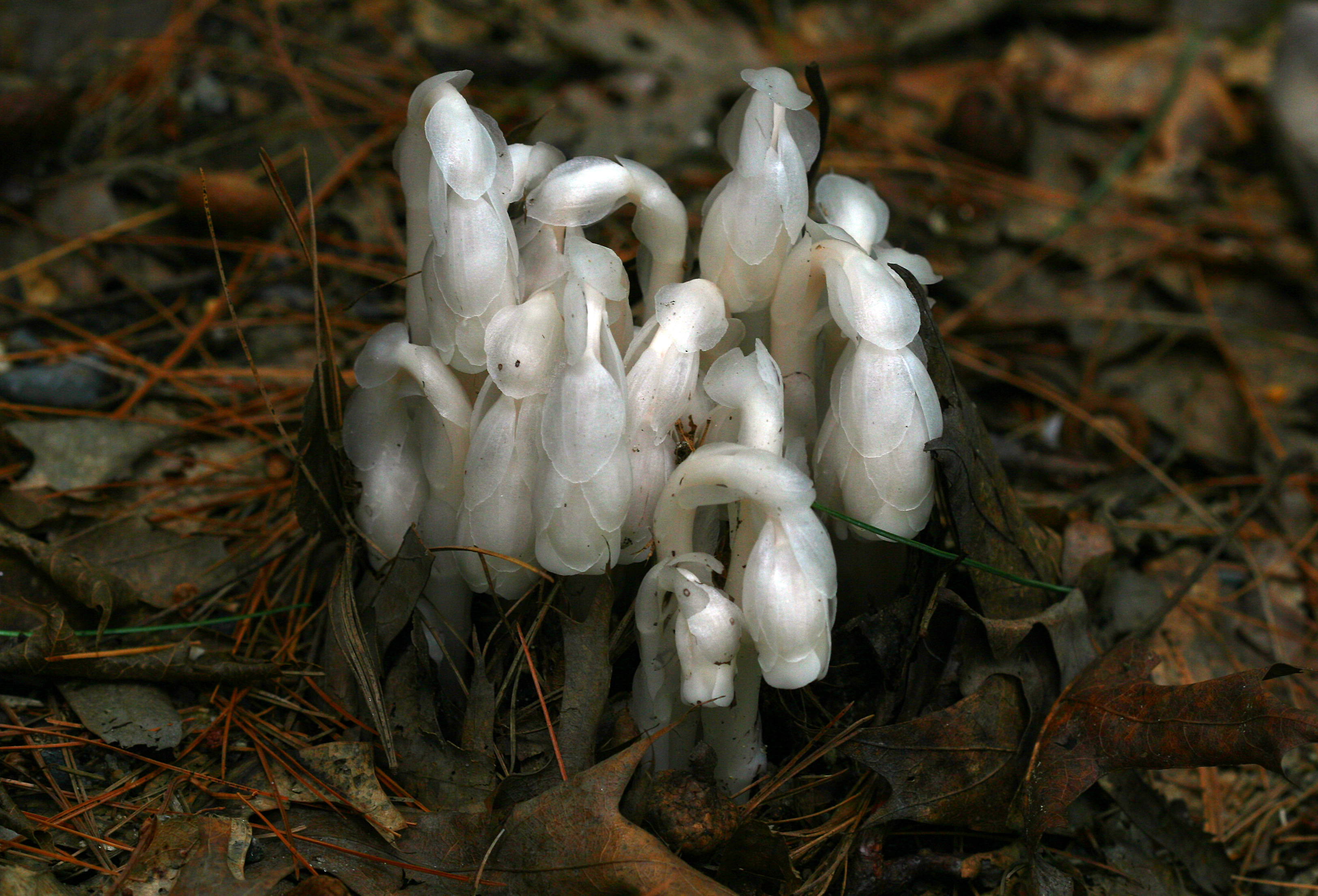
Still, just to prove that not all parasites are insects, worms, worm wannabes, or politicians, here is a plant parasite that I used to stumble upon all the time in the murky gloom while mucking around upstate New York forests hunting mushrooms and other oddities: Monotropa uniflora, also called Indian Pipe.

Monotropa uniflora (once-turned single flower, I think), also called Indian Pipe, Ghost Flower or (most luridly) Corpse Flower.

You see, parasitism can happen to anyone — even a nice flowering plant like Monotropa. Its flowers are the bulbs at the end of the curled-over stems, above. It is usually ghostly white or sometimes pink (though I’ve never personally seen a pink one) because it has no more need of chlorophyll, the chemical that allows most plants to convert sunlight into food. It has found a way to parasitize the fungi collectively called mycorrhizae (miko-rye’-zee) that are cooperative with nearly all trees (and, in fact, nearly all plants!).

Since the mycorrhizae get most of their food from the tree they are helping support, this little flower is in effect parasitizing the trees it grows under. Its proximal victims tend to be mychorrhizal fungi in the family Russulaceae (Roo’-syu-lay-see-ay or Russ’-you-lay-see-ay), which contains the prolific genera Lactarius and Russula. If you’ve ever been in the woods odds are you’ve seen the mushroom fruits of these fungi. Russula sp. tend to make very common but mostly inedible chalky white mushrooms with red caps and white spores that frustrate North American ‘shroomers looking for better, more edible fare. In Russia, they pickle and eat some. No accounting for taste (or cast-iron stomachs), I suppose.

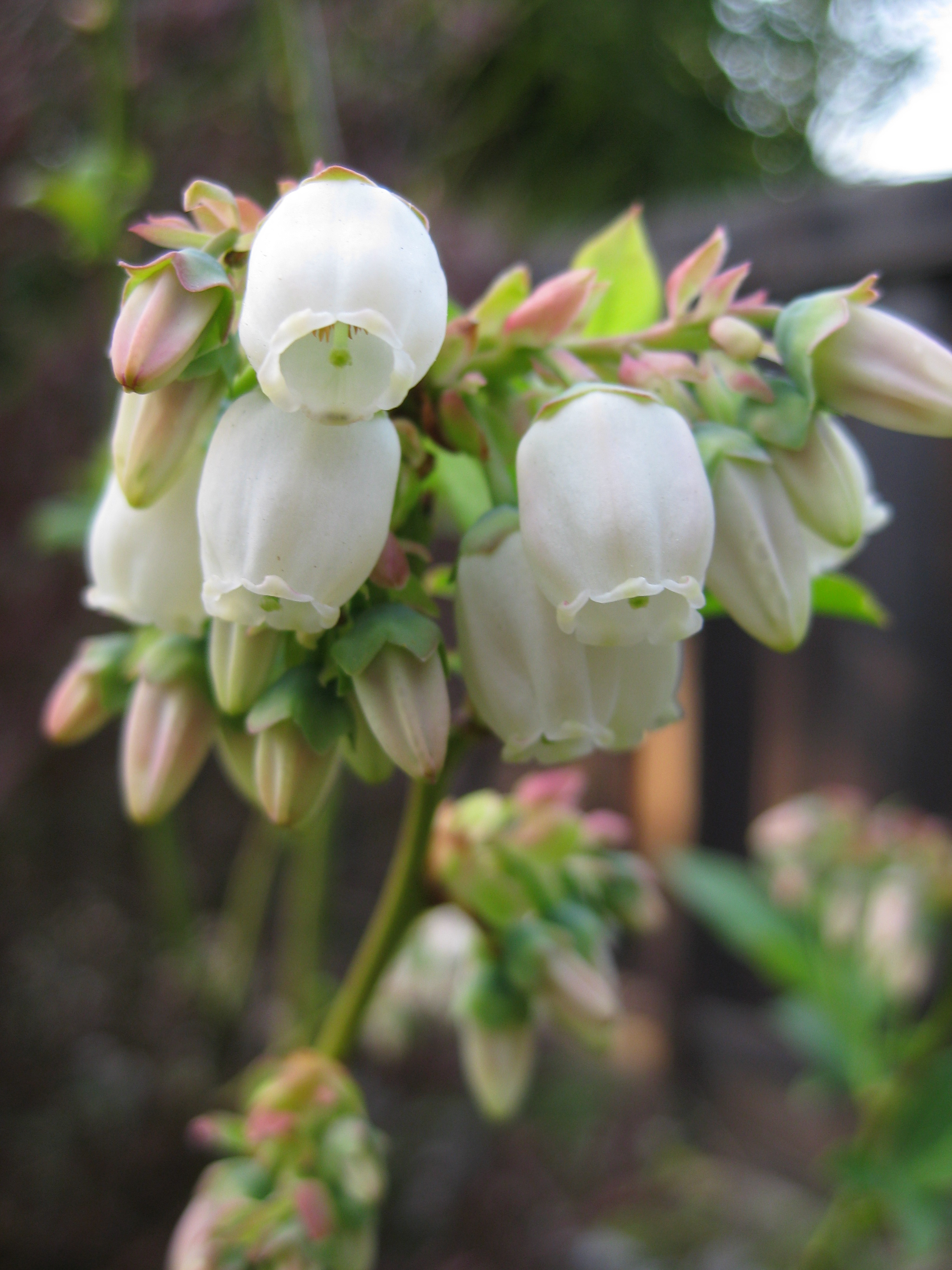
Monotropa itself is in the blueberry or heath family, also called Ericaceae (Eric-ay’-see-ay, which you can see placed among its relatives here). This family contains many familiar berries, including blueberries, cranberries, lingonberries, and huckleberries (alert Val Kilmer). Members of this family usually prefer the acidic soils of peat and bogs often have  “urn-shaped” flowers in which the petals are all fused (botanists would say the  corolla, or whorl of petals, is united), which you can see in these blueberry flowers.

Vaccinum (blueberry) flowers. Photo by Thomas Kriese. Creative Commons Attribution 2.0 Generic License. Click image for link.

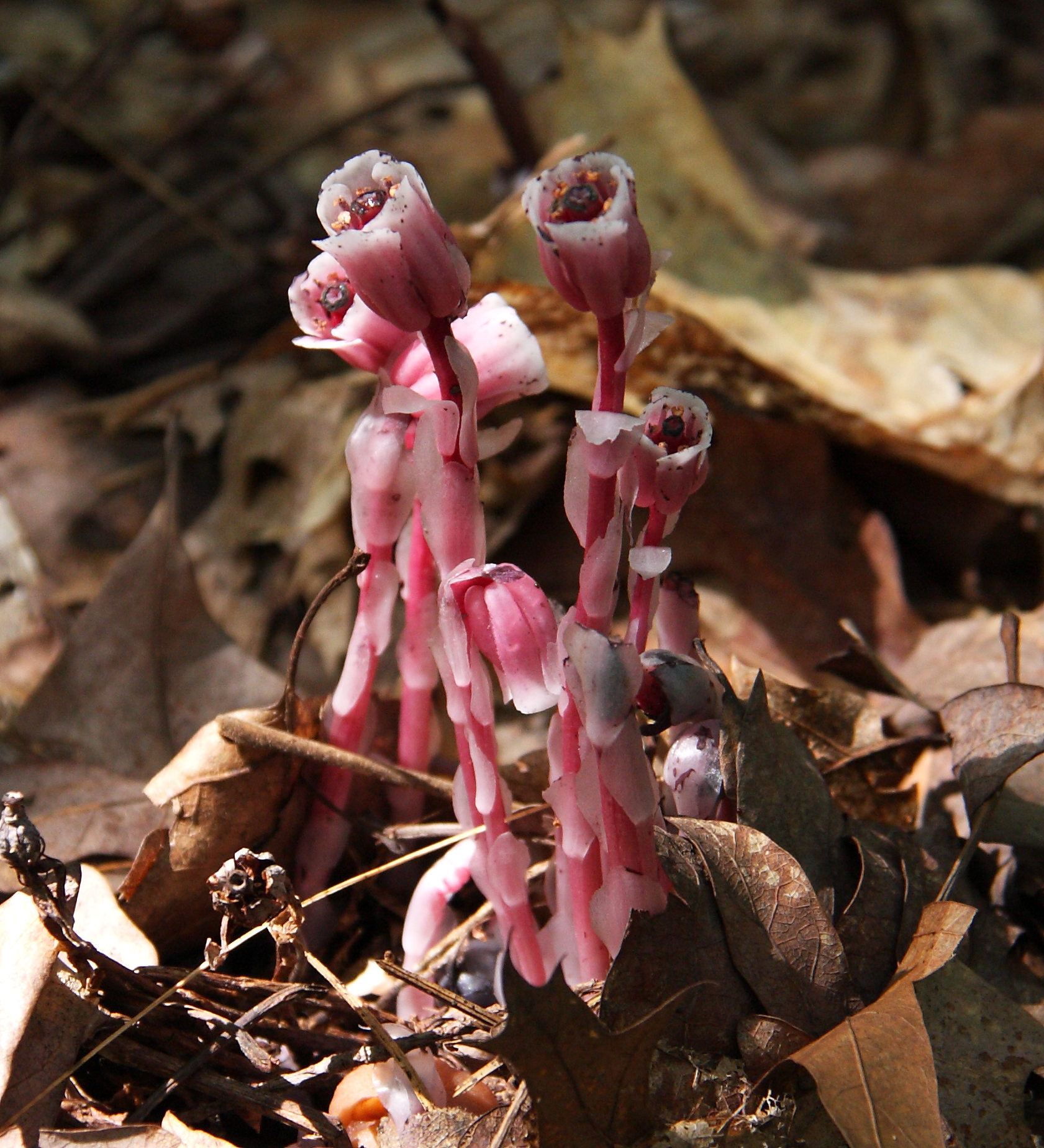
Though the petals of Monotropa aren’t united, they are clearly urn shaped, as you can see more clearly in this photo of the pink variant.

Note the bright orange pollen on the stamens around the dark-colored pistil, the tube that leads to the ovaries below. Photo by Magellan nh, Creative Commons Attribution 3.0 Unported License. Click image for link.

Since I moved out west I have not seen M. uniflora, though it allegedly does occur here. On the other hand, I see two other ghostly-pink parasitic plants all the time — pinedrops, also in the heath family, and spotted coralroot, an orchid (which also parasitizes mushrooms in the Russula family).

I seem to have written my way into an unplanned series on parasites. Let’s see if I can write my way out of it next time. Hmmm. I’m sensing slime molds in our future . . .

POTD discovered via The Loom.

{ 5 comments }

Gorgeous Corkscrews from Hell

by Jennifer Frazer on January 22, 2010

So I haven’t managed to get around to writing the post I had bee. . . look! Shiny! Spirochetes!

"Treats? Where!?" The social bacterium Treponema pallidum. (Subtle, very subtle)

This one goes out to those of you who think all bacteria are either boring rods or balls. (BTW, is it just me, or does this video have a strange first-moon-landing-recording-esque quality?)

Eat your heart out, physicists, engineers and animal behaviorists — you can’t say you’re not impressed here. Wave forms? Relaxation pattern? Forward and reverse? Not bad for a tidy .5 x 5-250 micrometer package. In case it’s still not clear, spirochetes (spy’-row-keets) are helical bacteria, and one of their members is the infamous Borrelia burgdorferi, the party behind Lyme Disease, the species in the video above. So is Treponema pallidum, the maker of Syphillis (TM). That’s right. Don’t mess with the ‘chetes.

Well. . . maybe not. In spite of what you might think from our highly skewed sample size of 2, most spirochetes are not nasty human parasites. They are free-living, oxygen-avoiding, bread-winning, welfare-eschewing bacteria. Incidentally, Spirochetes represent a happy accident of taxonomy. In the old days, microbes often got classified by shape. So all the spirochetes got lumped together. Turns out that actually reflects true kinship in this case. Lucky us! At least one taxon we don’t have to split and relearn!

For a look at all the groups of Eubacteria spirochetes are related to, click here. Once there, you can click on “Spirochetes” for a look at some of the specific genera in the group.

Thank you, YouTube, for making such wonders freely available to us all . . .

{ 0 comments }

Extinction by Design: Guinea Worm

by Jennifer Frazer on January 18, 2010

Though I could find little about the biology of rinderpest for the last post, guinea worm is a case of the opposite: Way Too Much Information. Guinea worm inspires horror not so much by its life history (many infectious organisms find ways to wander about your body at will), but by its size, Homo sapiens-escape method, and terrifying treatment.

So how does one go about acquiring a guinea worm? I’m glad you asked. It all starts with a copepod. During its life, an aspiring guinea worm must pass through both humans and a freshwater copepod. Remember the bioluminsecent bomb firing marine copepods I covered here?

I need a wall-mounted set of copepod antennae to impress my guests. Hook 'em, 'pods! Photo by Uwe Kils. Creative Commons Attribution ShareAlike 3.0 License.

Well, this isn’t one of them. It’s another marine copepod species, but the best I could do right now by way of illustration. Marine copepods, in turn, have freshwater cousins, and these cousins are hosts for the young aquatic guinea worm larvae. After a few weeks in the copepods, the larvae are ready. Drink this water without filtering out the copepods and congratulations! You’ve just acquired your own pet guinea worm, and will become host to one of the most gruesome human parasites on Earth.

For when the copepods hit the stomach, the acid dissolves the copepods but not the guinea worm larvae. Instead, the females migrate to the lining of the small intestine, burrow through, get knocked up by tiny males who then die and dissolve, and then grow into two-foot long spaghetti strands that spend a year sightseeing your body. I don’t know about you, but the only entities I want roving my body are blood, immune cells, and the occasional miniaturized submarine.

Strangely enough, you usually don’t notice all this until the worm is full term, about a year after you drank their larvae. When the blessed moment arrives, the worm migrates to a patch of skin most commonly located on feet or legs, but which can also include “the head, torso, upper extremities, buttocks, and genitalia” (eep!) and release chemicals that cause a searingly painful blister to form, which then pops. Mrs. Worm emerges — but just her tip. The pain is so intense victims are driven mad by desire to plunge the extremity into cool water. When they do, the worm immediately secretes a cloudy liquid containing scores of her copepod-seeking young, thus beginning the cycle anew.

The treatment, known since ancient times, is hardly better. You take a matchstick, twig, or pencil, wrap the end of the worm around it, and then slowly pull her out a few centimeters a day, like (brace yourself) this:

Pull any faster and she breaks, defeating your efforts. It can take weeks or months to pull the whole thing out. In the meantime, your open sore can become infected by bacteria, and the pain is so bad you find it hard to move, work, or care for others. This is not a living organism that it is easy to feel sorry for anihilating.

Like rinderpest, guinea worm is an ancient scourge whose prevention has been long understood but which thrived on ignorance and poverty. All one has to do to prevent guinea worm is drink clean water, but clean water is a luxury for millions. The nuclear option is dosing local water bodies with copepod-icide. They (and anything else that happens to depend on copepods for food) can’t be happy about that. The alternative is behavior change — persuading people to filter their water through cloth (carefully checked for stray holes!) to strain out the fairly large copepods. That’s fine for adults, but often the victims are small children who don’t know any better when they get thirsty.

Dracunculus medinensis, as this pest is most formally known, is, believe it or not, a nematode, or round worm. Roundworms are distinguished from flatworms because they have a round (duh) body and true digestive tract: a tube that opens at the mouth and exits at the you-know-where. Nematodes crawl invisibly throughout your environment every day, in soil and fresh- and saltwater. They are among the most diverse groups on Earth, and probably heaviest by biomass, on earth.  They’re everywhere. I’ll never forget teaching introductory microscopy lab during my first year of grad school and seeing a very surprised nematode crawling around a dish with a thinly sliced apple we were observing. So believe me, you have almost certainly consumed many of these little guys in your day. As with most nematodes, it looked like this.

Obviously, pregnant guinea worm females are the ultra-super-uber-heavyweights of the nematode world, and, at least in my experience, atypcial. Many nematodes are harmless free-living soil-dwellers, like the Caenorhabditis elegans that has contributed so much to our knowledge of basic development and gene function. But there are also scores of nasty parasites of both plants and animals: root-knot nematodes, hookworms, pinworms, whipworms, heartworms, and Trichinella spiralis, the reason you should not eat undercooked pork. To see where the nematodes fit into the rest of the animals, click here.

In December Nigeria announced it was the latest country to be free of Dracunculus medinensis, leaving only four in Africa that are still beset. Jimmy Carter’s on the case, so you know it won’t be long. To see a slide show from Time that vividly illustrates the worm’s toll, click here, and to read the latest news about the eradication, see here and here.

And of final note, dracunculuiasis, the disease’s formal name, means “afflicted with little dragons.” Quite so. I am glad I will never experience that firsthand, I hope that soon no one else will either.

{ 5 comments }

Extinction by Design: Rinderpest

by Jennifer Frazer on January 13, 2010

Rinderpest is somewhere in this image, but the source did not describe where. If I had to guess, I'd say it's the rods and that they're packed into a host cell with a few floating free. If so, the rods also have a membrane around them that is difficult to see. Copyright held by Dr. Rajnish Kaushik, Creative Commons Attribution-ShareAlike 2.5 License.

Extinction has a flip side: eradication. We did it to smallpox (or rather, almost did it; a few samples survive in U.S. and Russian labs), and though the ethics of that are interesting to think about as an intellectual exercise, there is no question that it has relieved the suffering of millions. Scientists are on the verge of doing it again with two organisms: another virus and an infamous parasitic worm. The obliteration of either one would mark only the second time this has happened in human history, and the first in 30 years.

Rinderpest is a vicious livestock virus that has sickened hundreds of millions of cattle in Eurasia and Africa since ancient times. In herds that have never encountered the disease, it can fell nearly every animal, and it’s not a pretty death: weeping mouth and urogenital ulcers, constipation followed by diarrhea, and a struggle to breathe. Though the virus affects only cattle and related wild animals like wildebeest and giraffes, when millions of cattle die, their keepers starve.

The rinderpest virus, a paramyxovirus in the “genus” Morbillivirus, seems to be related to the measles, mumps, and canine distemper viruses. Rinderpest is an RNA virus, which means it uses the material we normally use to translate DNA into proteins as its hereditary material. For the bio geeks out there, it’s a negative-sense virus, which means the genome has to be translated into the positive sense by an RNA polymerase conveniently packed into the virion. The positive sense strand then acts as mRNA and can make all the virus’s hijacking, lockpicking, and get-out-of-cell-free proteins. When the virus is done replicating, new negative-sense RNA and a sampler of the appropriate proteins are then enveloped by a membrane spiked with fusion and attachment proteins that help the virus get into cells.

Every paramyxovirus has  but a single strand of RNA, on which a mere 6-10 genes lie. In Morbilliviruses, there are exactly three nucleotides (A(denine)s, G(uanine)s, C(ytosine)s, or U(racil)s) between each gene, which is incredibly efficient packaging for those of us familiar with the thousands and millions of non-coding nucleotide bases between genes in be-celled life. The order of the genes is conserved too because the virus practices “transcriptional polarity”, a phenomenon in which genes closest to the “beginning” of the RNA strand are transcribed more often than the ones at the end. That’s probably because the protein that translates the strand — the RNA polymerase — has a tendency to fall off before it’s finished. This provides cheap and easy transcription regulation, but also a strong incentive not to shuffle your genes. What I’ve told you so far applies to Morbilliviruses and Paramyxoviruses in general, but other than its mug shot, above, I can’t find out much more online about Rinderpest’s particular modus operandi.

Strangely, in spite of its prowess, the virus never succeeded in reaching the Americas. And in spite of a reliable vaccine and the near elimination of the virus from Africa in the 1970s, we didn’t finish the job, and tens of millions of livestock were dying again in the early 1980s. Finally, in 1993 the UN Food and Agriculture Organization had enough and decided it was time to bring it to the virus. 17 years later, the end game is at hand. You can read more about the history of the virus and eradication effort and how close we are here (subscription required) and here to only the second intentional extinction on Earth.

Next time: Reason # 1,356 to be thankful for your local water treatment plant: Guinea Worm.

{ 0 comments }