The Biodiversity of Cigarettes

by Jennifer Frazer on March 17, 2010

Campylobacter "twisted bacterium" sp. I need quotes around my middle name. Note the stringy flagella. U.S. Agricultural Research Service

Not long after I became a health and environment reporter in Wyoming, I was assigned to cover a smokeless tobacco talk given by a scientist from the Mayo Clinic.

Smokeless tobacco (aka moist tobacco,  chewing tobacco, and spit tobacco), he said among other points, supported huge populations of live bacteria.

That was surprising to me. I’d never thought about it before, but it did make sense. The tobacco companies don’t exactly autoclave their product.

Since it was my job to report on the talk, I reported that the substance was “teeming with bacteria”, a statement I felt was amply supported by the evidence presented by this guy.

The next day I got a call from a scientist at a state university in the south. He said he was calling to correct what he claimed were the inaccuracies in my story. He then proceeded to enumerate my alleged errors. I clearly remember him singling out the “teeming bacteria” statement.

“Come on,” he said.

For those of you not in the United States, the Mayo Clinic is one of the top, if not the top, medical centers in the country. And though the Mayo Clinic scientist backed up my reporting on his talk when I subsequently called (and the story was just about his talk — not an attempt at a broader survey of the science, even if the southern scientist’s points had been backed up by a broader literature), I felt stung, to be sure. The Gulf Coast scientist even went so far as to send me some of his papers supposedly disproving what I’d written. It was all rather odd. I ask you, why would a scientist at a university 1,000 miles away go out of his way to call a reporter at a circulation 18,000 paper in Wyoming to correct alleged errors that in no way mentioned his research? How would he even know about the story?

Well, guess what? It turns out that not only is smokeless tobacco teeming with live bacteria, so are dry cigarettes, according to a recent article in Science News (see also here for an earlier article). Scientists have found genetic markers for hundreds of species in cigarettes, and have cultured several of them out of packages purchased off the shelf.

When cultured with blood, some of these bacteria can digest it. And as the article points out, scientists have long known smokers have higher rates of lung infection. Doctors always assumed that was due to immune system suppression. But inoculating your lungs with bacteria or their spores several times a day probably doesn’t help.

In retrospect, it’s not surprising. You take leaves. You hang them up in a moist, dark, warm place (a tobacco barn). You wait. In plant pathology, we called this a moist chamber*. It’s how we coaxed fungi to fruit so we could grab their spores for pure culture. Bacteria seem to like the treatment too: scientists found Campylobacter, Clostridium, Corynebacterium, Klebsiella, Staphylococcus, Pseudomonas aeruginosa, Stenotrophomonas maltophilia, Escherischia coli, and Bacillus subtilis signatures in cigarette tobacco, according to the Science News article. Not only is this a who’s who of the pathogenic human bacteria world (although is should be noted many species in these genera are not pathogens under ordinary circumstances), these and other bacteria are responsible for producing the most potent carcinogens in cigarette smoke — nitrosamines — when they start chowing down on tobacco leaves. Nor is this the first time cigarettes were found to be hosting . . . er . . . organisms. Cigarettes are often contaminated with plant viruses too. Though entirely harmless to humans, it’s been known for years that people who’ve handled cigarette tobacco can transmit  tobacco mosaic virus.

Now don’t get me wrong — the presence of some bacteria is no reason not to eat or drink a food. Trust me, practically everything you put in your mouth has bacteria in it or on it. Even freshly cooked food probably has a few bacteria or fungal spores settle on it between the pot and your plate. And we purposely introduce billions of “good” bacteria and fungi into food all the time. If you’ve been reading this blog long enough, you know I’d be just as likely to say yogurt, your kitchen sponge, and your mouth are teeming with bacteria (which they are). This story does make me wonder, however, if tea leaves experience something similar to tobacco leaves during processing. Does anyone know? But you don’t smoke tea, and the products of bacterial action on yogurt and tea leaves don’t give people cancer. Tobacco bacteria do.

Next time: a closer look at Klebsiella.

________________________________________________________

*Now that I think about it, I think we used grow lights over most of our moist chambers. But I don’t think dark would necessarily discourage fungi.

{ 6 comments }

Taking "Life" on the Road

by Jennifer Frazer on March 15, 2010

Me and the state I love. Eccles Pass (12,435 ft) in the Gore Range, Colorado, July 3, 2009. Some of the meadows behind me were absolutely COATED with yellow glacier lilies.

I’ve been thinking of what I can do to support this year’s International Year of Biodiversity, and I’ve decided I’d like to take my “Life on Earth” lecture on the road. The talk will not be mere platitudes about biodiversity and its importance; we’re talking specifics — interesting science, weird organisms and their “alternative” lifestyles, beautiful photographs, and more natural history than you can shake a stick at. Basically, more of the same stuff you come to this blog for, plus you’d get to meet me and pick my brain in person.

I’m planning to expand the 25 minute talk I gave last year at the Colorado Skepticamp into something closer to an hour (although half an hour is still an option) that I could give at a few venues around the Front Range (or perhaps farther afield if travel stipends are involved). If you are in a group that would be interested in hearing me talk on the subject of biodiversity and life on Earth, leave a comment to this post or contact me privately at the email address listed on the Portfolio page. I can’t guarantee I’ll be able to speak for everyone who makes a request (should there BE any requests : ) ), but all requests will be carefully considered.

{ 2 comments }

The Creepy-Crawly Branch of the Family Tree

by Jennifer Frazer on March 13, 2010

Arthropods! The prolific joint-legged and exoskeletoned group is up there with bacteria, archaea, and nematodes in the relentless numerical domination of Earth’s surface. Here is a picture of me with one taken this week:

It’s a whip scorpion, in the order Thelyphonida, although this one has sadly somehow lost its long thin tail, or “whip” (called technically, like those of protists and sperm, a flagellum — but they are *not* evolutionarily-related structures). This one seems to be very well fed, though thankfully not on Jen. I’m taking a short arachnology class at the Denver Museum of Nature and Science right now, and this was one of our subjects. According to my classmate, these animals, also commonly called vinegarroons because of the defensive acetic acid (vinegar) glands they possess near their tails, are the nerds of the arachnid world: “They just kind of bumble along, smelling like a salad.” Raptoral pedipalps (big scary pincers) aside, the one I held did seem to be a sweet, gentle creature. I’ve now held a whip scorpion! Yay!

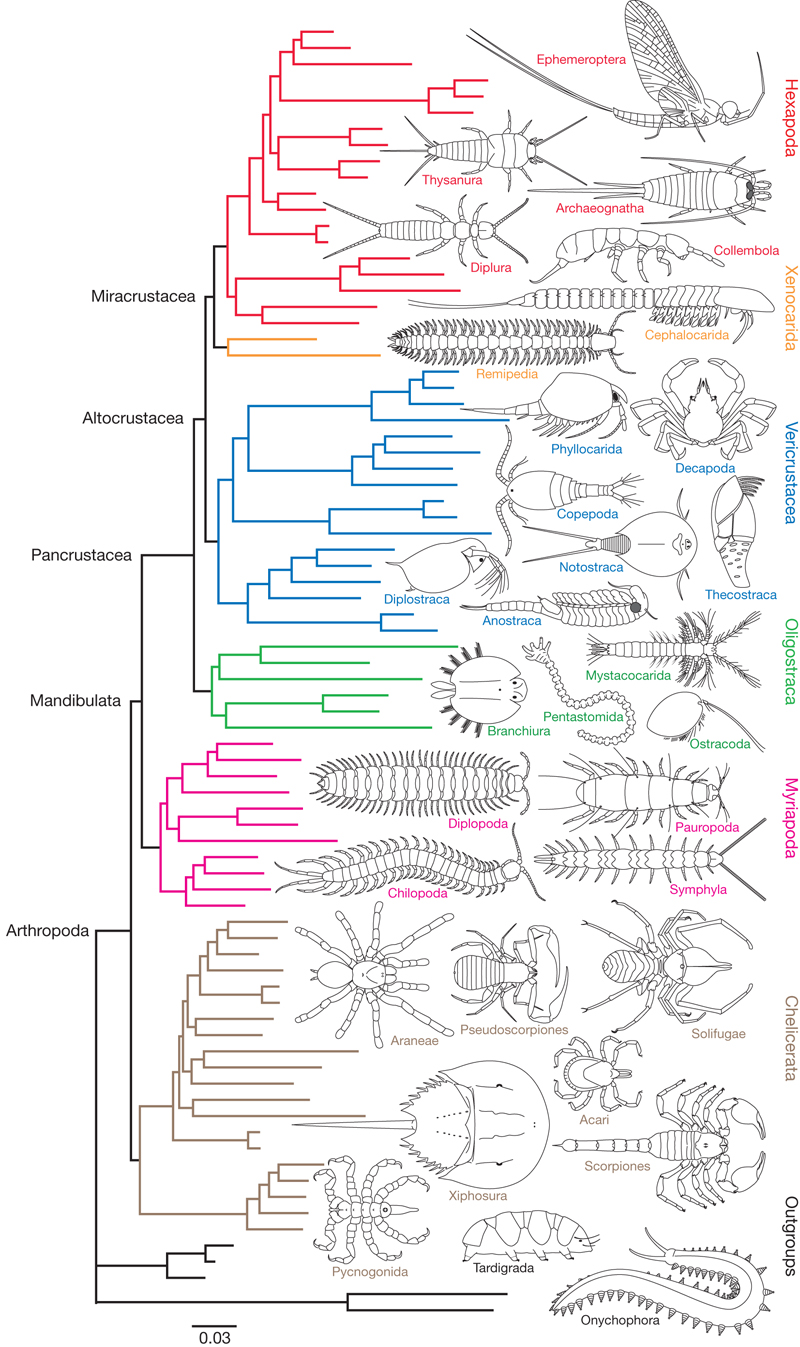
I haven’t talked about arthropods at this blog much yet, and a paper published in Nature a few weeks ago together with my play date with Stumpy, above,  provide the perfect opportunity to correct that. This post is called “The Creepy-Crawly Branch of the Family Tree”, but it could equally well be called the Floaty-Swimmy Branch, or the Bloody-Sucky Branch or the Borey-Eggs-Iny-that-Hatchy-and-Devour-the-Insides-of-your-Hosty Branch. There are arthropods that do all these things. So let’s have a look at the broad shape of the tree as revealed by this new analysis of the evolutionary relationships among members of Arthropoda:

Arthropod relationships revealed by phylogenomic analysis of nuclear protein-coding sequences Jerome C. Regier, Jeffrey W. Shultz, Andreas Zwick, April Hussey, Bernard Ball, Regina Wetzer, Joel W. Martin & Clifford W. Cunningham Nature 463, 1079-1083(25 February 2010) doi:10.1038/nature08742

Now there are a lot of scary words on this diagram, it’s true. But take heart! Look how many drawings of awesome creatures there are! And it’s way better than the alternative that most biologists have to deal with, which I also had to learn to read in school. Before I get to what’s new and cool about this tree, let’s talk a little bit about what trees like this are, and then about the main groups you see on it.

This tree is called a phylogeny, or phylogram (you also hear cladogram). It is a hypothesis of evolutionary history. That doesn’t mean scientists are hypothesizing that these creatures evolved. That’s a foregone conclusion. The hypothesis is what the specific relationships are between the different groups. In other words, the question is, “How is everyone related?”, and this tree is one possible answer. In some trees, as appears to be the case here, the branch lengths are proportional to the evolutionary distance between the different groups. That is, the longer the branches, the more evolvin’ that’s been going on. Evolution, in this case, is measured in DNA nucleotide changes. DNA, as you’ll recall, is made of many base pairs called nucleotides. There are four kinds. When one changes to another, that is called a point mutation. The more of these changes that build up, the greater the evolutionary distance between groups.

For this tree, scientists studied 62 genes in 75 arthropod species. They sequenced them all and compared the changes. They put all the data into a special computer program designed to figure out which sequences are most similar to which other sequences in the five-jillion possible combinations of relationships embodied by 62 genes in 75 species. Then they cranked the computers up to 11 and probably waited a few days (or maybe even weeks! I have heard stories of scientists locking computers in closets during this time) for them to churn out the solution to this hyper-space chess problem. The lone tree you see above is the result.

So what do we see? At the top is Hexapoda, which as you may guess are insects and friends — the six-legged among us. Below them you see an interesting group called Xenocarida. More on them later. Below that group are the Vericrustacea and Oligostraca, which are both, as far as I can tell, basically crustaceans. In both groups you see some old friends: the copepods (some freshwater species of which carry Guinea Worm larvae, a topic I covered in January), the ostracods (who we looked at in a post on deep-sea bioluminscent organisms last year), and the Decapoda, which has a high taxonomic tastiness index: it includes lobsters, crayfish, crabs, and shrimp.

Next are the myriapods: centipedes and millipedes. Below that are the chelicerates, or organisms with special mouthparts called chelicerae — sea spiders (pynogonids), horseshoe crabs, scorpions, ticks, mites, tarantulas, spiders, and Stumpy. And rounding out the base of the tree are the outgroups — the groups we use to “root” the tree, or give it a direction. They are usually the most closely related organisms not in the group of interest, here arthropods. In this case, they are the ridiculously cutely-named water bears or moss piglets — the tardigrades — and velvet worms, the onychophorans. Velvet worms are half of the subject of a crazy-*** theory that somehow got published last year hypothesizing that metamorphosing insects like butterflies were the result of an unholy chimerical union between velvet worms and a larva-less insect.

Also looming large in the arthropods but not on the tree simply for reasons of chronological discrimination (and also because, being extinct, we have no DNA to sample) are the the trilobites. According to my copy of Colin Tudge’s Variety of Life, they branched off somewhere between the Tardigrades and Chelicerates.

OK, so now that you’ve waded through all of that, what were the surprises in this new tree? Scientists also used to think millipedes and centipedes were closely related to insects. They’re both land arthropods, after all. My two college biology texts (published 1995 and 1996) show this relationship, though Tudge(2000) is agnostic on whether millipedes and centipedes or crustaceans are more closely related to Insects. Now it appears certain that, since all crustaceans are aquatic, insects and centipedes/millipedes represent a seperate evolutionary invasion of land by arthropods, much as seals and whales represent two seperate re-invasions of the sea by mammals.

This study also supports the hypothesis that insects evolved from a crustacean, which is why we can’t use the term “Crustacea” any more — the group as traditonally defined doesn’t include the insects, but this tree shows that it should (since the principles of modern evolution-based taxonomy require proper groups to include an ancestor and ALL of its descendants). The term “Reptiles” poses the same dilemma, because it should technically include  birds. So some scientists have stopped using that term as a taxonomic classification, too. Little-r reptiles is OK, though, as informal name for the group.

Finally, it appears hexapods’ (insects’) closest relatives are an obscure underwater-cave-dwelling group newly dubbed the Xenocarida. Carl Zimmer goes into that in admirable detail here.

But the take-home message of this tree for you is simple: look, admire, and marvel at the variety and abundance. In fact, I give you a homework assignment, should you choose to accept it: pick a group on that tree that looks interesting that you’ve never heard of before. Look it up. Find out what it is, what it does for a living, and where it directs its mail. You’ll be glad you did, I promise.

{ 1 comment }

Giant Amoebae on (Extremely Slow) Rampage

by Jennifer Frazer on March 10, 2010

This is so cool. I totally missed it when it came out in November 2008. If you did too, here’s your second chance.

In Russia, amoeba study YOU.

OK, giant deep-sea amoebae that roll around like possessed dust bunnies? AWESOME. The 411. Though this group had just been discovered in the Arabian Sea in 2000, it seems it was still a surprise to find them *leaving tracks* (although I should emphasize no one can actually see them move in real time. This sounds like a job for the BBC’s magic time-lapse camera). They are testate amoebae, or ameobae that make shells called tests (a few other deep sea protists like foraminifera also make shells called tests, and I just discovered that Chris Taylor over at Catalogue of Organisms just happens to have coincidentally published on the foram version yesterday.). This species, Gromia sphaerica, fits into the Gromiidea on this tree. Just look at all the uncharted territory and things you’ve never heard of. Space is not the final frontier. . . not by a long shot. Not yet.

The bigger, non-motile existing deep-sea protozoans Matz refers to in the video are probably xenophyophores, an outrageously bizarre group alluded to here before. You’ll just have to wait on a post about those another day. And there’s probably lots more giant deep sea protists I don’t know about yet. Readers?

The big take-home message of Matz’s discovery (or at least what they’d like us to take home) seems to be that we could really be misinterpreting Pre-Cambrian fossil trackwaves — that is, the fossil tracks of organisms that predate the blossoming of most modern animal groups in an event called the Cambrian Explosion, ca. 550 million years ago. These tracks can be found in fossils as old as 1.8 billion years (yes, that’s billion with a pinkie to the corner of the mouth). These tracks were for many years interpreted as early modern animals for whom we just didn’t happen to have fossils. But what if they were giant protists? Or something else? Possible, and probably not surprising given the fossils we do have of Ediacaran creatures, they bizarre early animal(?) forms that predate the Cambrian explosion and are the first fossils of complex multicellular organisms we have. They all seem to be soft and, for lack of a better term, pillowy. Yes, like Charmin.

Will we ever know? Probably not. But you never know. A fossil of a recognizable ancestor of a modern animal keeled over at the end of one of these tracks might settle things. On the other hand, simple tracks do tend to look alike. And with hundreds of millions of years on hand, there’s plenty of time for lots of really weird things we’ll never know about to have made them.

You know what this video reminds me of, of course . . .

{ 4 comments }

Bacterially Tye-Dyed Caves

by Jennifer Frazer on March 5, 2010

Lichens(?) and bacteria coat the interior of a lava tube in Hawaii. http://www.flickr.com/photos/lrargerich/ / CC BY 2.0

Life on Earth is everywhere, from pores in rocks miles beneath the surface to tiny cloud particles floating high above. Here’s another example of life turning up in a spot we’d not previously suspected: cave mineral deposits. Turns out the colorful encrustations are sometimes raw bacterial sewage. Pretty sewage, though!

Cave bacteria are often actinomycetes, which were so named because they actually branch (yes, some bacteria can branch!) and make spores similar to fungi. They’re also part of the crowd responsible for that wonderful earthy/cavey smell I mentioned a few posts ago. Actinomycetes are great at making competing-bacteria repellent, aka antibiotics. You might have heard of a few: actinomycin and streptomycin.

This came out in November but I’d been saving this slide show for a fun Friday eye-candy treat. Enjoy!

{ 3 comments }

The Oceanic X Prize: Deep Sea for the Rest of Us?

by Jennifer Frazer on March 3, 2010

“This here’s a bottomless pit, baby. Two and a half miles, straight down.” — Catfish De Vries, The Abyss

One of my many dreams is to travel to the bottom of the ocean to see hydrothermal vent communities, bizarre abyssal creatures and methane seeps with my own eyes. I can’t believe I missed this when it came out, but that dream took one giant leap forward in January: The X Prize people (of first private spaceflight fame) have announced a prize for the first company to return humans twice to Challenger Deep, the deepest point on Earth — 35,761 feet down. That’s over six and a half miles. In that crushing water, the pressure is 15,750 pounds per square inch: over 1,000 times atmospheric pressure at sea level. The announcement was made 50 years to the day after the first — and still only — two people reached that spot and returned alive.

Above you see the Bathyscaphe Trieste, the first vessel to reach this spot, manned by Jacques Piccard and U.S. Navy Lieutenant Don Walsh on Jan. 23, 1960. An article in The Times of London announcing the X-Prize news describes the tense descent that, unlike Neil Armstrong’s famous approach, has gone largely unheralded by history.

On a test dive off the island of Guam two months before the dive, the glue holding the hull together failed after the Trieste had just set a new record at 5.4km. Metal bands were used to strengthen it, and dives continued. On the big day, water began dripping into the cabin, but Jacques Piccard and Captain Walsh carried on and the leak stopped. Then, at 9.5 km, a crash shook the bathyscaphe.

“In the past we had some very small external components fail and those events produced sharper sounds of implosions. This noise was much lower in pitch, as if something big had broken,” Captain Walsh told The Times this week.

The two men checked their instruments. All seemed fine, so they continued. But a porthole on one of the tubes used to access the cabin had cracked. They were not in immediate danger, but if the tiny window gave way they would die instantly. “We could see it bulging, being pushed inwards by the pressure of the sea,” Captain Walsh said.

You can read the rest over at The Times.

Though few people can recite the details of this dive or where they were when it happened the way most people know exactly what they did on July 20, 1969, the event and place have still crept into our culture. Auguste Piccard, father of Jacques and designer of the Bathyscaphe, and/or his brother Jean Felix inspired Gene Roddenberry to name his new starship captain Jean-Luc Picard. Challenger Deep itself is named after HMS Challenger, a sailing ship that led the first true oceanographic cruise of the world’s waters from 1872-76 that is still renowned in scientific circles, cataloguing 4,700 new species and taking the first soundings of the Deep that bears its name. The expedition also inspired the naming of one other landmark exploratory vehicle — the Space Shuttle Challenger.

Yet in spite of the significance of this step, people have never returned to Challenger Deep. According to the Times, Piccard and Walsh fully expected it to happen in a few years with a better-designed sub. Instead, 50 years have passed. Only two remotely operated vehicles have returned. The X-Prize people, with any luck, will soon fix that.

The Times expects ocean nuts and kajillionaires James Cameron of The Abyss, Titanic, and (I cringe to mention it) Avatar fame and Paul Allen of Microsoft to be contenders for the prize. And though they go with exploration and science on their mind, worthy ends by any measure, it bodes very well for me and any of you who’ve ever dreamed of exploring life in the deep.

Right now, reaching the deep ocean in person is excruciatingly expensive and limited to a few lucky scientists and an occasionally extremely lucky member of the press. Even if the immediate aim is research and exploration, a successful design could be developed commercially by one of these guys to take the rest of us to the ocean floor much as X-Prize-Winner SpaceShip Two (aka Richard Branson’s sexy new ride) will soon open the heavens to mere mortals. Well, mere mortals with 200 Large to spare. They say that fare might eventually come down to $10,000. I’d pay that to see any of this. Sir Richard thinks everyone should be able to experience space; I think everyone should be able to experience the ocean deep. I hope I’m not the only one.

{ 1 comment }

A Moment of Zen: The Clark's Grebes' Romantic Weekend

by Jennifer Frazer on February 28, 2010

I’ve been at an awesome wedding out of town this weekend, so here is a sweet treat that fits with that theme from the latest in our Pre-Life trailer series.

The Fresh Prince called. He wants his haircut back.

Grebes are interesting taxonomically. Originally, in the old system of classifying life whereby scientists squinted at creatures and lumped them with whoever they seemed to look most similar too (more or less), grebes were classifed with the similarly aquatic and water-dancing (and awesome-voicedloons. However, there were doubters, including some wild-eyed crazies who, when they took a closer look at the details of grebe anatomy, determined they shared many unique characteristics (scientists would call them synapomorphies, which are the gold standard for modern evolution-based classification) with . . . are you ready for this? . . . flamingoes. Lo and behold, DNA comparisons bear this out. If that wasn’t enough to convince you, it turns out that flamingo lice are actually closely related to grebe lice, seemingly having diverged only when the two lineages of bird split.

So it seems the hypothetical grebe-loon connection was yet another case of convergent evolution, whereby unrelated organisms evolve to look similar when they set up shop in similar environments. This happens all the time and really messed with taxonomists until DNA sequencing came along.  Here’s a nice tree to give you a sense of who fits where; click “Podicipediformes” to take a closer look at the grebe family itself.

Life is coming in March, my American friends with cable! Get excited!

{ 1 comment }

Tolkien the Botanist and the Tale of the Larch

by Jennifer Frazer on February 25, 2010

Tolkien during World War I

I am rereading The Lord of the Rings, as I do every four years. You only get to read it so many times before you die, and I have determined four years is the ideal interval for me. As always, I am struck by what a fine botanist Tolkien was for a man with a Ph.D. in linguistics.

South and west [Ithilien] looked towards the warm lower vales of Anduin, shielded from the east by the Ephel Duath and yet not under the mountain-shadow, protected from the north by the Emyn Muil, open to the southern airs and the moist winds from the Sea far away. Many great trees grew there, planted long ago, falling into untended age amid a riot of careless descendants; and groves and thickets there were of tamarisk* and pungent terebinth, of olive and of bay; and there were junipers and myrtles; and thymes that grew in bushes, or with their woody creeping stems mantled in deep tapestries the hidden stones; sages of many kinds putting forth blue flowers, or red, or pale green; and marjorams and new-sprouting parsleys, and many herbs of forms and scents beyond the garden-lore of Sam. The grots and rocky walls were already starred with saxifrages and stonecrops. Primeroles and anemones were awake in the filbert-brakes; and asphodel and many lily-flowers nodded their half-opened heads in the grass: deep green grass beside the pools, where falling streams halted in cool hollows on their journey down to Anduin.

Wow. Say it aloud: “deep green grass beside the pools, where falling streams halted in cool hollows on their journey down to Anduin.”

Tolkien spent lots of time exploring bog and field in his childhood, and his mother Mabel taught him botany,

and awakened in him the enjoyment of the look and feel of plants.

I, too, spent many long hours as a three-, four- and five-year-old exploring the hills, fields, and streams around my birthplace in southeast Tennessee, where wild blueberries grew next to waterfall-fed pools and the iron-oxide dirt stained my socks pink to the eternal chagrin of my mother. Take-home lesson: If you have children, don’t be a paranoid helicopter parent. To the extent possible, live near natural areas, and let your children build their imagination and love of nature by exploring them on their own.

In any case, I want to take a closer look at one plant Tolkien mentions. Here’s another excerpt from the text just before the last passage:

The long journey from Rivendell had brought them far south of their own land, but not until now in this more sheltered region had the hobbits felt the change of clime. Here Spring was already busy about them: fronds pierced moss and mould, larches were green-fingered, small flowers were opening in the turf, birds were singing. Ithilien, the garden of Gondor now desolate kept still a dishevelled dryad loveliness.

Observe: “larches were green-fingered.” You may be tempted to think larches are some sort of broadleaf shrub or tree. You’d be wrong. Larches (genus Larix) are a very unusual thing: a deciduous conifer. That’s right — though they are firmly ensconced in the ancient and aristocratic Pine Family, their needles turn gold or brown and drop every autumn, and new green needles take their place every spring.

Browning larch trees in autumn near the Dolomites in Italy. http://www.flickr.com/photos/krossbow/ / CC BY 2.0

Another interesting thing about larches is their needles grow in whorls. Observe:

Male cones of the larch near needle-whorls.

For those of you who may be wondering how to recognize this tree from quite a long way away, here’s a helpful instructional film:

Alas. None of the American larches — Tamarack, Western, or Subalpine — grow in Colorado, so I will not be recognizing them from near or far anytime soon.

_____________________________________________________________

*A plant’s “goodness” or “badness” depends on the context. Tamarisk, which Tolkien mentions in the first passage in a scene intended to evoke beauty and goodness, is also called salt cedar in the United States, and is an imported cone-bearing shrub that has caused endless migraines for land managers across the west. Planted for erosion control by the millions during the Great Depression, it has proceeded to invade the banks of most waterways, siphoning billions of gallons of precious western water out through the tiny openings, or stomata, of its leaves to be wasted in the air and crowding native plants like willows and cottonwoods out of their habitats. In Eurasia, it’s a natural part of the landscape.

Salt cedar, by the way, is not actually a cedar but a flowering plant. It just looks like a cedar. Pesky common names!

{ 0 comments }

Extreme (Plankton) Closeup!

by Jennifer Frazer on February 22, 2010

Punk rockers are clearly dinoflagellate posers. Is it just me or does (a) appear to be a member of the House Harkonnen? Dinoflagellate micro-plankton of Atlantic tropical waters. P. 75. In: "Aus den Tiefen des Weltmeeres" by Carl Chun, 1903. NOAA Photo Library.

Most people have only seen plankton in crappy, fuzzy photos in college textbooks, if they’ve seen it at all. If you have heard of it, it’s probably in the context of the stuff baleen whales eat, and that’s about it. I personally was lucky enough to see an entire jar of the delicacy when I visited the Smithsonian’s Sant Ocean Hall last fall. It looked a lot like the larvae of the neural parasites that took over the brains of the Federation’s top brass in the first season of Star Trek: TNG. Mmmm, mmmm good!

Plankton is not a taxonomic/phylogenetic group like most of the things I write about on this blog. Plankton instead refers to any sea creatures that drift. That can include things as large as jellyfish, but typically plankton are much smaller and include things as small as the bacteria, archaea, and viruses with which the oceans teem. The phytoplankton, or photosynthesizing component, are responsible for half of the oxygen you breathe.

Well, someone’s finally taken some skillful, beautiful pictures of the plankton and they’ve gone on display at the London Zoo in honor of the Royal Society’s 350th Anniversary (Dang! That Society’s been around over 100 years longer than my country!). Over at the BBC there is a don’t-miss slide show of the exhibit, narrated by the scientist photographer, Dr. Richard Kirby. Let me repeat that: DON’T MISS THIS SLIDE SHOW.

You’ll get to see how evolution has taken body plans on some interesting trips, as larvae that retain ancestral forms metamorphose into sea creatures you are more likely to recognize. The squid-like larval origin of starfish, in particular, is a fascinating thing.

One final note — Dr. Kirby mentions that plankton are responsible for the characteristic smell of the sea. That is not surprising to me. When I was a grad student in plant pathology at Cornell, I was startled one day to discover that dirt doesn’t smell like dirt. Dirt smells like the bacteria that are living in dirt. In one lab we were allowed to sniff (I believe “waft” is the preferred term) a pure culture of soil bacteria. It was a clear agar dish with opaque colonies of bacteria. But it smelled just like fresh topsoil or a cave — dirty, earthy, wonderful.

Discovered thanks to the fine staff of Deep Sea News.

{ 4 comments }

The Mushroom that Sleeps with the Fishes

by Jennifer Frazer on February 19, 2010

Psathyrella aquatica, an aquatic mushroom

NOTE: Correction below.

Well, this brings new meaning to the concept of gilled mushrooms. Scientists have stumbled upon the first mushroom that fruits underwater, as proudly displayed on the cover of this month’s Mycologia. Notice the little bubbles on the outside of the mushroom. On aquatic plants (like the moss to the left), bubbles form because the plant is producing oxygen via photosynthesis. On the mushroom, the bubbles are probably the product of respiration, which means they are filled with CO2, not O2, as the mushroom “breathes”.Yes, fungi burn sugar with oxygen to produce energy and CO2 just like we do, but you can see it here because the fungus is underwater*. Way cool! (CORRECTION: HeyPK points out in the comments that CO2 is highly soluble in water (true — at 20C in freshwater, the solubility limits are 1.45 g/L for CO2 vs. 9 mg/L for O2) so the bubbles are more likely more oxygen bubbling out of the supersaturated stream using the mushroom as a substrate much the way the CO2 in carbonated beverages comes out of solution on ice in glasses. Oops! Sorry for the mistake readers — I’m still learning too. I’m sure I’ll make more from time to time despite my best efforts so please do help me fix them when you see them and I will post a prompt correction. : ) )

According to the good folk over at MycoRant, where I discovered this, scientists had never looked for mushrooms underwater before, but that didn’t mean they weren’t there. Brit Bunyard, editor of Fungi, speculates there may be a whole world of aquatic mushrooms out there we didn’t know about because we never really looked. If so, he noted at MycoRant, it would not be the first time that happened.

The mycologist Cecil Terence Ingold (who as of last year was still alive at the age of 104) stumbled upon an entire world of virtually undescribed fungi living in ephemeral forest pools and trickling streams:

In 1937 Ingold moved to University College, Leicester, where he “became excited by the chytrids attacking planktonic algae”.  It was his discovery of one particularly beautiful such chytrid (Endocoenobium eudorinae) that reportedly caused him to specialize thereafter in mycology rather than plant physiology; and the next year, while searching for chytrids in a small brook near his home, he found in the stream scum an “abundance [of] many kinds of most extraordinary fungal spores”, most of which were large and tetraradiate in shape.  For several months he continued to find such spores in scum, and he finally discovered their source to be fungi living on submerged alder leaves in the stream bed.  He later learned that a few such fungi had been described earlier, but, he thought, “rather inadequately”; and so he undertook to classify those aquatic hyphomycetes into eight new genera, all of which remain valid today.

They are sometimes called the “Ingoldian Fungi” in his honor. The incredibly beautiful spores of these fungi (often called amphibious or aero-aquatic fungi or aquatic hyphomycetes), in addition to being star-shaped, whorled, knobbed, or otherwise tricked out in the most wonderful fashion, are hollow when found in still pools — so they can float and get first crack at the ecosystem’s power source: leaves that have just dropped to the water’s surface.

Dear readers, there’s a whole crazy world of living things out there, often invisible to the naked eye but fabulous beyond belief, even in an otherwise unexciting-looking puddle in the forest outside your door. All we have to do is look.

_____________________________________________________________________

*And by the way, the gills in mushrooms are for maximizing the spore-making surface area, not for maximizing the gas-exchange surface. Most mushrooms are small enough the CO2 just diffuses out passively (giant puffballs notwithstanding).

{ 7 comments }