A Sea Biscuit’s Life

by Jennifer Frazer on April 8, 2010

Hi all — We’re still in the process of moving the blog over to its new server (remember, if the feed dies, just come back to theartfulamoeba.com and hit the button in the upper right corner), so I probably won’t be able to crank out a proper post until this weekend. Also, at this point, I’m not even sure this post will make it over since we’ve already copied the files.

So until then, enjoy this beautiful film documenting the life of the real sea biscuit, a sand dollar relative in the echinoderms — the starfish, sea urchins and friends, who along with the hemichordates are the most closely-related animal group to the vertebrates, as we are all deuterostomes. Notice also that although the adults are radially symmetrical (star-shaped), the larvae are bilaterally symmetrical (mirror-image symmetry) like us.

The thick vitelline envelope forms immediately after fertilization to prevent the disaster of *two* sperm fertilizing an egg (three copies of chromosomes in animals = bad. Plants have their own ideas on the subject). It’s also amazing how you can see the nuclei actually migrating towards each other and fusing. And their little larvae are just so darn cute. They look just like Darth Vader helmets, and then moon landers! Awwww. And who would have guessed a sea biscuit’s life would involve such a peppy soundtrack?

The Aristotle’s lantern, by the way, is the five-toothed chewing organ, so name by the great Greek scientist and teacher of Alexander the Great, Aristotle. Who, in addition to being one of the most amazing philosophers of all time was also the world’s first marine biologist. For real!

***

{ 1 comment }

When the Pen is Mighter than the Lens

by Jennifer Frazer on April 3, 2010

The host site transfer of this blog has been postponed until tomorrow. So in the mean time, let’s look at some beautiful images of plants to celebrate this glorious spring weekend! Seed Magazine has created another gorgeous slideshow of biological art, this time highlighting the release of a new book on botanical illustration at the Kew Gardens called “The Art of Plant Evolution”.

In this new book, not only is art gorgeous and the plants (as ever) fantastic, the works are organized according to currently accepted evolutionary order. Useful! Educational!

The book highlights modern examples of botanical art created after the advent of the camera. Though some may argue that instrument made natural history art obsolete, I beg to differ. Often art can highlight features that would be quite difficult to see in one photograph. Anyone who disagrees is directed to the Sibley Guide to Birds.

Any guesses what the work above is of? It’s something you use a lot . . .      Think . . . don’t peek till you’ve really thought about it . . .

Vanilla planifolia is its name. Dairy flavoring is its game. When the long skinny fruit (packed with jillions of tiny seeds) turns brown and is properly cured and subjected to alcohol extraction, you end up with a dark brown liquor that little kids are always surprised to find tastes wretched. That’s why you’ve got to add the products of Saccharum sp. and Bos primigenius.

The plant is in the massive orchid family(Orchidaceae), one of the coolest on the planet. Its members generally live in trees and require particular symbiotic fungi to infect and feed their endosperm-less seeds before they can germinate, and they’re known for producing exquisite flowers pollinated by a variety of specialized insects. Orchids have gone as far as tricking insects into having sex with their flowers so they can . . . have sex. Oh, the irony.

{ 0 comments }

The Amoeba Crawls this Weekend!

by Jennifer Frazer on April 2, 2010

If all goes according to plan, this website will be making its move this weekend from frazer.northerncoloradogrotto.com to being truly hosted at theartfulamoeba.com (right now I employ masking to make that work). That may mean the feed will change and you will need to resubscribe, but I’m not certain yet as I have yet to consult with my volunteer tech department. Rest assured I’ll do my best to make the transition as seamless as possible, and the feed may not need any updating on your end at all. If for some reason it does stop working, just go to theartfulamoeba.com and hit the little orange RSS feed subscribe button at the upper right to resubscribe this blog to your feed reader.

In addition, if you have any links to my blog on your site, the links will break unless you sub theartfulamoeba.com for frazer.northerncolorado.grotto in the root once the transition happens. Finally, if you have a link to this blog in general from your blogroll, etc .(thank you! Very honored by that!), make sure the link is to theartfulamoeba.com and not frazer.northerncoloradogrotto.com

I’m making this move to make things less confusing for readers (what the heck is frazer.northerncoloradogrotto.com?!) and in preparation for some big changes: I hope to attempt join to the Nature Blog network and Researchblogging.org soon and I figured it would be best to get the tech stuff squared away before I complicate things further.

In any case, theartfulamoeba.com, artfulamoeba.com, theartfulamoeba.org, etc., will all continue working no matter what happens. Bear with me, faithful readers, and in the meantime, enjoy this movie of an amoeba strutting its stuff. This phenomenon by which amoebae move is called “cytoplasmic streaming“. I love that the amoeba seems to “change its mind” several times about whether that top pseudopod (arm) should be expanding or contracting. : )

{ 0 comments }

The Forests of Antarctica

by Jennifer Frazer on March 30, 2010

Since this appears to be algae week here at The Artful Amoeba, I couldn’t resist posting this video news from Antarctica:

Hundred-foot tall forests of algae (in this case, kelp) in Antarctica?? Criminy! It’s long been known that polar waters can be very productive where nutrients are brought to the surface by upwelling. But kelp forests? Which were formerly chiefly known (to the public) from California coastal waters? Cool! The kelp in the California version of these forests are known for their lightning-fast growth, in which they can solder on up to a foot and a half of new algae per day, reaching over 100 foot in length. Sea urchins then delight in chewing these things off at the root, setting the mighty fronds adrift after all that hard work. Whether they’re capable of those growth rates in the bone- and cell wall-chilling waters of Antarctica, I have no idea. Though I’m sure the algae would love to have heater packs for their blades (can’t call them leaves — only plants have leaves), too. : )

These specimens appear to be brown algae (Class Phaeophyceae), again in the Heterokonts/Stramenopiles, with the tinsel and whiplash flagella on their mobile cells we discussed two posts ago. Brown algae get their characteristic color from one of their photosynthetic pigments — fucoxanthin — though they also possess chlorophylls a and c (true plants have chlorophyll a and b). They also serve as proof that some protists can form complex multicellular organisms. Though they don’t have true roots, leaves, or vascular tissue(as far as I know) like “real” plants, they do have groups of specialized cells (aka tissues) like us “higher” animals, plants, and fungi. Though if you think about it, we all descended from protists at some point, so it should be no surprise. Social cell collectives (aka multicellular organisms) probably evolved many times from loner cells, though whether they all eventually go on to drop out of the ecosystem, grow their flagella out, and hang Grateful Dead posters everywhere is still a question for science.

{ 1 comment }

Mushrooms, Me, and You

by Jennifer Frazer on March 29, 2010

Me and Ganoderma applanatum.

Mark your calendars — I’m excited to announce I’ll be teaching “Mushrooms of the Front Range” this August 19, 21, and Sep. 4 through the Boulder County Nature Association. If you are a fan of fungi or of just expanding your natural history world in general, come join us! The course description and instructions for signing up are here — and the class size is capped at 12, so reserve your spot now.

One of the things I enjoy most about mushroom hunting is the chance it gives me to *really* get to know the forest on an intimate basis — not just the fungi, but also plants, animals, lichens, and whatevers — and how the forest changes, and what grows where, and when. If you want to understand the part of life on Earth that takes place in a forest, picking up mushroom foraying as a hobby is a great way to do it. Plus you get to see some parts of your public land that almost no one else ever sees, and that’s on top of all the bizarre things you find in the woods. Really, there are few nooks and crannies of forests near towns that haven’t been touched by man, and that detritus is sometimes sad, sometimes fascinating, and sometimes utterly bizarre. And finally, it’s so quiet and relaxing out there. If you like fishing, hiking, or meditation, you will love this. It’s kind of a hybrid. With a nerdy basket.

We’ll be holding “Mushrooms of the Front Range” in August in Boulder just after the North American Mycological Association’s 2010 annual meeting Aug. 12-15 at the YMCA of the Rockies’ Snow Mountain Ranch over by Winter Park, so I will be freshly full of new fungal ideas and tales of Colorado fungi. Speaking of that meeting, you should come if you really want to immerse yourself in the world of fungi and perhaps equally eye-opening world of fungi-lovers, spend lots of quality time seeing beautiful views, get to know the Colorado sub-alpine forest post-mountain-pine-beetle (and I won’t lie — it’s a tree graveyard in a lot of places out there), and hear all sorts of colorful lectures by world-renowned mycologists.

It will be a ridiculously affordable natural history vacation: For about $300 (if you take a bunk in a room with five others and join the Colorado Mycological Society for a mere $28 or NAMA for $35/40) you can get all the fungal knowledge/foraying you can handle; all-you-can-eat buffet meals for breakfast, lunch and dinner; and lodging for three days. Trust me, as amazing science vacations go, this is dirt cheap, and it is going to be an awesome experience, even if it’s a terrible mushroom year. And if it’s a great mushroom year, the experience will be *unforgettable*.  We may even be doing our third annual mycoblitz at Rocky Mountain National Park that week, which would allow you to take part in Citizen Science!

One final note — I have confirmed* a speaking engagement at the Denver Museum of Nature and Science for their November 3 Lunchtime Lecture series. The title has not yet been decided on, but the format will be a photographic survey of life on Earth that incorporates as much diversity as possible — one beautifully photographed organism/phylum/minute for 45 minutes with a little bit of information about each. It will be less a science talk and more a science appreciation experience. Behold, and wonder. I’ll have more information on it as the date gets closer.

* Not so confirmed after all. Maybe not happening. : ( Stay tuned.
{ 0 comments }

Diatoms, or The Trouble With Life in Glass Houses

by Jennifer Frazer on March 28, 2010

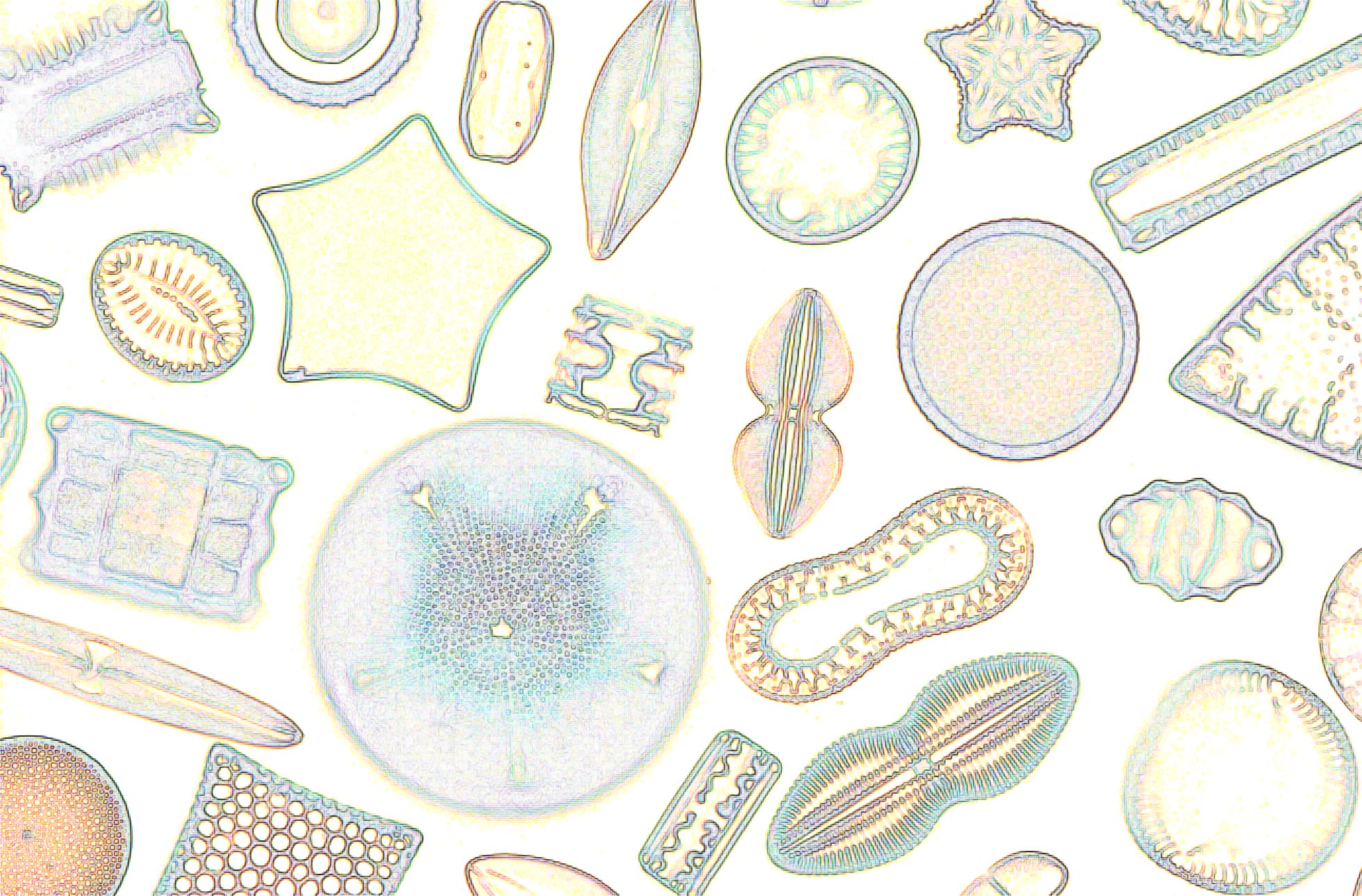
Diatoms: What Would Result if the Japanese Could Design their Own Microorganisms. These guys are screaming for a collector card set. Image by Rovag, Creative Commons Atribution 3.0 Unported License. Click for link.

Earlier this week I posted a link to Victorian microscope slides that included arranged diatom art. People really seemed to respond to the diatom image I posted with it, so I wanted to talk a little bit more about what diatoms are and a lot about their amazing shells. Diatoms literally live  in glass houses, and as you can imagine, that makes sex, growth, and buoyancy a tricky business. How do you have sex when you live in the architectural equivalent of a microscopic  petri dish? As they say — very carefully.

A diatom is a single-celled organism that is also considered an alga  — for values of algae that include “anything that photosynthesizes(makes food using light) but isn’t a plant or bacterium”. They are in a high-level taxon called Stramenopiles, or Heterokonts, a group that’s a grab bag of eukaryotic(cells with a nucleus) goodness that includes water molds (the oomycetes, a scion of which is responsible for the Irish Potato Famine), the fabulously cool and obscure slime nets (labrinthulids), and the brown algae. Here’s the tree so you can see how everyone’s related. Heterokonts are mostly algae, and the heterokontish algae are mostly diatoms. The name heterokont comes from the trait the group’s common ancestor likely developed of having two unequal propulsive tails called tinsel and whiplash flagella (love the names!), though some groups (including the diatoms) have mostly lost theirs. Believe it or not, the tinsel flagellum (so called because of all the little hairs on it) actually points forward and pulls the cell through the water.

But enough about Heterokonts/Stramenopiles. Diatoms live in pretty much any moist environment, including mud puddles, wet rocks, film on moss, etc., though they are most commonly found in fresh and saltwater. If you’ve ever swallowed lake or seawater, odds are you consumed some unlucky diatoms.

Somewhere along the way, probably in the Triassic or early Jurassic, diatoms discovered that making their shells out of silica (SiO2, aka glass) instead of cellulose, chitin, calcium carbonate or any other mineral/molecule/protein/sugar saved them 8% in energy costs compared to an organic wall and helped them compete in a crowded phytoplankton marketplace. The glass shells of diatoms have an incredible structure: they come in two halves called frustules (again, love the name!) that fit together like a pill box. For you engineers and artists in the audience, here’s your 1,000 words:

Schematic of diatom frustules. (A,B) Centric Diatoms. (A) girdle view, (B) valve view. (C,D,E) Pennate Diatom. (C) broad view, (D) valve view, (E) narrow girdle view (transverse section). Cupp, E.E. (1943). Marine Plankton Diatoms of the West Coast of North America. Bull. Scripps. Inst. Oceanogr. 5: 1-238 Image by Matt-eee, Creative Commons Attribution 3.0 Unported License. Click for link.

As may be obvious, centric diatoms are radially symmetrical, and pennate diatoms are bilaterally symmetrical (like us). The valves are the face plates and the girdles are the sides.

Here’s the problem with this system: when a diatom gets ready to divide, its shells pull apart and one goes with each daughter cell. Once these glass shells are formed, they can’t really be . . . er . . . expanded. With glass, you get what you get. One of the daughter cells gets the big frustule or epitheca, and one gets the little frustule that fits in it — the hypotheca. They both grow new shells that fit *inside* whatever shell they got. If you think about this, you’ll realize that one of these two daughter cells got the raw end of the deal — it can never get any bigger than its reduced-size shell. And one of its daughters will get an even rawer deal.

Carried out indefinitely, the cells keep dividing until they’re so small they simply die. That does not sound like the recipe for an evolutionary WIN. Diatoms could, I suppose, get by on the part of their population that always inherits the biggest shell. But that’s an increasingly small proportion of the population, and let’s face it: after a while that frustrule is starting to seem a bit shabby, out-of date, and funny-smelling.  So what is the escape from this evolutionary dead-end? I’m glad you asked!

Ta-Da!

Notice that the sperm have flagella that point *forward*. Those are the tinsel flagella, that pull the cell behind them. Image by Matt-eee, Creative Commons Attribution 3.0 Unported license

Sex! Sex is the answer! (I know what you’re thinking: when is it not?) You have sex, grow your membrane out into a diatom shipyard, then build an entirely new and full-sized frustule inside. When you’re finished, you simply cast off your old-and-busted frustules and membranes, and Voila! New Diatom hotness!

The above solution is what the centric, or radially-valved diatoms do. Here’s what the rest of the diatoms do (warning: graphic diatom sex image):

Hey, baby, wanna swap nuclei? The life cycle of the pennate (not-radial) diatoms. Image by Matt, Creative Commons Attribution 3.0 Unported License. Click for link.

Incidentally, like women of a certain age, diatoms also have a biological clock. If they miss their time to mate and make a new initial cell, they just keep dividing until they get so small they die all alone. Aww. Sad diatom.

So why do these utilitarian glass shells have all these beautiful shapes and forms? I wish I knew. What purpose natural selection has found in them I can’t say, but I can say I appreciate the results — and I’m glad I don’t have to live in one.

{ 8 comments }

The Math of Natural Beauty

by Jennifer Frazer on March 25, 2010

Could not resist re-posting this short movie from Bioephemera lest anyone miss it. I love, love, love the music.

I also love the way natural patterns are repetitive*. Similar patterns pop up in the oddest places. Look at the Charter Oak on the Connecticut quarter

and you’re looking at the search pattern of a feeding plasmodial slime mold (a giant ameoboid eukaryote), Physarum polycephalum,

http://www.flickr.com/photos/randomtruth/ / CC BY-NC-SA 2.0

which sends out protoplasmic veins in all directions in search of its prey: bacteria, fungal spores, and other microbes.

Does math underlie that too?

____________________________________________________
*I also love how this video was for his mom. : )

{ 4 comments }

Microscopes + Victorians = Match Made in Heaven

by Jennifer Frazer on March 22, 2010

Diatoms: the tinker toys of the microbial world. MacGyver could build a bomb out of the components on this slide. A modern microscopic image of diatoms, artfully arranged. Image by Wipeter, Creative Commons Attribution ShareAlike 3.0 License. Click for link.

There aren’t many things about the Victorian world I would have liked, but their impulse to combine nature and art is one thing I could get solidly behind. Don’t miss this slide show over at SEED Magazine highlighting the work of Victorian prepared slide makers. This was a time when the general public actually enjoyed scientific pursuits like looking at things under a microscope in their spare time, so much so that they could actually support an entire diatom art sweatshop industry. Seriously. It happened.

Enjoy!

{ 1 comment }

OK. This is it. Life premieres in America this weekend! For a video preview of the U.S. version (and in case you missed the huge banner ad splashed across the top of the NYT Friday, yet silly Discovery Channel still won’t let me embed the video here), see here.  For those of you with cable, rejoice. Deets: 8 p.m. Sunday, Eastern and Pacific. Perhaps 6 p.m. Mountain Time? For the rest of us; don’t despair. That just means we’ll get to see the original Attenborough version when it gets released to DVD, rather than the inferior Oprah-ized edition. Still, if I had cable, I’d be watching Sunday night.

In other news, my car currently smells like the inside of a dive shop.

Two gigantic neon tanks of compressed air (properly braced)? Check.

Regulator? Check.

20 pounds of weights and weight belt? Check.

Buoyancy Control Device (aka scuba life vest)? Check.

Mask, fins, snorkel? Check, check, check.

7 mm wetsuit that adds the blubber equivalent (BE) of a pilot whale? Check. I’ve tried that puppy on, and all I can say is that there is clearly a reason sea creatures look doofy anytime they try to get around on land. This is about as thick as wet suits come, but in the Blue Hole (average temperature: 62-64F) where I’ll be diving, I’ll be glad to have it. 62F is trout country.

Spirit of Adventure? Check.

Remember when I discovered the Pelagic Magic blackwater dive? Well, I’m halfway to my dream. I finished the classroom and pool work for SCUBA certification in February, and this weekend I’m traveling to Santa Rosa, NM to complete my open water certification dives. My plane tickets are booked for Kona, Hawaii for April 17. I’m on my way.

As for the rest of you, I want reports on the first episode of “Life”! I won’t be around to post this weekend, so cozy up at home Sunday night for some Life on Earth goodness, and then report back here what you thought. See you next week!

{ 4 comments }

Where There's Smoke, There's Klebsiella?

by Jennifer Frazer on March 18, 2010

So who are the bacteria in cigarettes discussed in the last post? I don’t have time to profile them all, so we’ll briefly look at one I picked more or less because I didn’t know anything about it: Klebsiella.

Pink colonies of Klebsiella pneumoniae in culture. Brought to you by Pepto Bismol.

Klebsiella sp. are flagellum-less, rod-shaped, Gram-negative bacteria. The Gram state of a bacterium has to do with the  properties of its outer coating; Gram-positive bacteria have a membrane surmounted by a thick outer wall made of peptidoglycan that readily takes up purple Gram stain, while Gram-negative bacteria have a thin peptidoglycan cell wall sandwiched between inner and outer membranes. Knowing the Gram-state of bacteria helps microbiologists sort out what kind of bacteria they might be dealing with. That’s helpful, as you can imagine, when many of your subjects are simple balls (cocci) or rods (bacilli) that look more or less the same.

The funny name comes from a 19th century German microbiologist named Edwin Klebs. The group is in the enteric bacteria, which itself is within the Gamma-purple bacteria. Misleadingly, many purple bacteria are not purple. But they are bacteria. Tricky, I know. That’s probably why the group seems to have acquired a new name: Proteobacteria. See if you can find it on the bacterial family shrub.

As implied by the term enteric bacteria, many are found in the gut of animals, but many others roam wild and free. Like Klebsiella, they’re all Gram-negative rods, but some do have flagella. Enterobacteria contain some famous names indeed: Escherichia, Shigella(a maker of dysentery), Salmonella, Proteus, Klebsiella, Enterobacter, Erwinia(a plant pathogen that causes fire blight in apples and pears and soft rots in vegetable crispers around the world), and Yersinia, one species of which (Y. pestis) made it big as bubonic plague (aka The Black Death). There are others, too. Though Klebsiellas are sometimes human pathogens, some strains live happily in your gut or on your skin, and many others thrive in the environment and may never see a human their entire lives.

There are presently about seven species of Klebsiella known, and they are becoming important as hospital-acquired (nosocomial) infections. Now we don’t know what species was in the tobacco the researchers studied — they only narrowed it to genus with their genetic screens. Perhaps many species in this genus were present. But take note of the final sentence from this WebMD article about Klebsiella pneumoniae:

Infection with Klebsiella organisms occurs in the lungs, where they cause destructive changes. Necrosis, inflammation, and hemorrhage occur within lung tissue, sometimes producing a thick, bloody, mucoid sputum described as currant jelly sputum. The illness typically affects middle-aged and older men with debilitating diseases such as alcoholism, diabetes, or chronic bronchopulmonary disease. This patient population is believed to have impaired respiratory host defenses. The organisms gain access after the host aspirates colonizing oropharyngeal microbes into the lower respiratory tract.

{ 2 comments }