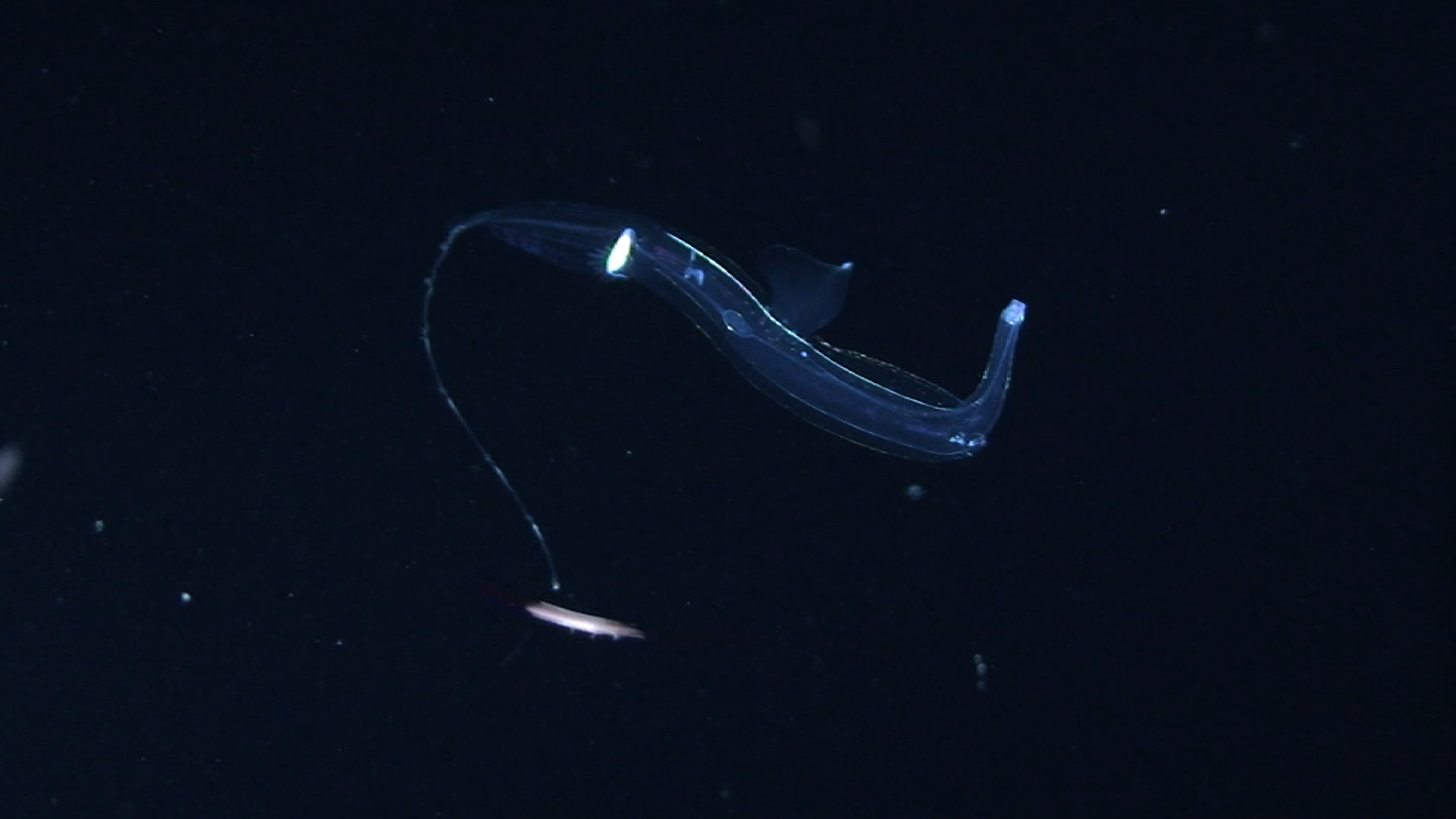
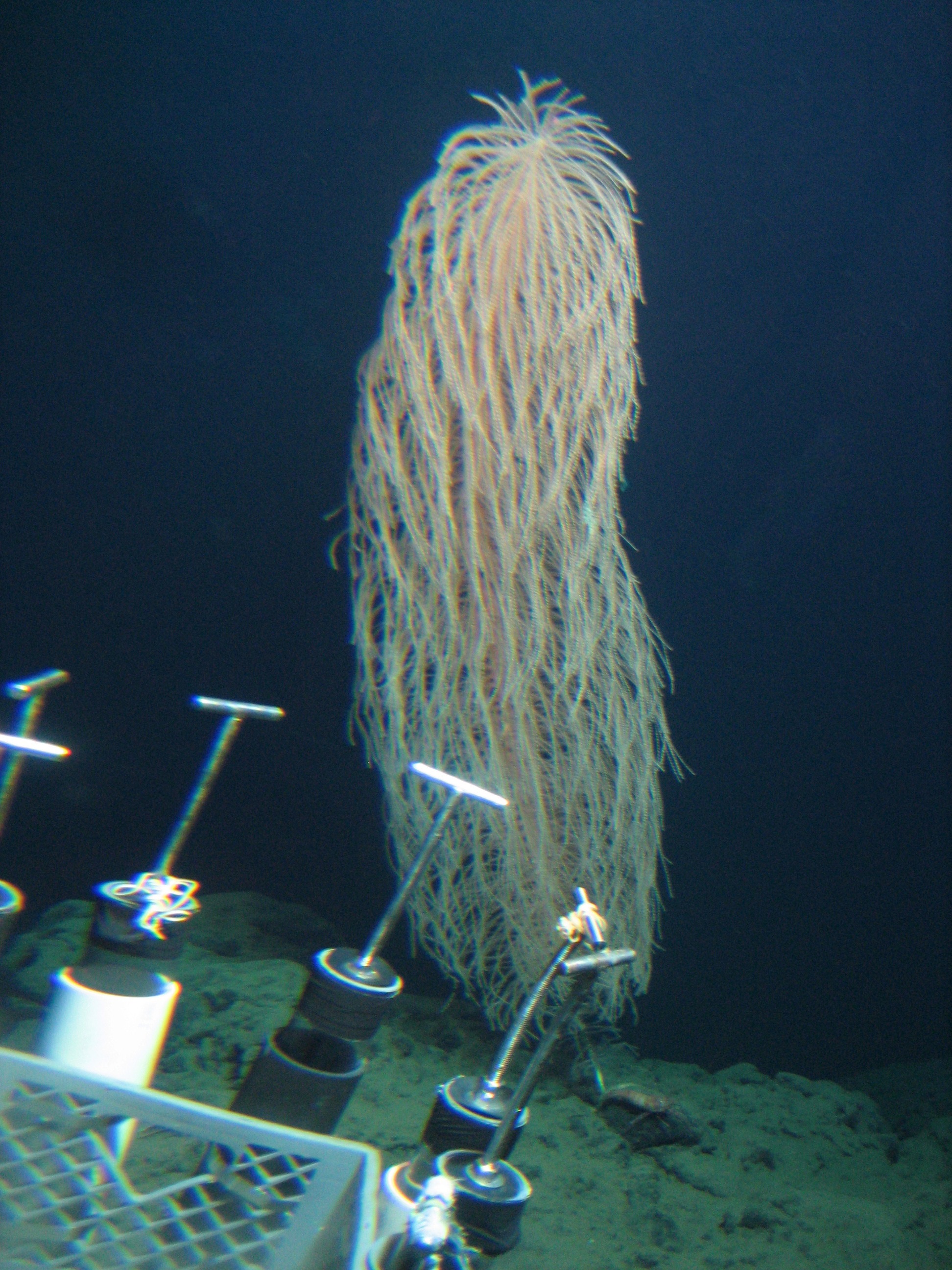
A coral relative called a gorgonian -- or in this case, Cousin It -- found off the coast of Moloka'i. Eric Vetter, Craig Smith & the Hawaii Undersea Research Laboratory

Have you ever wondered what happens to stuff that falls into the ocean from shore? Where does it go? What happens to it? Well, if it’s plastic or something else floaty, it’ll likely end up in some vast floating garbage vortex, as we apparently have, in our apathy, created in several locations on the planet. But what if it’s heavy, like tree nuts, waterlogged PBR cans, or a multimillion-dollar sapphire? The ocean is not a memory hole, and it turns out that (organic) stuff washed into the sea near shore collects in places that can help support a gaggle of interesting creatures.

Though teeming with bacteria and viruses, the Earth’s oceans are largely a desert for mobile megafauna (i.e. big things that swim, walk, crawl, scuttle, or ooze) like sharks, whales, fish, and cephalopods. Coral reefs are a well-known exception, but it turns that where this stuff goes is another darker, deeper source of biodiversity, and we’re not talking about deep-sea hot springs or Cthulu-esque spawning zones. A study in Marine Ecology by scientists at the University of Hawaii, Manoa, found that submarine canyons at remote Pacific islands may act as oases that funnel nutrients (and other debris) to the bottom in a way that creates a smorgasboard for big swimming or crawling things. They wondered if this would be so by analogy with studies of similar canyons on continental margins, but no one had ever looked in the canyons ringing a remote island chain before.

ResearchBlogging.org

They started using submersibles that videotaped the bottom of canyons and control slopes nearby, but found there were too few things to look at for that to work. So instead, they sent people down in submersibles to essentially sit on either side and look out the window, calling out what they saw as they cruised along (I cannot imagine they had a hard time finding volunteers. I would pay to do that). They studied two groups of islands in the Hawaiian chain — two in the main group (O’ahu and Moloka’i) and two of the teeny tiny obscure northwest isles, Nihoa and Maro Reef, an atoll.

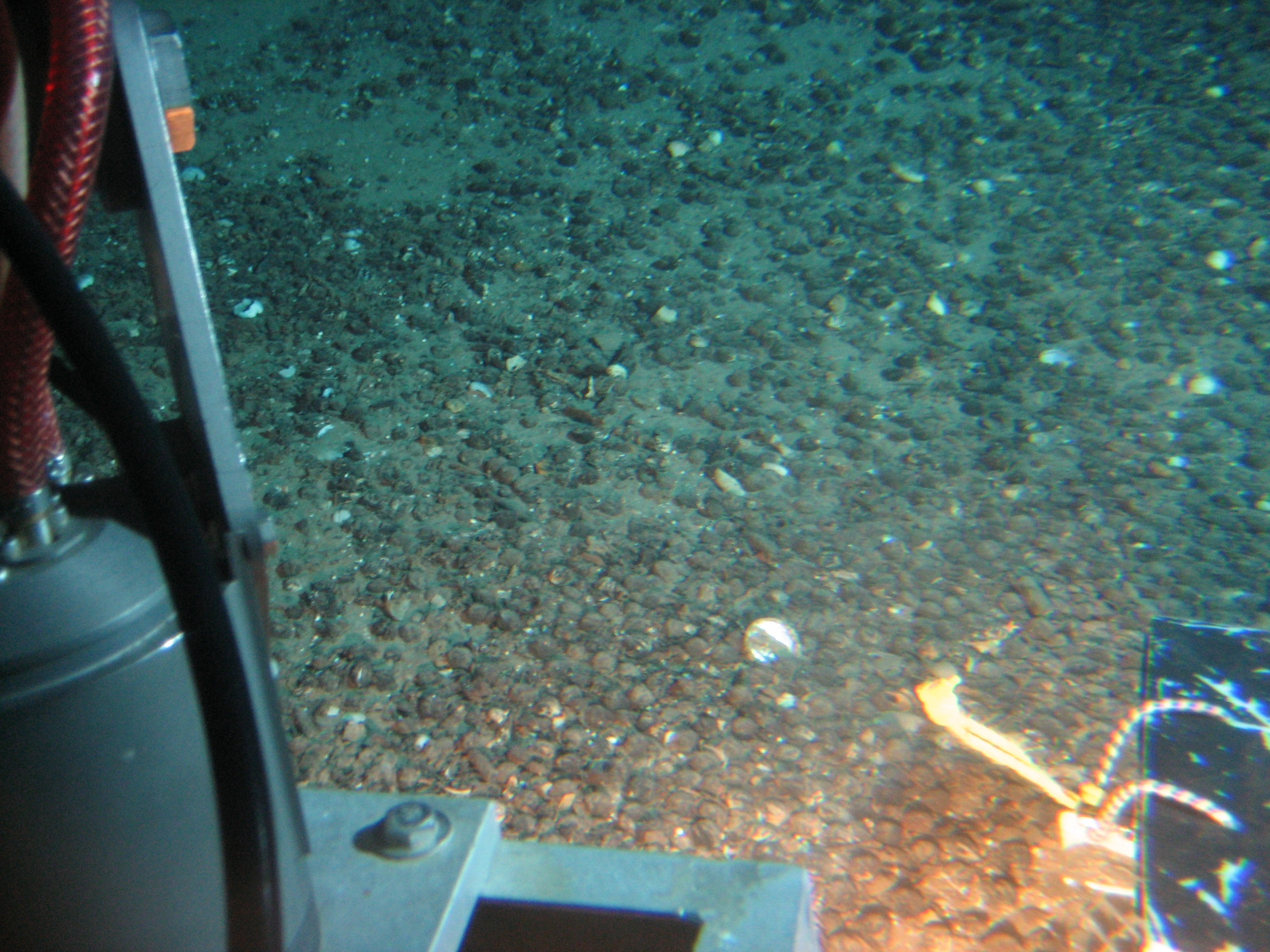
Though they hypothesized that the canyons on big islands would have more biodiversity than the canyons on little islands since there was theoretically more crap to roll off the island and into the canyon, they found this was not so. Nor was total biodiversity higher in canyons than on slopes. But they did find the biodiversity (both counted in absolute abundance and unique species counts) of big swimming or crawling things was enhanced in canyons compared to sedentary or sessile animals. On the other hand, sessile filter-feeders (like Cousin It, above) seemed to do better on the flat slopes between canyons. Why? They don’t know for sure but suspect it’s related to frequent turbidity currents and submarine landslides in canyons. Put simply, you’re less likely to get buried by one of those if you can swim or crawl out of the way. Once done, you are now in position to capitalize on the buffet brought in from above. And what a buffet! Take a look at this picture from the expedition.

Kukui nuts, an oil-rich fruit of the candenut tree, in the Spurge Family (Euphorbiaceae)

Call Diamond: A bonanza of kukui nuts (from the candlenut tree, in the Spurge Family (Euphorbiaceae) in Moloka'i Canyon. Eric Vetter, Craig Smith & the Hawaii Undersea Research Laboratory

I half expected to see several lost socks and Jimmy Hoffa sticking out of that pile. Consider that this nut bonanza from trees growing on land was discovered 500 meters — 1,500 feet — below the surface! Canyons may also concentrate food by funneling in carcasses that drift from above and by concentrating plankton that migrate up and down over the course of a day.

As for the fantastic Cousin It look-alike they found, he is a gorgonian (or sea whip or sea fan). These little cnidarian high-rises are colonial polyps related to soft corals and sea pens(another of my favorite marine groups) within the phylum Cnidaria, a vast and unbelievably cool group that includes the jellyfish and portuguese men o’painwar. They build a skeleton of protein or calcium within which their little eight-tentacles polyps sit and wait for plankton and other tasty tid-bits to drift by. Some of them can take in algae called zooxanthellae like other coral and work symbiotically with them for food. Others (like those found at 650 m below the surface, like Cousin It) get by only on the sweat of their own tentacles.

Vetter, E., Smith, C., & De Leo, F. (2010). Hawaiian hotspots: enhanced megafaunal abundance and diversity in submarine canyons on the oceanic islands of Hawaii Marine Ecology, 31 (1), 183-199 DOI: 10.1111/j.1439-0485.2009.00351.x

{ 1 comment }

Morel Hunting Hooky

by Jennifer Frazer on May 8, 2010

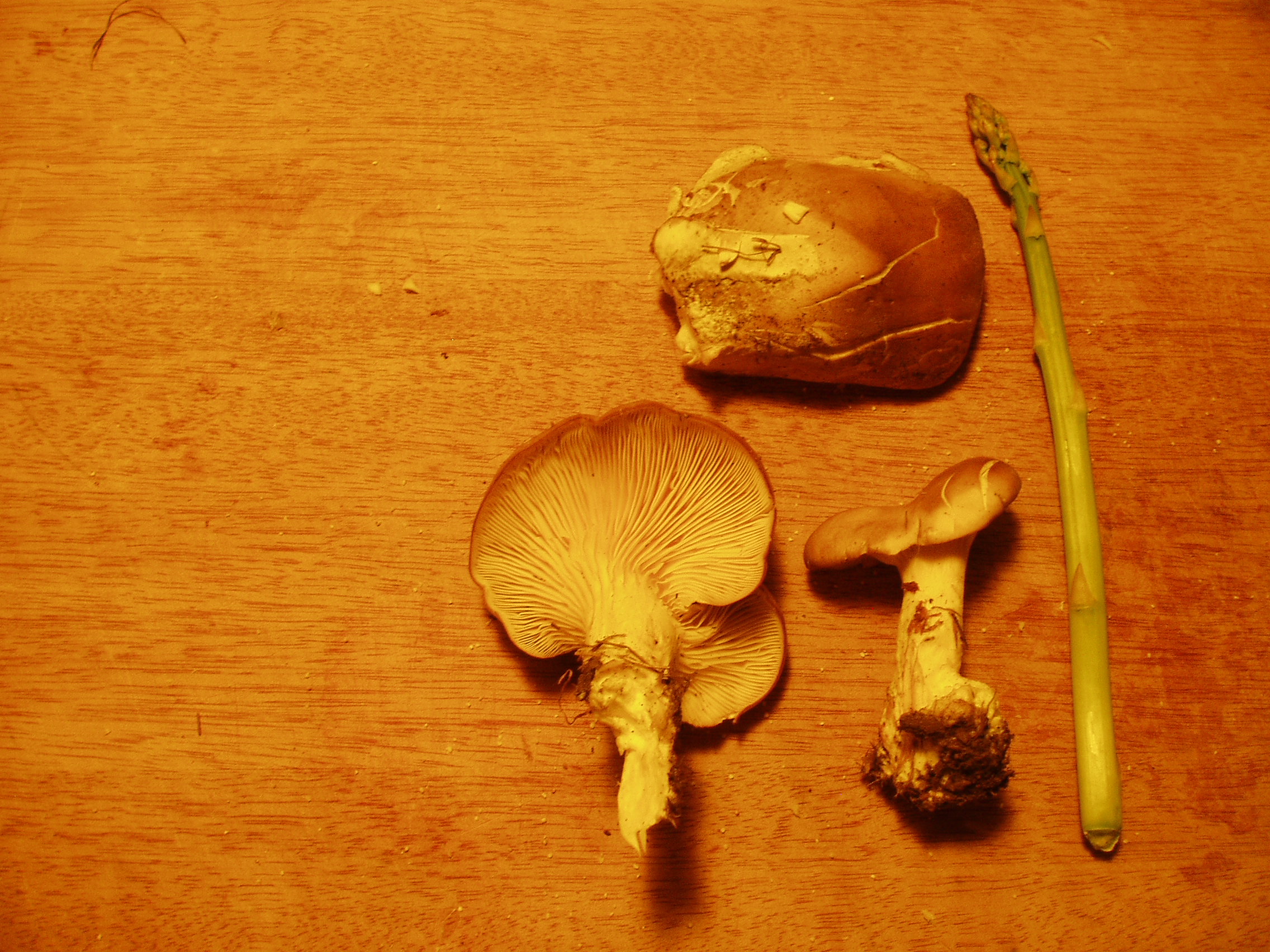
Delicacies of Spring: Pleurotus pulmonarius and Asparagus officinalis, shortly before they met their end at my table.

You may have noticed that blog posts have been scarce lately. It’s finally Morchella esculenta season around here and I’ve been out two nights this week hunting and am going out again this morning in the time I’d normally be blogging. You’ll have to forgive me; with morels you’ve got two weeks to find them and that’s it for the year. Never fear! I’ll be back this afternoon Sunday(morel hunting was too good today! 12 finds and 9 taken home. Did not, however, strap them across the hood of my car, and more’s the pity) with a new post.

No morels yet, but oyster mushrooms (Pleurotus pulmonarius is the western flavor) and wild asparagus have been found — and found to be tasty. : ) I normally hate asparagus, but I could not believe the flavor difference of eating wild fresh-picked. It was sweet! Sweet like sweet peas — not bitter like most asparagus I’ve had. I’ve heard it’s the same with peas — the sugars degrade quickly after picking — which is why it’s best to buy them frozen unless you have your own garden.

If you can manage it, get out there and take a walk in the woods/on the prairie/on the shore today. It’s spring in the northern hemisphere, fall in the southern, and you lucky bums in the tropics always have it great. Get out there and experience life for yourself! Poke around and see what you can find growing, swimming, crawling, or flying. There’s no substitute for the real thing.

{ 0 comments }

Oceans: A Review

by Jennifer Frazer on May 2, 2010

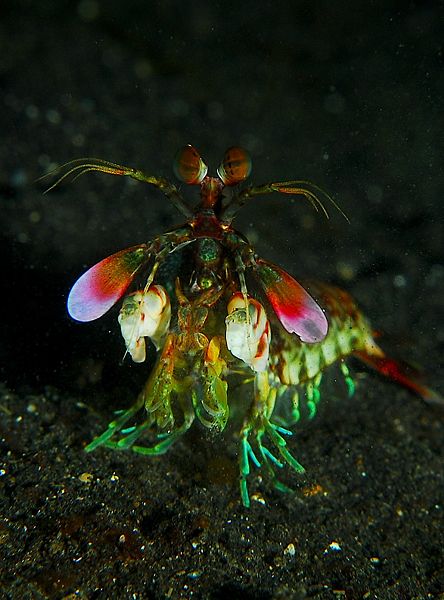
Do not taunt happy fun mantis shrimp. Trust me. http://www.flickr.com/photos/diverslog/ / CC BY 2.0

There was a cruel irony to the U.S. release of “Oceans”, the latest work by Jacques Perrin, my favorite natural history filmmaker, on Earth Day this year. It was only two days before, on April 20, that an oil rig named Deepwater Horizon exploded in the gulf. Two days later, on Earth Day and Oceans release day, it sank and began leaking oil, precipitating a spill of disastrous and historic proportions.

I will not dwell on the politics or blame for this, except to say I think it is long past time we find something other than oil to power our economy, and that we make this an urgent priority. Whether it comes now or 100 years from now, the oil will eventually run out — there is only so much planet — and helplessly watching the slow-motion but irrevocable poisoning of the Gulf of Mexico is breaking my heart. It must surely also be so for Jacques Perrin.

Last night I finally made it out to see “Oceans”. Though it wasn’t as bad as I feared, given that Disney had got its tentacles on it, it wasn’t as good as it could have been either. That is to say, being a Perrin film, it was still a work of extraordinary natural history film making. It registered a 7-8 on the Audible “Wow!” Scale. But it was not Perrin at the top of his game. He excels when he lets organisms speak for themselves. Here, Pierce Brosnan — yet another Hollywood big-name voiceover artist, though a far less-bad choice than it could have been — does too much of the talking.  Perhaps that’s less his fault than that of the writers. For the most part, the script is the cliche and mind-numbing natural history pablum that’s all too common at your local IMAX theater (and the major reason I think there’s a special circle of hell for the makers of IMAX films who squander the medium with crappy scripts). Natural History narration can be done well and with wit and spirit — Exhibit A would be David Attenborough, but there are a few other notables — but this is not that. The only previous experience I have with Perrin films is when he takes the opposite tack. “Microcosmos” is virtually wordless, and that is a great part of its power. A similar approach here  would certainly have been more effective.

But all that cannot take away from the arresting visuals. Stunning. Poetic. Sensual. French. Let’s face it, folks: There are some things the French do really well, and filmmaking is one of them. The oceans slip by like Dove chocolate (also filmed for the commercials in super-slow mo) as seals swim above and below the water in slinky mammalian sine waves. The silky webbing of the blanket octopus is a fluttering technicolor dreamcoat. Cuttlefish cast deadly spells by hypnotizing their prey with their LCD skin. The oceans rage in a gale as ships bravely part the waters in a monsoon of spray.

If one of the aims of natural history film making is to capture moments that would be impossible for most of us, with our offices and own offspring to raise, to witness ourselves, then this film is a glowing success. I live in Colorado. Even as a  diver, I may never personally witness the vast majority of what I saw in this film. One of the big wows was — for the first time ever for me — watching a blue whale feed, the accordion throat of a half-block sized animal fully inflated. In another scene, humpback whales blowing bubble nets rise to the surface like sandworms with mouths agape, their throats so close and clear you could see the pink frills of some sea parasite or algae sprouting from them like the frothy collars of 18th century men’s shirts. And then there was the smackdown between a crab and perhaps the most bad-*** mantis shrimp ever captured on film. You could practically hear him, before he viciously sucker punched the defeated crab, cry, “I am not a shrimp! I am a king prawn!”

So my advice remains the same: Go. See Oceans. Rejoice. And do what you can to help protect them. Three biggies are: use less plastic, don’t eat endangered critters or seafood that’s irresponsibly caught, and reduce your carbon footprint. Here’s a start on the second with a wallet card you can easily print out and carry with you for those last-minute seafood orders.” Here’s a start on the second with an iPhone app or wallet card you can easily print out and carry with you for those last-minute seafood orders.

{ 5 comments }

Wonderful Pelagic Things

by Jennifer Frazer on April 29, 2010

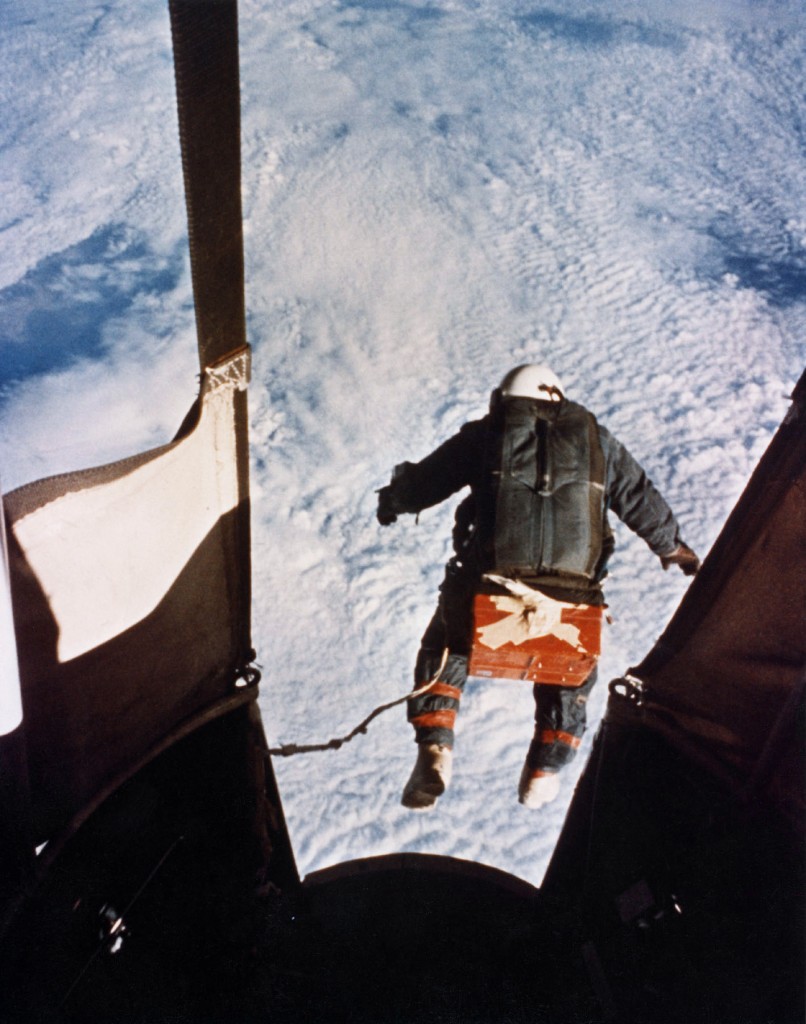
On August 16, 1960, Capt. Joseph Kittinger leapt from the gondola of a balloon 102,800 feet above the American southwest as part of the Air Force’s Project Excelsior. He fell for four minutes and 36 seconds, setting the record for highest balloon ascent, highest parachute jump, and fastest speed by a human being through the atmosphere. Here is a picture of the moment just after he took the critical step.

I like the spirit of this photo — not just the brave Indiana-Jones style leap of faith from on high, but also the fact that the guy appears to be doing it in a suit held together with electrical tape. Lowest bidder electrical tape.

This was the photo I’ve studied for inspiration on many a day in the last few weeks leading up to the blackwater pelagic dive I planned to do in Hawaii, in which you jump into 4-7,000 feet of water at night suspended by a 45 foot tether in shark and marlin-infested waters. As I mentioned, I wasn’t sure I’d be able to take the plunge when the time came.

Reader, I jumped in.

And when the moment came, it wasn’t even all that hard. But getting to the dive platform wasn’t so easy. Over the last few months my mind closed in on me at times with the horror of the idea: the abyss below, darkness around, and the the reality that the boat would essentially be trawling with the lines baited with divers. I had sometimes a hard time falling asleep thinking about this, laying awake and questioning whether I was out of my mind to do it. But I couldn’t shake the conviction that it was an experience I had to have. And, as my friend Dave pointed out, if it wasn’t really safe, they wouldn’t let you do it.

On the evening dives I did the day before the pelagic dive, I met Matthew D’Avella, one of the first to do the dive and the current pelagic dive leader with Jack’s Diving Locker, the outfit I used (A company called Big Island Divers also does this dive). He’s done the dive hundreds of times, and his advice for dealing with the dive was simple: Just don’t think about it. It was a strategy I used for most of the week, and I have to confirm it works. Right up until the last minute, that is . . . The fateful night came, and on the way to the dive shop, I began to have that feeling you get on the way to the dentist to have cavities drilled: a dread, but an overriding realization that you’ve got to do it and it’s best to get it over sooner rather than later. There were to be four paying customers that night: myself, two other women, and a man. Two or three divers with the shop would be joining us, including co-owner Jeff Leicher.

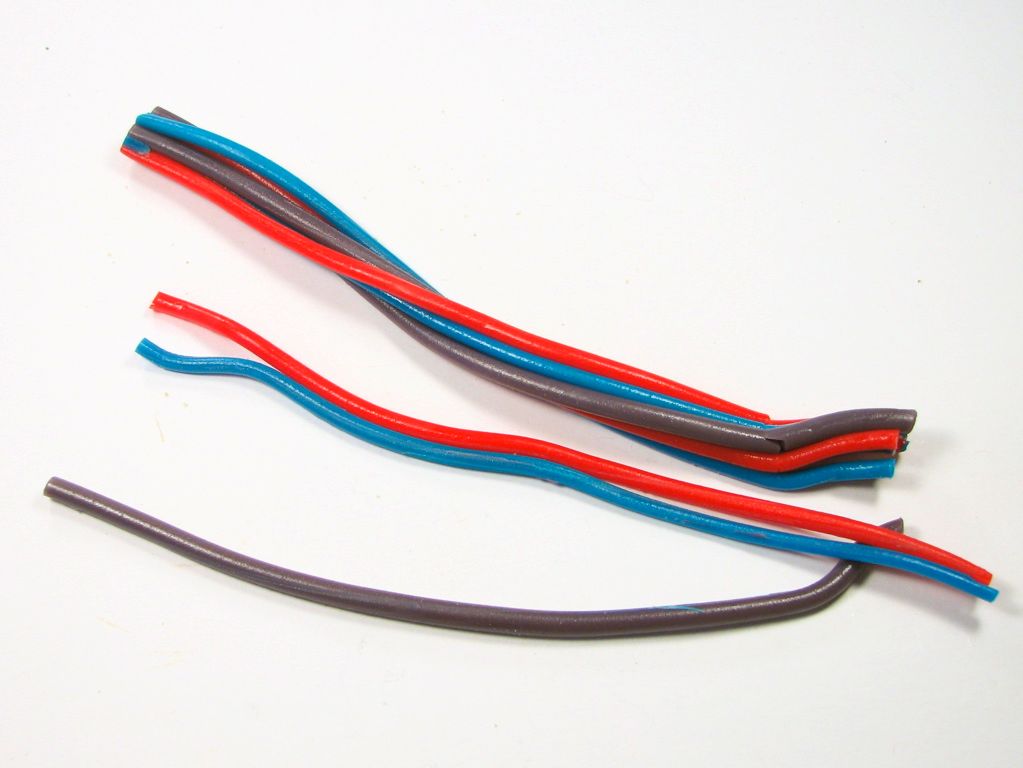
We headed into a classroom for a pre-dive briefing by Matthew. He explained the rope and tethering setup of the dive and the army surplus parachute they would deploy to slow the drift of the boat. He covered all the different organisms we might see, from the commonly encountered to the rare. “Odds are if you’re looking at it, it’s alive,” he said, although that isn’t always the case. Jeff once filmed a twizzler for 6 or 7 minutes, Matthew noted, before realizing his error. Hey, we all make mistakes.
http://www.flickr.com/photos/oskay/ / CC BY 2.0

He covered the risks and the things that might startle us: don’t be afraid of the chute when you see it out of the corner of your eye, he said, or the pull cord on your wetsuit wrapping around to touch you, or if you accidentally (I am not making this up) get whacked by a squid. Turns out the squid show up about 30 minutes into the dive as we are beginning to attract our own ecosystem, Matthew explained. Usually they hit the fish we are attracting and the scales come off like fireworks, he said. But sometimes they mistake a diver’s black wetsuit for empty water and jet right into them — chest, legs, or groin. Then they get all confused — like a bird hitting a window, one of my fellow divers suggested — and start inking everywhere and freeze for a few seconds while they’re sorting things out. If you can snap a photo of them in those few seconds, you can get them on film, Matthew said. If I could survive that experience without peeing in my wetsuit, I’d consider that a huge success. On that note . . .

The bad news, he said, was there were a lot of things out there looking for dinner and we are not at the top of the food chain. The good news was that we are not on the menu. Most of the time, sharks, swordfish, dolphins, et al. approach, decide it’s not a place they want to be, and move on, he said. Only once had a shark with a bad attitude approached. Matthew slugged it when it got too close to him (which is, I understand, proper protocol) but it was undeterred. At that point, he wisely ended the dive and no one was hurt. A shark had never opened its mouth near them on a pelagic magic dive. The main thing, he emphasized, was NOT to pee in your wetsuit. Divers already behave like wounded animals, he explained, and the scent of urine in the water does not help matters. As I have a bladder the size of a school girl (since I’m actually pretty much the size of a school girl) I made a mental note to hit the marine head with extreme prejudice pre-dive. I was gonna be ready for those squid.

Finally, if your mind starts spiraling downward for whatever reason, Matthew said, tell yourself, that was cool, great experience, but I’m getting out now. Don’t wait for a panic attack that could lead to a bad situation for everyone. Duly noted, I thought. I only once got to a place where my mind truly spiraled downward, and that was in radon-gas laced quarter-mile cave crawl in Wyoming. I told one of the trip leaders I needed to leave but was informed I couldn’t given where we were and that I had to keep going. I never panicked and calmly kept going without saying a word, but I knew exactly what he meant by the brain decay. I would watch for it.

Soon there was no more to be said and it was time to gear up and ride down to the Kailua-Kona pier. The van door closed with a clang worthy of prison transport. In my mind, it felt that way too, but I struggled to clear my mind and think of other things. I had earlier commented on the 3:1 ratio of women on the dive that night. That’s not unusual, Matthew said: Pelagic Magic is usually Ladies’ Night. I now asked why he thought that was. His feeling was that women have more refined underwater taste (my words. His: women are smarter) than men. Pelagic organisms are the thinking diver’s sea creatures, and women are more into the intellectual side of diving than the adrenaline/blood/guts side.

Whatever the case may be, we slowly made our way down Ali’i Drive past all the tourist bars where the revelers were living it up on a Thursday night. At the pier, I could hear a party across the inlet near the ‘Ahu’ena Heiau (Temple). Colored lights were flashing and music was playing. Suddenly I understood how a jumpsuit-clad guarded prisoner I once saw who’d been allowed to go fishing off a dock at a Kansas lake felt when I waterskied by and waved. I wasn’t about to chicken out now, though. On the boat ride there one of the women said she hadn’t want to tell anyone she was doing the dive until after she’d done it. Are you kidding? I said. I told everyone so I’d have to do it. (That includes you guys) : )

Jeff gave us the boat safety talk before we boarded the Nai’a Nui. I found Jeff’s calm presence reassuring. He and the guys had done this dive hundreds of times. And they all seemed surprised and impressed by the fact they said I was the first person to ever get scuba certified specifically to do this dive. They were very curious about it. How did I find out about the dive? How long ago? What attracted me to the dive? He told me they’ve been trying to publicize the dive so more people know about it, and he was glad to hear I was planning to do a blog post about it.

As we were leaving port I made sure to, as planned, heed nature’s call. It was a very short ride to the dive site, which is why Hawaii is a great place for this dive. Since it’s essentially a giant seamount, there is no continental shelf to contend with and it’s very easy to reach deep water. The Jack’s crew has dubbed their pelagic dive site Stardust/Area 96 — because that’s where the aliens are. On the way there I asked about the history of the dive. According to the legend, some guy at the dive shop had reportedly started going out at night *alone* in the mid-80s, jumping out of his boat untethered, and dropping down 50-100 feet. He was getting photographs no one else was getting. The Jack’s guys were skeptical about the untethered bit because it would be so easy to lose the boat. Matthew said on one recent dive, even with the parachute, the boat had drifted four and a half miles, and they had never felt a thing underwater. In any case, the staff at Jack’s, feeling a bit of ennui about diving routine, started doing something similar as a day dive several years back. They saw a few interesting things. But then they tried it at night and saw 10 times as many (since there is a nightly migration surface-ward of deep sea organisms to feed). After they realized that, they decided never to go back to days.

The boat came to rest and they tossed the parachute out. To my surprise we could still see the lights of Kona and the Big Island — and that was a great comfort. We donned our wetsuits. Matthew prepared to jump in first. The first person in has to check for sharks, etc. They generally perform this duty by turning like a washer on spin cycle. Jeff’s first-in routine is like a frogfish feeding, he said: “It’s one of nature’s fastest movements when I get in.”
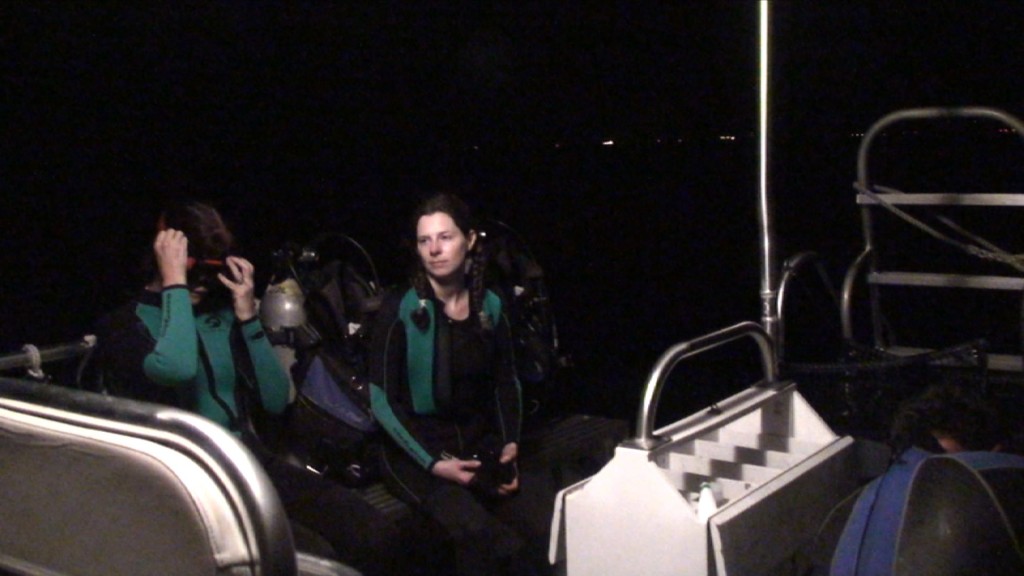
Me seriouly pondering the adequacy of my insurance coverage pre-dive.

Matthew urged us to be ready to jump in not long after he did (can’t imagine why), so after he performed the shark check, the moment had finally arrived. As I was first in line on the starboard side of the boat, I decided fortune favored the bold. I felt now, as I mentioned, remarkably little fear. The water was relatively calm, or as calm as can be expected for the North Pacific, and I overheard the crew remark on that and the fact it hadn’t been any rougher in port. A gentle breeze blew. Perhaps it was the fresh air and the lights of Kona that buoyed my spirits, but whatever it was, I felt calm but excited. I knew what I had to do and I knew I could do it. I stood up and shuffled to the dive platform and prepared to take the giant stride. Jeff reminded me to put my regulator in my mouth. Important safety tip. I thanked Jeff. I put my right hand on my regulator and mask and my left on my BCD (vest whose air volume I control to control my buoyancy) and I walked in with a splash. I did my buoyancy check to make sure I had the right amount of weight. Seemed perfect. I yelled that up to Jeff and he gave me the go-ahead to descend. Without hesitation, I let the air out of my BCD and slipped beneath the waves.

They had given me a dive light before I jumped in, and its beam was long and yellow. I had been the first one in after Matthew, and he was still at the surface. Down five feet, 10 feet, 15 feet, and still I was the only one below. I could see the white weighted lines the others would use. Here I was suspended above the abyss, and I wasn’t afraid at all. You can’t, of course, see the bottom 4-7,000 feet below. All you can see is a beautiful blue. It’s a calming color. 20 feet. 25 feet. I knew predators were very unlikely this early in the dive. I wasn’t afraid. 35 feet. 40 feet. I stopped just above the weight at the bottom of the line. I looked out into the open ocean away from the boat and marveled at the vast  space. I thought, “This is so cool! I’m suspended in the middle of the Pacific Ocean with thousands of feet of water below me! Awesome!”

After about 5 minutes the others finally joined me. Both women — Nancy and and astronomer named Laura — had agreed to look out for me and be a dive buddy should I get into any trouble or need anything. That helped bring peace of mind. And once they and the other paying customer, Matthew, and Jeff were all in the water, it felt like a totally safe environment. I was hooked to a line. I could see the boat above. There were at least six other people a few dozen feet away from me and we all had lights.

At first I couldn’t see anything in the water. Or rather, I was expecting to see big stuff — ctenophores 8″ long like at the aquarium, or a 5 foot chain of salps. But you have to look with different eyes. When Howard Carter first made a hole in the plastered over door to Tutankhamun’s tomb and stuck a candle in to see what lay inside, the escaping hot air and the dimness prevented him from seeing anything for a short while. After a few moments, his patron Lord Carnarvon asked anxiously, “Can you see anything?” And Carter replied, “Yes, wonderful things.” Once I adjusted my eyes, so did I.
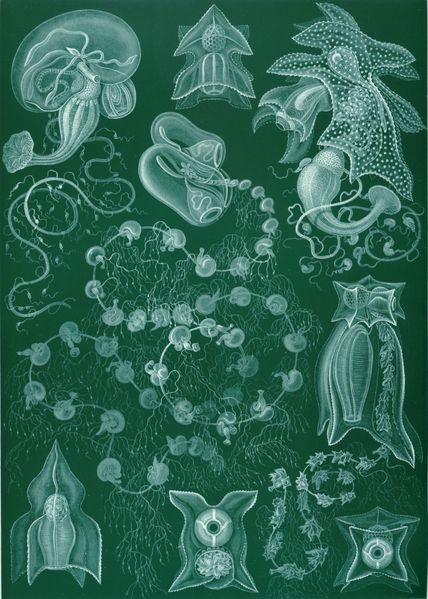
Siphonophores by Ernst Haeckel, 1904

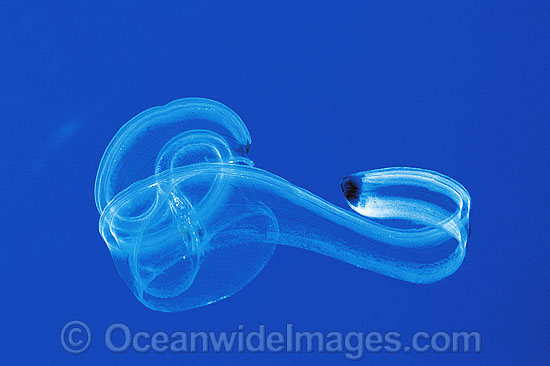
Many of the pelagic inverts are only an inch or so long and nearly transparent. Once I started looking for small, nearly invisible things, I spotted my first life of the evening: a siphonophore, or colonial cnidarian in a group separate from the jellyfish. The second picture here is the closest I can find to what it looked like. There was a small jade-colored bag or disc at the front, followed by a long strand trailing dozens of gossamer filaments that lay motionless in the water. It was no more than 5 to 7 inches long. It had always been my impression that most of the pelagic fauna were passive floaters. But I learned I was wrong on that count many times over. After a few seconds with my light pointed at it, the siphonophore’s head decided it didn’t really care for the spot light. The filaments suddenly retracted to the main line and the head started to pulsate and pull the colony  away from me. COOL. I saw a few other similar siphonophores on the dive and they all behaved the same.

Many big things (fish, jellies, coral, etc) have little larval stages, and these often drift in the open ocean. There were many teeny fish and other things that swam up to my light during the dive that I couldn’t really identify other than to say they were larvae of some sort. Among the teeny tiny stuff I did see one thing I recognized: a copepod!  Those long horns and its overall body shape gave it away. I had a brief flash of recognition and it was gone.

The next “big” thing I saw was the most amazing crystalline spider-like object. It was about 2-3 inches long and almost flat — about the size of a silver dollar or a little bigger. It looked like a transparent spider that had been pressed flat, and as it tumbled slowly in the current it twinkled with a rainbowy iridescence, as if it were made of glazed glass. I knew from arachnology that there are such things as sea spiders, but after the dive Matthew identified this creature as a larval lobster. Here’s a picture of a larval lobster that does look similar to what I saw. I saw at least one more that night.

Then I didn’t see anything nearby for a while, so I started looking at what people were looking at nearby. One of the cameramen (Jeff or Matthew, not sure which) beckoned me over as he was filming a comb jelly(see the comb jellies here). Just as I looked at it it sucked in a pale orange zooplankton, which remained perfectly visible in the ctenophore’s stomach. Wow! And once again, it startled me with its ability to move. I thought from watching them in aquariums that comb jellies pretty much just sit there, capable of moving only by beating their tiny cilia on the combs. But this comb jelly decided it didn’t like light any more than the siphonophore — and promptly jetted off by contracting its lobes like a jellyfish.

Things start to get all blurred in my brain at this point, but at some point soon thereafter I noticed a tiny orangey-pink thing that momentarily flashed out eight tiny legs and looked like a crab, but instantly retracted back to an orange pea-sized object that swam away from me as fast as it could, chase it though I may. I learned from Matthew after the dive that this was in fact a swimmer crab. It flashes it’s legs out in a threat display when startled and then swims off, he said. It has no idea, he said, how big it is compared to you.

Box Jellies by Ernst Haeckel, 1904

In the water there were also many tiny bells less than a centimeter long and not pulsing — possibly larval jellyfish. At one point, I definitely remember seeing a conventional jelly fish with long stinging tentacles pulse by, but the bell was only 1-2 in. in diameter and the tentacles 2-3 times that. It looked like the photo labeled “Hydro” here (I have to link to Matthew’s photos from previous dives since I had no camera worthy of the task myself). At another point, I’m pretty sure I saw a box jellyfish like the one labeled “Box Jelly Side” here. Box jellies are a subset of the true jellyfish in the phylum Cnidaria. If you know anything about box jellies, you know that’s a potentially very scary thing as a few species are among the most venemous animals on earth, though Matthew had told us these box jellies are not nearly as dangerous as their famous kin. But still, keep your distance, he warned. I definitely made sure to get out of the way as it pulsed by.

Late in the dive I saws a salp — one on its own and possibly two linked together. They are commonly colonial, but they also grow to be fairly big in their own right — 5-7 cm long in this case. They looked like the ones in the lower right hand photo here and they pulsated with a strong steady rhythm. Salps are floating tunicates, which means they are distantly related to us as the larval form of tunicates . . . wait for it . . . has a spinal cord! Hence they are chordates just like us.

I also saw the squid flash by in a big school toward the end of the dive just out of the circle of our lights. They never came close, but their numbers and speed were amazing. Although some of the things we looked at are rumored to bioluminesce, there was no way to tell with all the lights in the water. If I were to suggest a way to really take the dive intensity up a notch, I’d suggest having everyone turn out their dive lights for a minute toward the beginning of the dive to see if anything glows. Course, that wouldn’t be scary. Not at all.

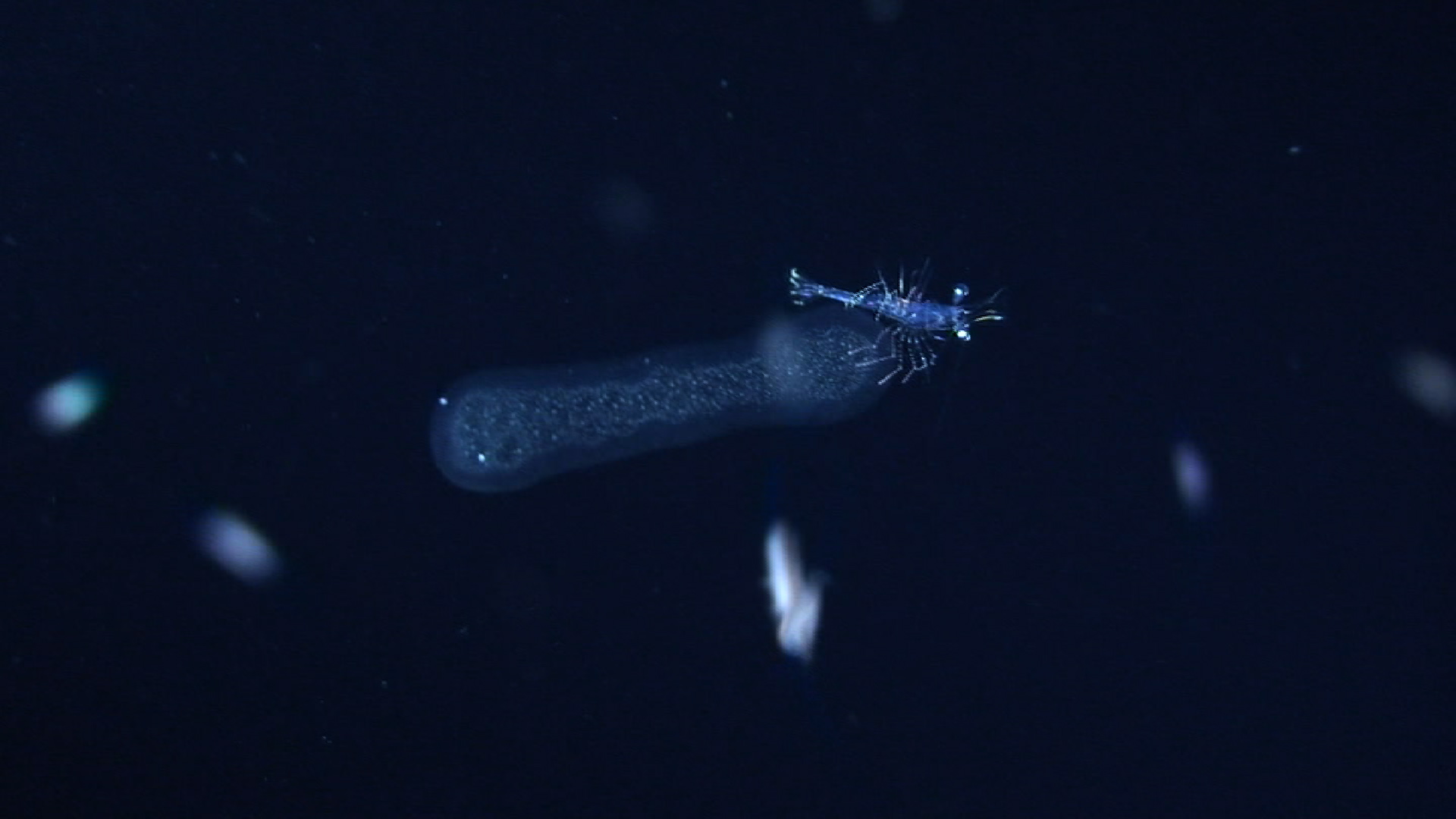
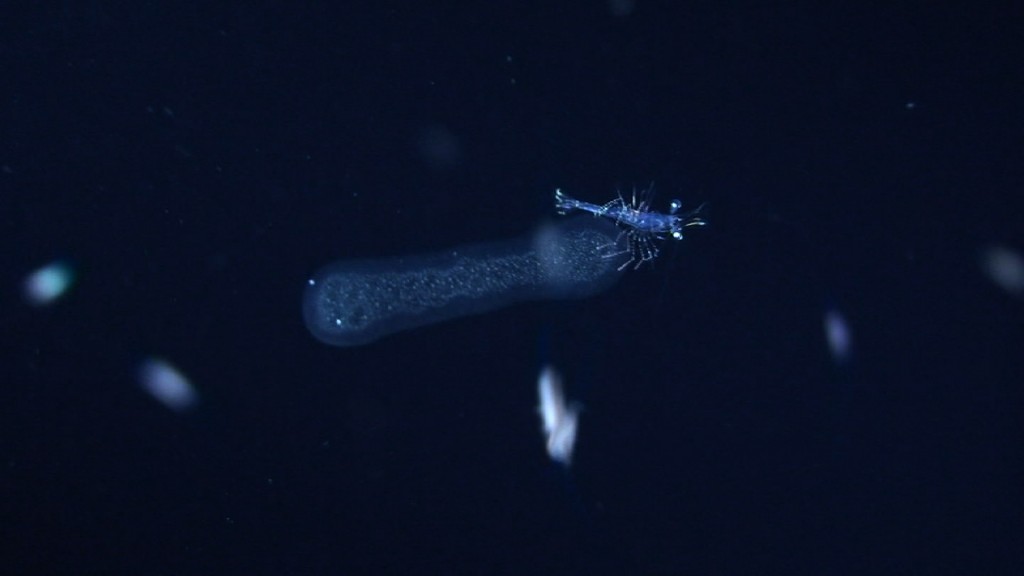
One of the last things I saw — and I saw more than one — I am still not certain of what it was nor do I have a picture to show you. It was shaped and sized like a peanut, or a little bigger. The inside was stippled with opaque dots, and the outside had a solid milky colored coating about a quarter inch thick — like a bacterial capsid writ large. Matthew suggested it was some sort of radiolarian or its egg mass or some combination thereof, but I haven’t been able to get any further figuring out what it was since I got back. If you think you know what the alien peanut pelagic creature was, write it on the back of a $20 bill and send it to Jennifer Frazer, P.O. Box 3000, Boulder CO, 80307. : ) Or even better, stick it in the comments below.

New! Now with picture of alien pelagic peanut creature (with shrimp hitchhiker):
As cool as all this was, air was beginning to run low. The women had left the water 5 -10 minutes ago and there were only two divers beside myself left. Matthew hadn’t given us a specific time to be out, but he had warned, “Don’t be the last out of the water.” Plus, I was starting to get a little queasy. My scopalamine patch had worked great the previous day in preventing seasickness, but I hadn’t gotten my new patch on until three hours before the new dive (eight hours is recommended). Since I was such a new diver and hesitant to trust my own buoyancy control in open ocean without reference points, I had clung to the line. But the line moved up and down with the boat, and that was starting to take its toll. I did my 3 minute safety stop and surfaced, but as I climbed aboard the boat I felt terribly seasick. I slowly pulled off all my gear and joined the women up front in the fresh breeze. Matthew offered me a cookie but I didn’t think that was a good idea.
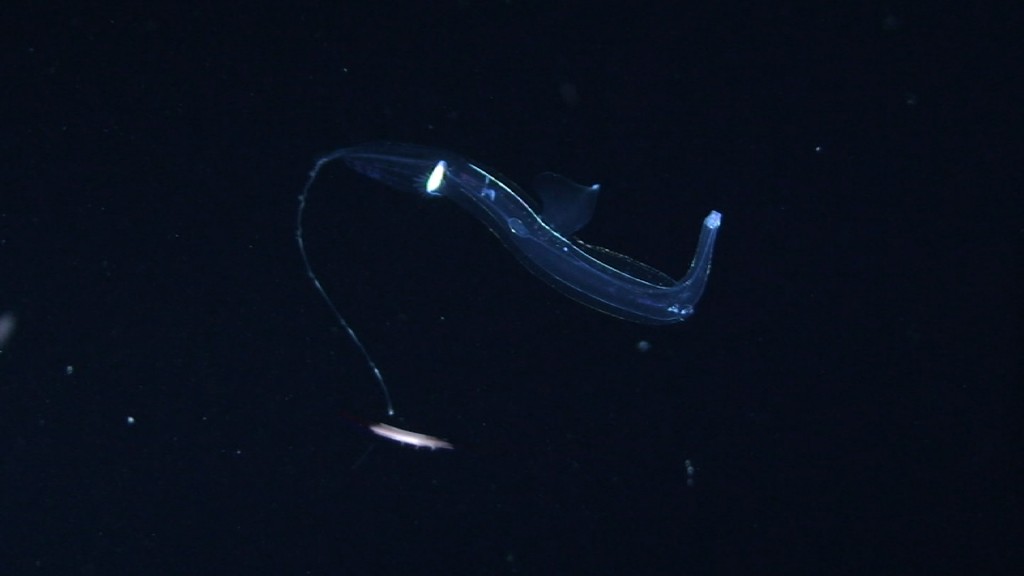
I listened to Matthew, who had greatly enjoyed the dive (It never gets old, he said) and who had spent some time watching a rare heteropod (see photos labeled heteropod here), a type of mollusk that has lost its shell and uses its foot to swim like a fin and its teeth to take large bites out of jellyfish and other floating pelagic creatures. It was fascinating, he said. Sadly, I missed it. But I now understand why the dive never gets old and why my dive master they day before had done the dive two dozen times — it’s addictive. It’s like a box of cracker jacks: there’s a prize inside and you never know what you’re going to get. Cookiecutter sharks, bizarre larvae of ocean fish, pelagic seahorses, sea butterflies, sea angels, paper nautiluses, venus’s girdles — who knows! Could be anything, and it could be something no one has ever seen before but YOU. That is, you don’t have to be an astronaut or even an oceanographer to explore a new frontier. You can take that giant leap for mankind right here on Earth in the waters off Hawaii. Who among us here, given the capability to dive, could resist that? And now that I’ve done it, I feel like a little kid after their much-feared but exhilarating first trip on a scary ride: “Again!”
{ 13 comments }

Sweet Island Living

by Jennifer Frazer on April 27, 2010

Still working on my dive post, but in the meantime, more life in Hawaii . . .

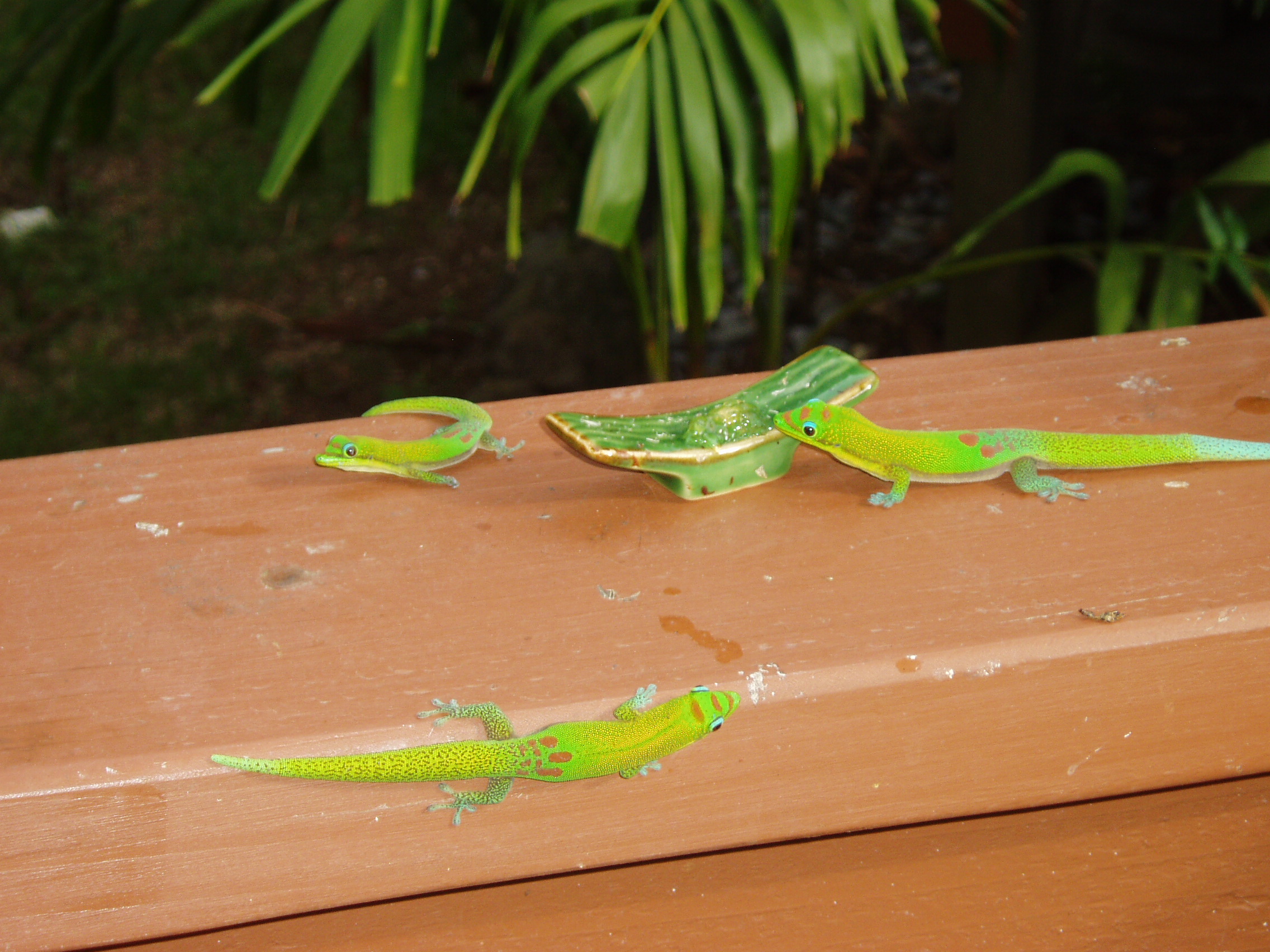
Guava jam = roxor. Gold day dust geckos on our B/B’s railing getting the morning dole.

Best buddies . . .  awww. Sea turtles conked out at Punalu’u Black Sand Beach. That glow above them is not camera error; it’s the sea getting sucked into the sand as a wave retreated.

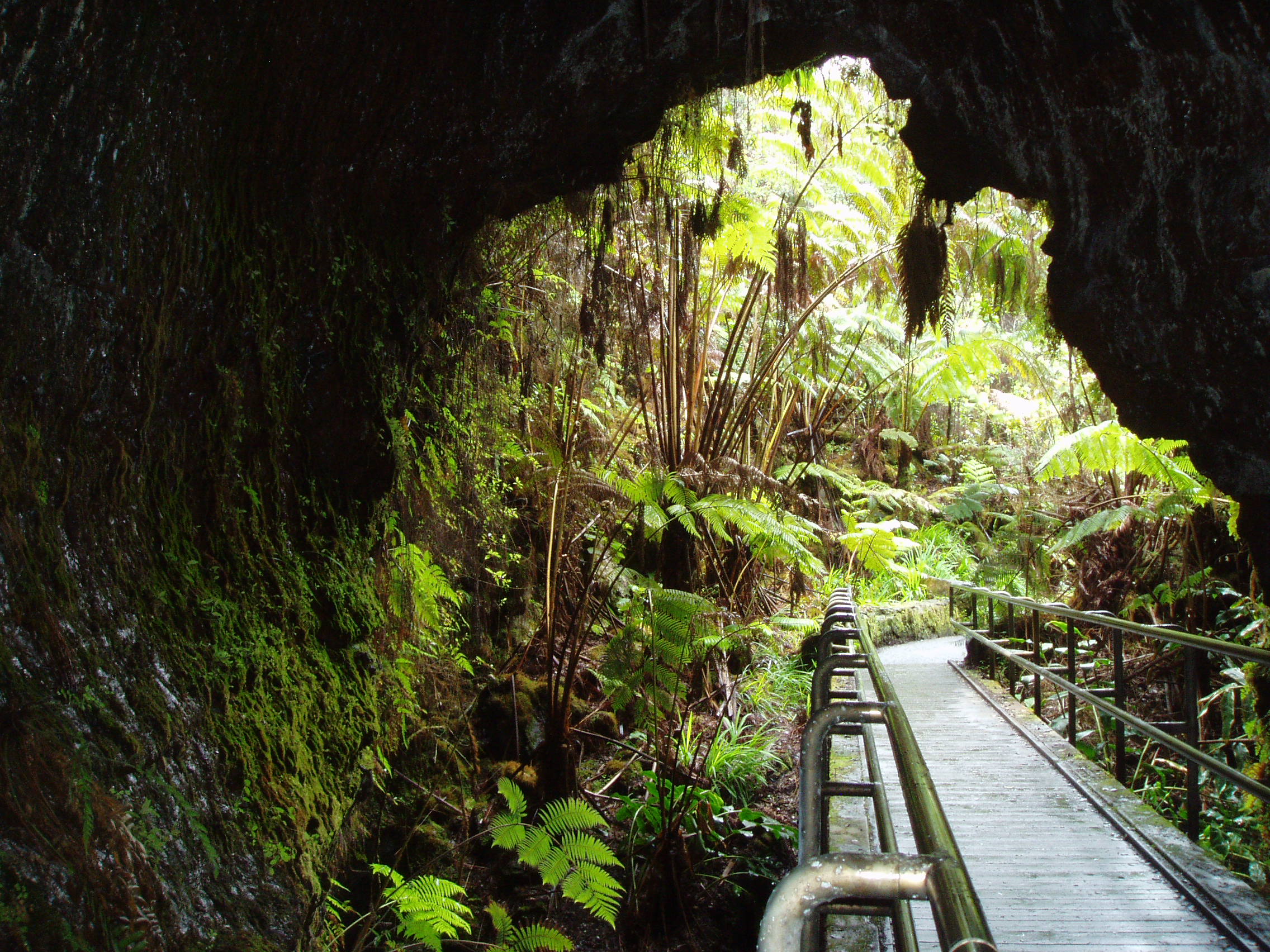
That moss is practically radioactive. Looking back through the entrance of the Thurston Lava Tube at Hawaii Volcanoes National Park.

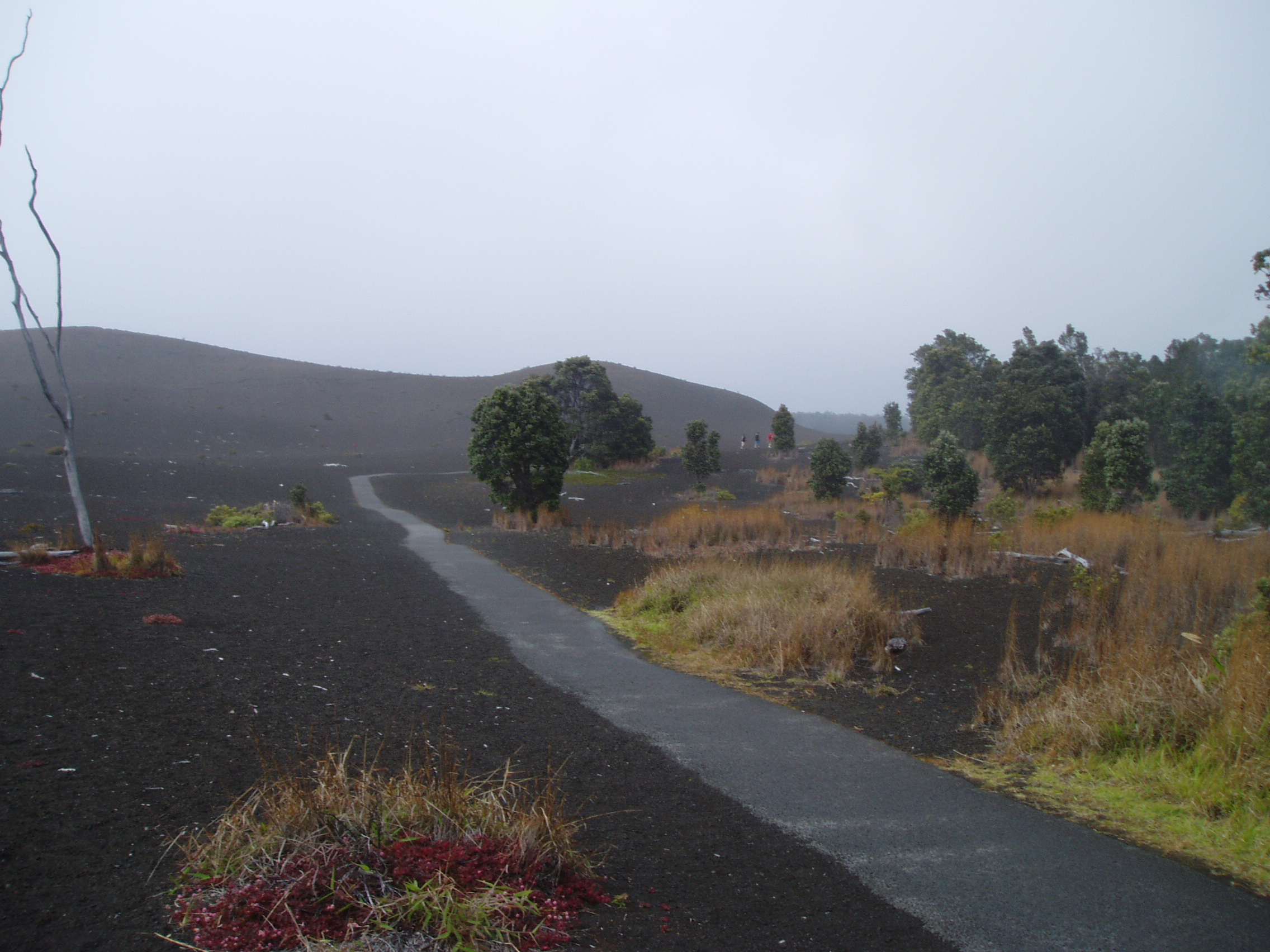
Life finds a way: The Devastation Trail at Volcanoes National Park. In 1959 the trade winds blew tephra from a lava fountain four times as high as the 500 foot crater it spouted from (that is, 1,500 feet higher than the horizon in this photo) onto a lush rain forest outside the crater, branding the fountain’s shadow into the ground. The forest is gradually taking its turf back. The crater (Kilauea Iki)  is on the other side of those hills. The gloom of this photo is from a passing storm.

{ 0 comments }

A Beautiful Hawaiian Nudibranch

by Jennifer Frazer on April 26, 2010

Errr. . . not what you may be thinking. Women do not walk topless on nudibranchs. : )

http://www.flickr.com/photos/ken-ichi/ / CC BY-NC-SA 2.0 I need the bathtub toy version of this, preferably with squeaker.

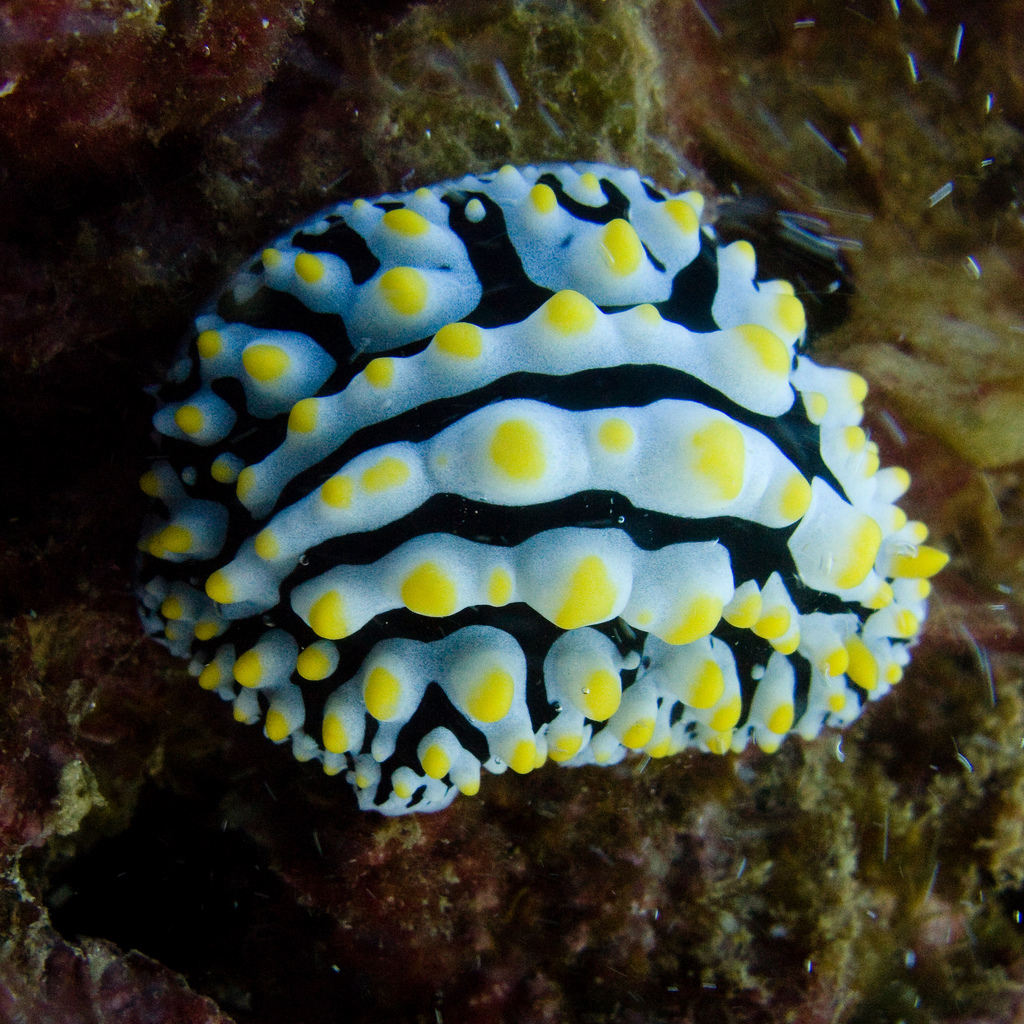
I’m back alive from Hawaii (yay!) and working on an account of what happened with my planned pelagic night dive (and whether I worked up the courage to do it! : ) ). In the meantime, enjoy this photo (not mine) of a species of nudibranch that I encountered on one of my dives. It goes by the somewhat undignified name of  the varricose phyllidia, or fried-egg phyllidia (Phyllidia varicosa).

Nudibranchs (an unholy bilingual union of the Latin for “nude” and Greek for “gills” pronounced “nu’-di-brank”) are naked mollusks sometimes called sea slugs, but so are a lot of unrelated things, so wikipedia gives the impression that that is now officially frowned upon. But why even bother calling them sea slugs when nudibranch is so much fun? These organisms are among the most beautiful and psychadelically colored invertebrates on earth. Because they lack shells, they’ve developed other methods for predator deterrence, including the acquisition of several nasty toxins, stinging cells, and tentacle gestures from other organisms. Like poison dart frogs and some poisonous species of snake, caterpillar, and butterfly, being poisonous seems to work best when you are brightly colored enough to help predators remember that they hated eating you (or rather, one of your less fortunate and swiftly regurgitated kin). Here’s how the gastropods, of which nudibranchs are a member, fit into the mollusks.

Other biodiversity highlights of my dives, hikes, and trip to the Hawaii Tropical Botanical Garden included (and none of these photos or video are mine but they amply serve here) several divided flatworms; a conch that pounced on a sea urchin; hard-working sargeant majors guarding their blue egg masses plastered on rocks from hordes of ne’er-do-well marauding fish (watching this free-for-all was one of the best arguments for pregnancy that I have ever seen); a night-hunting yellow-fringed moray eel that pounced and (as per usual, I understand) missed (divers in Hawaii seem perplexed at how moray eels manage to survive); many Hawaiian lichens including shrubby reindeer lichens and pixie cups sprouting from pixie cups near the Kilauea Iki crater; the stunning native ohia trees with their brilliant red-stamened lehua blossoms; some sort of lycopod (very exciting to see in Hawai’i!), gold dust day geckos aplenty; saffron finches; Cook pines; and an explosion of Heliconias, orchids, wild gingers, ti plants (whose leaves composed the famous “grass” skirts of Hawaiians), and “Beware of Falling Mangoes” signs at the botanic gardens. Considering acquisition of “Beware of Falling Mangoes” sign.

More soon!

{ 2 comments }

40 Feet Down and 7,000 Feet Up in the North Pacific

by Jennifer Frazer on April 16, 2010

Well kiddos, this is it. I leave shortly for a week in Hawaii, and alea iacta est. Thursday night is my chance to step off of a boat into the inky black ocean and whatever I may find there tethered 40 feet down, suspended over more than a mile of water. I don’t think I’ll really know if I really have the guts to do it until I’m standing there. What awaits: You will, of course, get a full report should I survive. : ) There are reports of curious (and a little more than curious, perhaps) oceanic whitetip sharks and marlins checking out the divers on this trip. I am trying to console myself with the numbers. If you believe them, my odds of death are significantly higher for any activity (including lighting a candle, putting on a hooded sweatshirt, or (especially) driving to the dive shop) *besides* the blackwater dive.

In the meantime, you should all go see the opening of (the appropriately themed) Oceans on Earth Day — April 22! As covered in this post, this is my favorite natural history documentary maker’s latest film, and it does not look likely to disappoint unless Disney gets too much of their way with it. To refresh your memory, here is the trailer of the French version: So there will be no new posts for over a week, I’m afraid. Expect me back, should all go according to plan and Kilauea doesn’t decide to pull an Eyjafjallajokull, sometime on April 25. Aloha!

{ 0 comments }

The Whiteworm Lichen

by Jennifer Frazer on April 14, 2010

. . . N ot to be confused with the Whitesnake Lichen (gotta love the hair — it definitely looks chitinous).

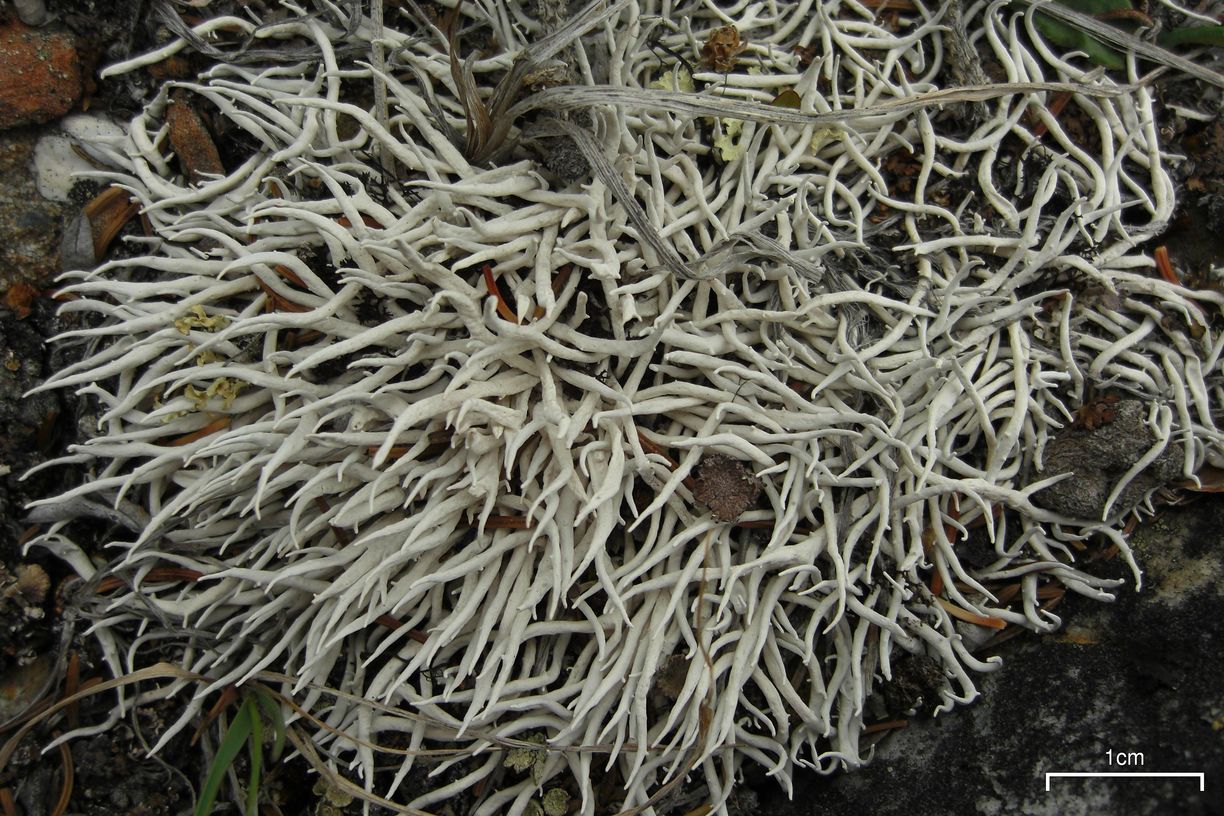
Snakes are not the only animal to have assumed a worm-like form without being standard-issue worms; indeed they are not even the only organism to do so. Here is a lichen, of all things, that seems to have decided it’d be cool to dress up as a Guinea Worm.

Image by Pellaea, Creative Commons Attribution License 2.0 Generic. Click image for link.

As you may recall, lichens are in that twilight zone between two organisms working together for the common good (like a grouper and a cleaner wrasse) and a single organism that was long ago two (like us and our mitochondria). The lichen is both fungus and alga — the exterior (i.e. crunchy coating) is usually fungus, and the inside is stuffed with a fluffy algal filling. As I’ve mentioned before, it’s not at all clear whether it’s a truly reciprocal relationship, or if the fungus is shamelessly exploiting the alga. I have my own view (I think it’s more the former), but I can’t really be sure that’s always the case and I’m not really an expert. As they say on Facebook. . . it’s complicated.

In any case . . . in North America, this little fruticose (shrubby) lichen, Thamnolia vermicularis (the only member of its genus), grows on tundra as far south as my neck of the woods (i.e. the Colorado Rockies) or on windy Pacific Northwest coasts near sea level. It has none of the reproductive equipment with which many lichens come standard: powdery tufts of soredia, fingery projections called isidia, or little cups made by the fungus half. For this lichen to reproduce, it must do so the old fashioned way: plain-vanilla fragmentation.

Here’s one way for that to happen:

When interior decorating, it's important to mix patterns and textures while keeping the color palate unified and predators stymied. Image by MeegsC, Creative Commons Attribution License 3.0 Generic. Click for link.

Because, as it turns out, the golden plover thinks the whiteworm lichen is <lilt>*fabulous*</lilt>!

This post inspired by a recent entry at Botany Photo of the Day.

Additional sources: The Lichen Bible, aka Brodo and the Sharnoffs’ Lichens of North America.

{ 0 comments }

Snakes that Became Worms and Discovered Yachting

by Jennifer Frazer on April 10, 2010


ResearchBlogging.org
Since evolution is an inherently aimless process, it often seems fickle and prone to “changing its mind”. Vertebrates came out of the oceans only to return as icthyosaurs, mosasaurs, whales, and seals. Birds took wing only to get grounded as ostriches and auks. And snakes, whose long-ago ancestor (who was also the common ancestor of all vertebrates, including us) was probably some sort of tiny, wormy, spinal-corded thing, returned to a vermicular lifestyle after a fish/amphbian/legged reptile interlude. But there is a class of snakes that went above and beyond the call in returning to worm form. These would be the blind or thread snakes, the scolecophidians. You might think of them as the fish bait snakes.

These snakes seem to have evolved to capitalize on the veritable all-you-can-eat buffet of ant and termite larvae in the soils of many desserts and steppes. Though they’re thin as earthworms and only a few inches long, that’s more than enough, evidently, to tackle the teeming hordes of these nests. It’s as if someone released the sandworms of Dune on the planet of Aliens, but they all took a swig out of the “Drink Me” bottle. And someone made the sandworms cute:

Another organism seemingly designed by the Japanese! As you can see, blind snakes are not truly blind. They have two eye spots they can use to get an idea of where the big yellow hot thing is, roughly speaking.

And can these guys ever burrow. Leptotyphlops humilis, the western blind snake that inhabits my little corner of the world, has been found cruising around as deep as 66 feet underground. These organisms have several interesting strategies for gettin’ ‘er done, including a thick skull (! — this thing has a skull?) selected for burrowing and a spined tail they can use to gain leverage in their ant and termite colony-pillaging operations.  When they find their prey, the suck out the hemolymphy, creamy centers and leave the exoskeletons or shells behind.

Scientists recently discovered and reported in Biology Letters that a particular subgroup — the blind snakes — somehow made it to from Africa to South America tens of millions of years after the splitting of the two continents and *without* using any frequent flier miles. Wha?

To figure this out, the scientists used the sequences of five genes to compare the differences and thus gauge relatedness between blind and thread snakes. They they used a molecular clock (an occasionally dodgy timepiece that gauges time based on number of accumulated mutations in coding genes) to estimate the time since different blind snake species shared a last common ancestor.

Some diversification was due (unsurprisingly) to continental drift: the ancestors of the threadsnakes were marooned on West Gondwana and the blindsnakes on East Gondwana and diversified accordingly. There seem to have been further splits in the blind snake lineage when India separated from Madagascar.

But their data yielded the further surprising result that the blindsnakes must have dispersed across oceans on at least three occasions: 28 million years ago from southeast Asia to Australia, 33 million years ago from South America to the West Indies, and 63 million years ago — incredibly — across the Atlantic Ocean, some 40 million years after Africa began to split from South America (ca. 100 million years ago). OK, now getting from Southeast Asia to Australia doesn’t seem so bad, and maybe one can see how they could manage the South America to Caribbean trip. But Africa to South America? Now it’s true that 63 mya sea levels were lower then and the Africa and South America much closer together. But the scientists still estimate the trip by blindsnake would still have taken as much as six months. Six months!

K. So it’s a blind snake. It has no legs, wings, fins, or reasonably functional eyes. How the heck did it accomplish what it takes humans with, at the very least, a row boat, a GPS device, half a million calories freeze-dried food, and several months of blog-documented travel to accomplish? Well, if you’re small, don’t really need to eat much or row, have packed along your food supply, and you have millions of years for just one blind snake ark to finally reach the promised land, odds are it will happen.

Scientists refer to the actual vehicles of dispersal as “rafts”. You might think of them more like floating terrariums, but what exactly were they? Were they pieces of soil and moss that happened to float? A rotting, termite-infested but still mighty tree? A Princess Cruise Ship? The ever popular African Swallow/coconut combo? Who knows. One way or another, the S.S. Scolecophidea made the Atlantic crossing.

Take home message from scientists: Even species that are total landlubbers (even landdwellers) can fire up a sea chanty when the right cruise opportunity presents itself.

Vidal, N., Marin, J., Morini, M., Donnellan, S., Branch, W., Thomas, R., Vences, M., Wynn, A., Cruaud, C., & Blair Hedges, S. (2010). Blindsnake evolutionary tree reveals long history on Gondwana Biology Letters DOI: 10.1098/rsbl.2010.0220

{ 4 comments }

Metamorphosis Complete

by Jennifer Frazer on April 8, 2010

We made it! The blog is now up and running at my new host server and it should be fully operational. I believe subscribers to the old feed should not have to change anything, but I will find out for sure in a few minutes when I post this (I’ll update it to let you know the results).

UPDATE: The feed still works!

In the meantime, I’m working out the kinks and updating links. And I’ve signed up to speak at Ignite Boulder on May 6 — a series of blitz talks lasting 5 minutes each and involving 20 powerpoint slides that auto-advance every 15 seconds. So far I’m not doing very well in the voting : (, but if you live in the greater Front Range and would like to see me give a five-minute well-illustrated talk titled, “Colorado Mushrooms You Should Not Eat Under Any Circumstances”, go here, register, and vote.

Final reminders: If you link to this site, link to theartfulamoeba.com. If you’ve linked to a specific post, change the root of the link to theartfulamoeba.com. If for some reason the feed breaks, don’t panic, just hit the little orange button in the upper right corner of the screen. And if you don’t know what a feed is, get an account at google.com/reader/, hit the button in the upper right corner of my blog or search for my blog at Google Reader, and find out the joy of getting *notified* every time your favorite blogs update rather than having to visit them individually.

I should have the blog back to full strength this weekend. Be back soon!

{ 0 comments }