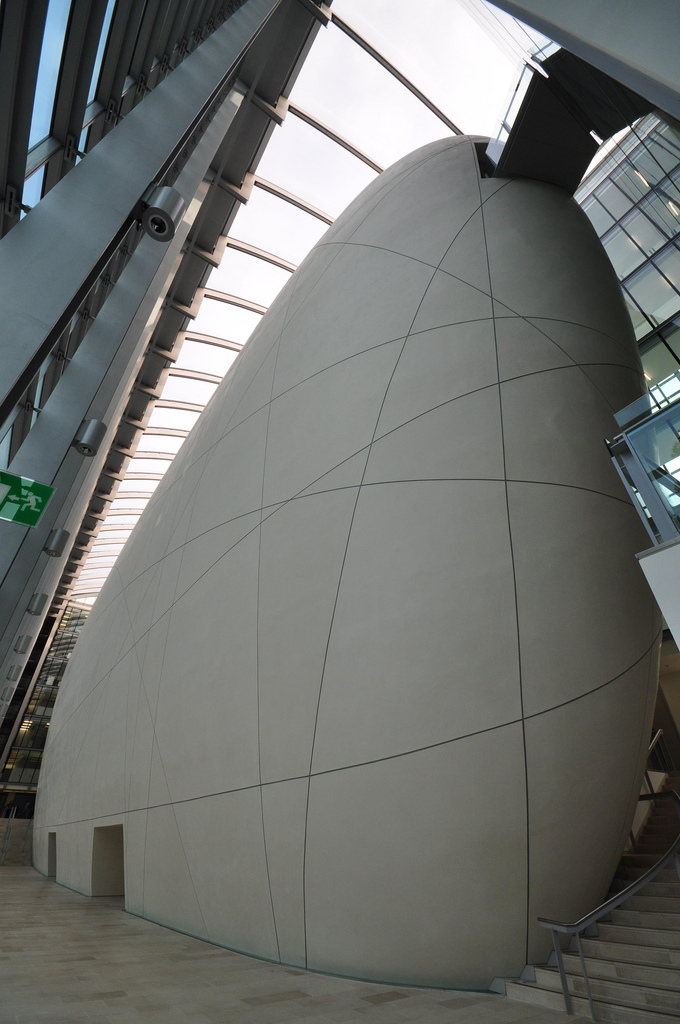
Review: The Natural History Cocoon

by Jennifer Frazer on June 6, 2010

The Cocoon. Creative Commons raindog

Note: Clarification appended

It’s not fair to review an entity one has not experienced oneself. But since the new Darwin Centre of London’s formidable Natural History Museum is in, well, London, and I am demonstrably not, nor easily got there short of a $1000 plane ticket (and I don’t expect the NHM’s going to comp me, especially after this review), I am reduced to reviewing by proxy: through the New York Times review, and my impressions thereof.

If you are not familiar with the newly opened Cocoon at the Darwin Centre, take a mosey on over to the NYT and so so here. Or check out the Darwin Centre’s web site here. In short, the Darwin Centre is the Natural History Museum’s attempt to put the museum and what it does on display in a thoroughly modern way*. Out with Victoriana, in with touch screeniana.

My chief complaint about the Darwin Centre, and its cousins like this exhibit on biodiversity at the Exploratorium in San Francisco, is that they continue the trend of ascepticizing natural history and self-gratifyingly focusing on scientists rather than the real show — the ORGANISMS.

As the New York Times says,

The research facilities and scientists are part of the exhibition; they are glimpsed through windows, framed by explanations. They even become the subject of the show. The Cocoon’s displays are not really about botany and bugs; they are about the collection and study of botany and bugs. The exhibition is really about the museum itself — its methods and materials, its passions and enterprise. I don’t know of another science museum that does this. Along the way, of course, you learn about the natural world, but the real focus is on how that world is studied, and how the museum pursues that goal.

I don’t want to paint the good folk at the NHM in a negative light. I’m sure the designers of this exhibit spent countless hours thinking it through and poring over what way they could best reach the public. They want to teach evolution, the scientific method, and how modern taxonomy works; they want to bring science to life by showing scientists in action. They were given a goal and a budget, and they did their best. I just don’t agree with the goal.

Or rather, that putting this information on display is as important or as interesting and appealing to the public as some other goals. Would you rather go to this exhibit with your child, or one about slime molds or diatoms?  In short, what bothers me most about this exhibit, and the one in San Francisco, is what they seem to say about where biological natural history education is headed. All the effort they put into this exhibit could have been put into making the world’s first Hall of Protists, or Plant Evolution Gallery, or a Bacteria and Archaea Family Album. Instead, we get swipe cards, video guides, sorting games, and generalities — and a rather narrow view of nature. Butterflies, insects, and flowers are great, but what about all the other stuff?

Personally, I find the products much more fascinating than the process. There should be a place to showcase all of them too, and not just the ones with backbones, shells, or exoskeletons. Because learning about the products, while inherently fascinating, almost always leads to questions about the process. After all, Darwin himself started there. He spent five years looking at products while aboard the Beagle.

When I write hear about yeast and their “lifestyles”, or about diatoms, or about pine pollen, or slime molds, or the sex lives of red algae, or about alien pelagic peanut creatures, I’m only scratching the tiniest surface of all the fantastic forms, creatures, structures, and lifestyles that I learned in school. And believe me when I say that *I* only scratched the surface of what’s out there. There is so much more: the fantastically beautiful filaments called slime mold elaters, for example. Hornworts. Nematode-trapping fungi. Where baby ferns come from (not adult ferns). Anglerfish and sea angels. Ping pong tree sponges. Archaea. Radiolarians. Camel spiders. Slime nets. A blizzard of protists and algae and all their mind boggling forms. These things are this blog’s raison d’etre: I want to show and tell you about them not only because I can barely contain my own excitement, but because almost no one else is, at least not in a way the general public can understand.

But I can tell you who should be: natural history museums. A few are trying. I’m particularly fond of the new Sant Ocean Hall at the Smithsonian, which I reviewed here last fall, and which makes an admirable attempt to convey biodiversity through pictures, specimens, and an armada of world-class fossils. I also quite like the evolution and fossils exhibit called “Prehistoric Journey” here in Colorado at the Denver Museum of Nature and Science. My memory is hazy, but I did visit the Hall of Biodiversity at the American Museum of Natural History in New York when it was new about 10 years ago, and I seem to recall it falls somewhere between the two extremes. And, I should note, the Natural History Museum in London itself has just begun what looks to be a fascinating new exhibit (again, I have no plane ticket) on Deep Sea Biodiversity.

I am also a *huge* fan of zoos, aquariums, and botanic gardens because they do such a good job of spotlighting the organisms, but often their signage falls short: it’s vague, confusing, overly technical, overly simplistic, or boring. It doesn’t help you make connections between organisms to understand common structures, interesting adaptations, the general features of a given group, relatedness — or evolution. And lets face it: fungi, protists, bacteria, archaea, microbes, algae, lichens and kin always get the shaft. There is no where you can go to see and learn about them and their forms and variety. But there should be, and as it stands, the natural history museums are the best existing place.

But they too struggle for funding, so it frustrates me that they now seem to be prioritizing and funneling what they do have toward this new once-removed tack toward natural history. Biodiversity and natural history as monolithic concept and scientific endeavor: scattershot, sterile, and boring. Only the choir will find that engaging. The cocoon, at least it seems to me, peering into it from 5,000 miles hence, insulates people from the real stars of the show — messy, wild, weird, surprising, and natural. If we truly hope to convince the world that saving these organisms from climate change and resource depletion is important (and it is, not just for their sake, but for our sake: preserving wildlife keeps the climate stable for agriculture and our water clean for drinking), we should shove the organisms themselves out on stage. All you have to do is take a closer look at them, and with suitably skilled and creative interpreters you’ll find, I think, they sell themselves.

* The Centre was also created to specifically house the botany and entomology collections, not any other groups. I apologize for the omission, but I didn’t realize this was the case until an alert reader pointed it out.

{ 6 comments }
3QD Opens Voting and a Cameo at SEED

by Jennifer Frazer on June 3, 2010

3 Quarks Daily’s Science Blogging Contest has opened the voting and I’ve got two posts in the running. You can see the nominees and vote here.

And I was surprised and honored yesterday to discover Dave Munger of researchblogging.org mentioned my Killer Yeast post in his weekly research blogging roundup at SEED magazine. Cool!

{ 6 comments }

Pine Pollen Power

by Jennifer Frazer on June 1, 2010

Today at a Memorial Day cookout I noticed our local pines are shedding pollen. You may be familiar with this phenomenon from the thick yellow coating that turns up this time of year on rain puddles, picnic tables, and, most notably, your freshly washed car. Whence this bounty? Have  a look pines’ remarkable pollen-producing powers:

Believe it or not, each pine pollen grain is actually an entire plant — the male gametophyte. Plants employ a system called “alternation of generations“, to which I’ve alluded before. The idea is that a diploid generation, or one with two copies of every chromosome, alternates with a haploid generation, or one that possesses but one. In some ancestral (aka primitive, aka less-derived) plants, both gametophytes and sporophytes (the diploid generation; in the case of pines — the tree) get big and live as a separate plants that look nothing like each other. Ferns are a good example of this; the gametophytes are tiny green sheets of cells hiding under leaf litter that you would never recognize as ferns.

In pines, the male gametophytes are the pollen, which come from their own separate male cones. Thus each pollen grain is actually an entire plant, and each little haploid plant is only two cells big: a tube cell, which will make the germ tube that seeks out the female gametophyte in the pine cone, and the generative cell, which will make the sperm. If you have pine pollen allergies here is what one of these little yellow misery-making plants looks like up close. Yes, that’s right: like Mickey Mouse. The “ears” are technically called the wings, and they help the wind-blown pollen grains sail about to find a female cone — or faux finish your car.

You can find the pines on the Tree of Life here.

{ 1 comment }

3 Quarks Daily Science Blogging Contest Opens Again

by Jennifer Frazer on May 29, 2010

Just a note that 3 Quarks Daily’s annual science blog post contest is open for nominations. I submitted “The Seafaring Killer Bacterium” from earlier this year, but you can nominate whoever and whatever you like, if you like, which the 3QD folk would like you to do. So if there’s another science blogger out there who’s written a blog post you like, consider submitting it. Each person can nominate only one blog post, and at this point, more than one nomination for a given post doesn’t help. The public voting (which will count for choosing the 20 finalists) will open next week and I’ll let you know when the time comes.

Final judging this year will be by Richard “Selfish Gene/God Delusion” Dawkins.

{ 2 comments }

Pelagic Glamour Shots

by Jennifer Frazer on May 29, 2010

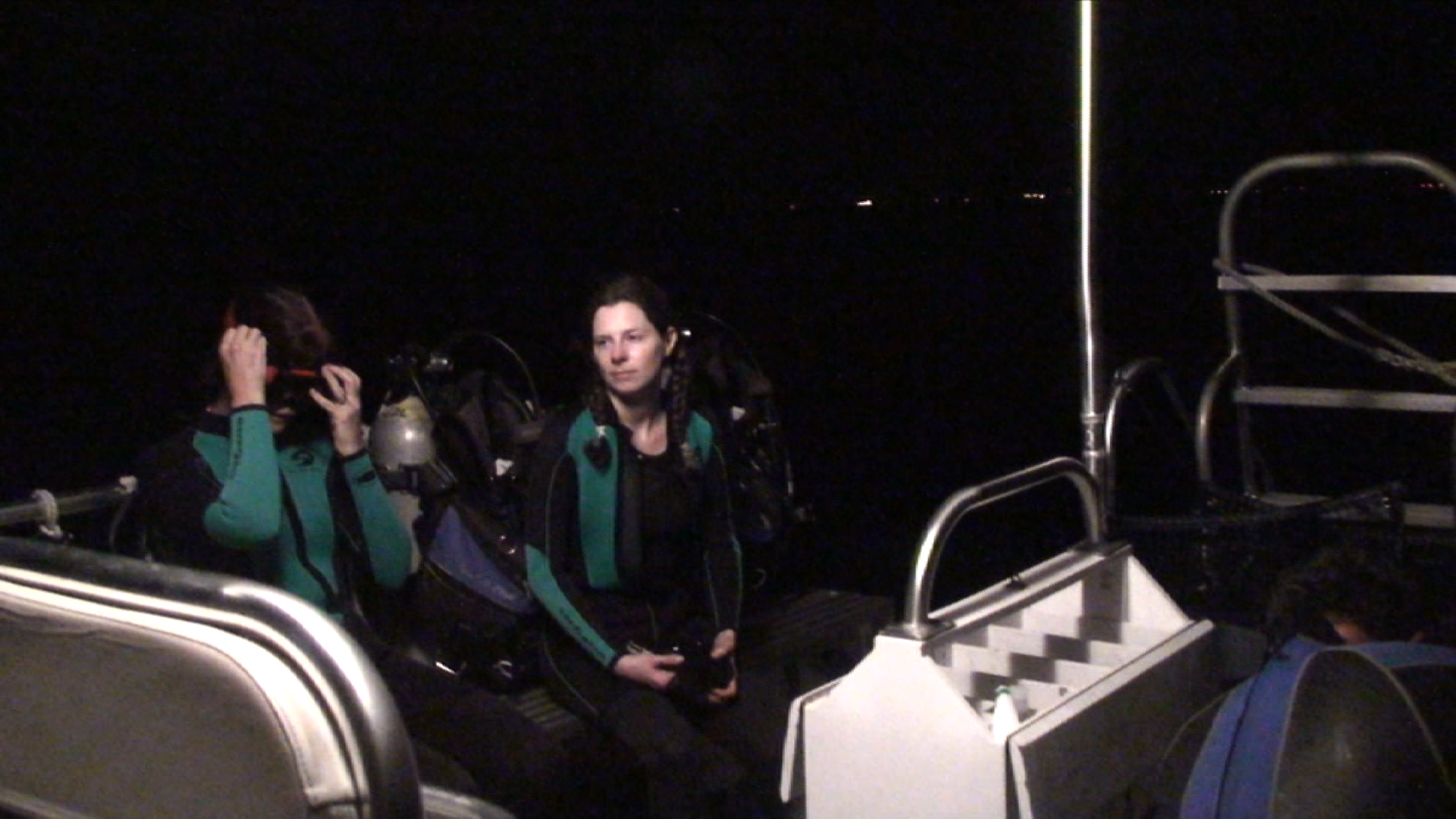
Good news, everybody! I just got some still images of my open water night dive in Hawaii. Finally . . . photographic proof I was sitting in the dive boat. You’ll still have to trust me that I actually jumped in.

What mystery of the deep or meditation on life was I pondering so seriously before the dive? Even I can't remember. This photo is kind of growing on me. It reminds me of a Rembrandt. We can call it "The Night Dive". Photo by Jeff Leicher

Don’t I look serious? You’d think I was about to dive at night into 4,000 feet of shark-infested* waters. Actually, I have no idea what I was thinking at that moment, other than probably trying to quiet my mind and prepare myself mentally. As you can see, the lights of Kona are not far behind us, and quite comforting. As recounted in Wonderful Pelagic Things, which I’ve updated with some of these photos to reflect what I saw, dive in I did. Here is some of what we saw (all photos are by Jeff Leicher and/or the crew at Jack’s Diving Locker):

I’m not really sure what this was, although it does look squid-like. I don’t recall seeing this one personally. These photos are a bit deceptive in that in order to capture the animals on film, the camera underexposes the background. In real life, our lights lit the water a vivid blue, not black as it seems here.

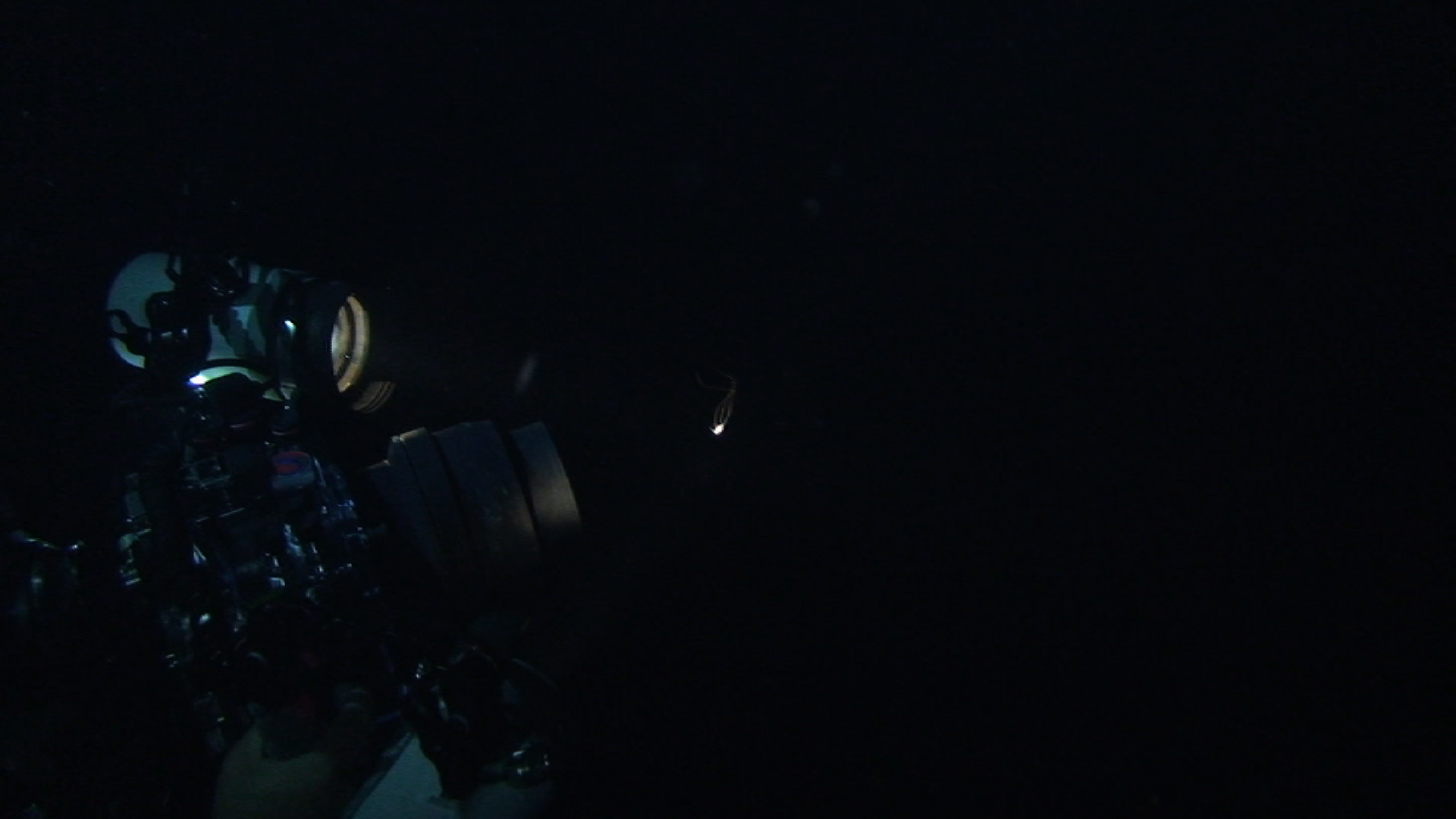
Here’s one of the pros with their big expensive camera. This photo helps give you the feel for the sort of equipment needed to film in these conditions, and most definitely not affordable by me.  It should also help give you an idea for the size of most of these creatures relative to us.

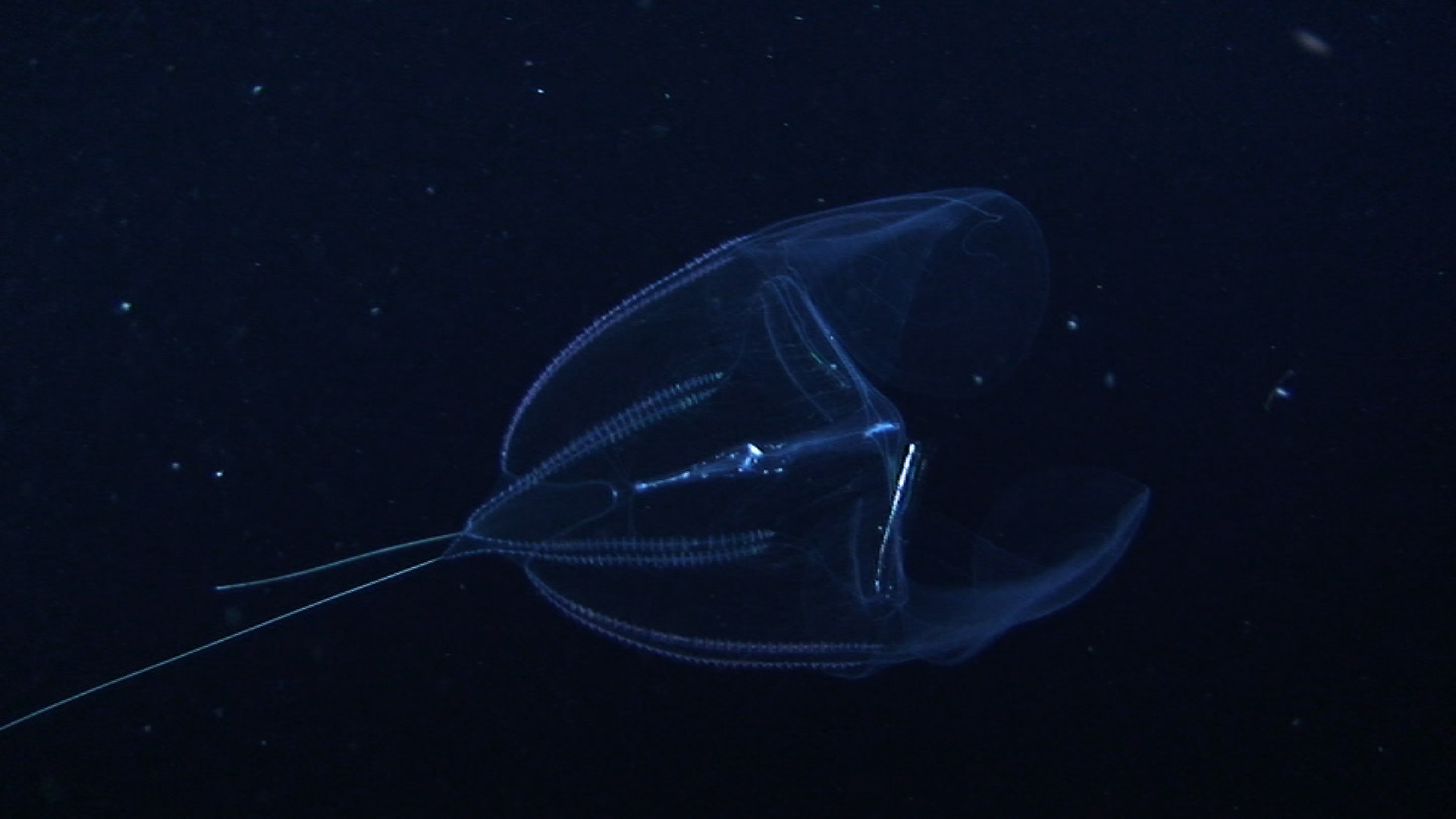
Here is one of the ctenophores, or comb jellies, that we encountered. You may recall from my post that just as I started looking at one, it sucked up a tiny pink plankton for dinner. This may or may not be the one — I can’t tell if that thing in its gullet is it, but in my recollection, it was definitely bright pink.

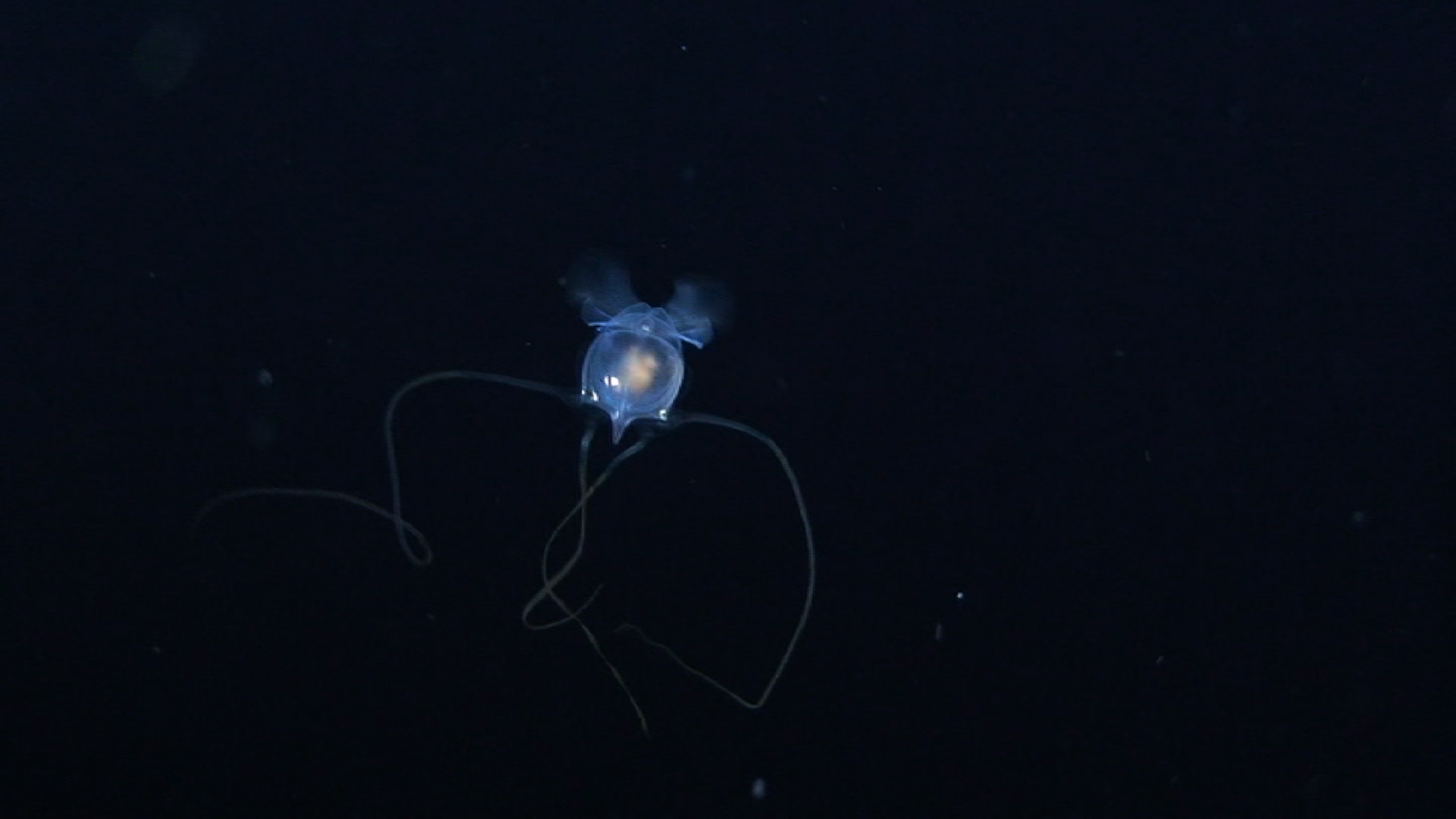
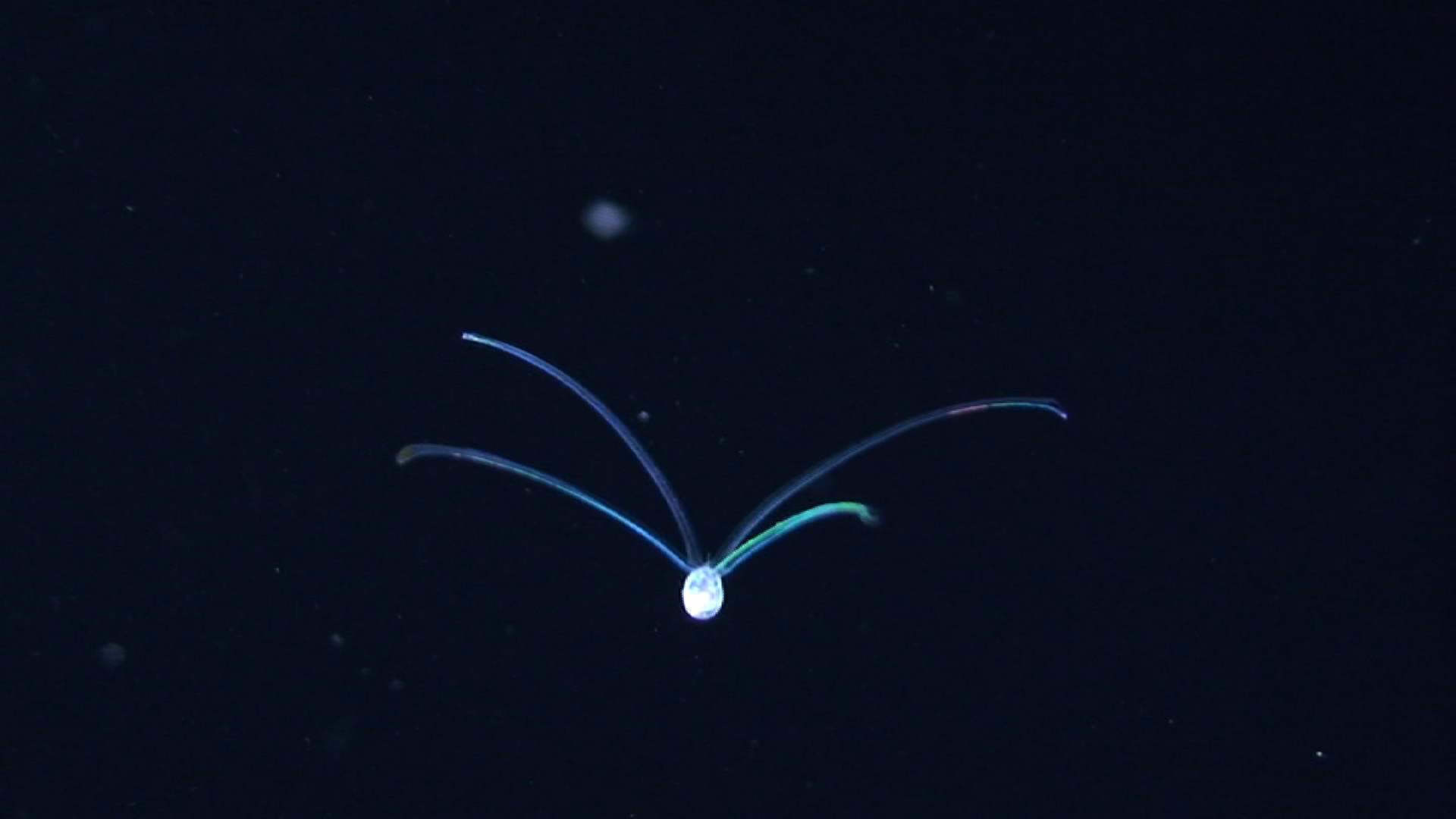
No idea what this is, and I wasn’t fortunate enough to see it personally. Jeff has labeled it as a “quadropus”, presumably the four-tentacled cousin of an octopus, but according to wikipedia, that is a fantasy creature. Any marine biologists out there have any ideas?

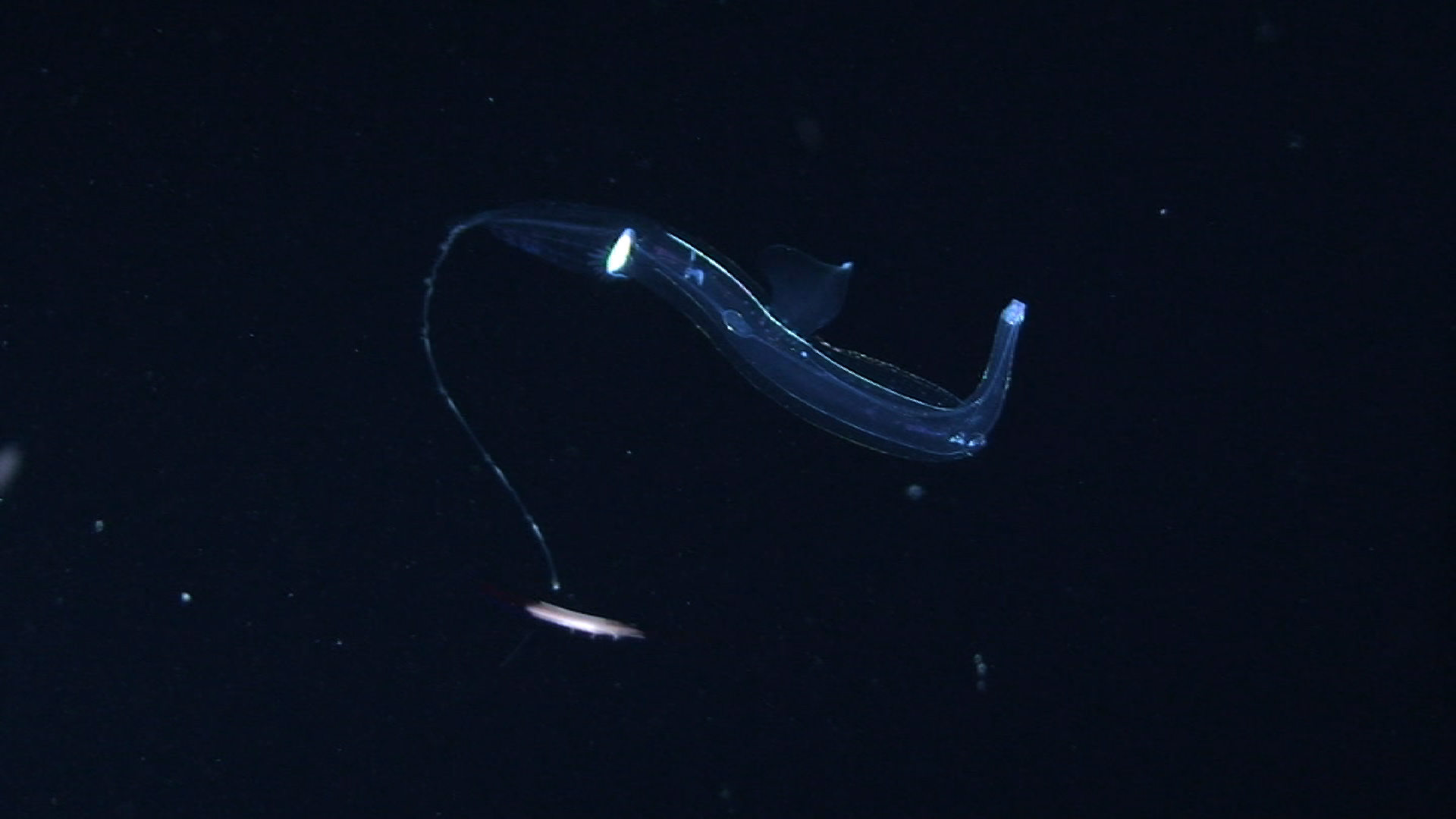
This is the fantastic heteropod I missed, with what looks like a small squid or fish in the distance at the tip of its tail. These guys are phenomenally cool ex-mollusks (and I mean that in the same sense as ex-Marines) that have forsaken their snail shells to swim naked and free in the ocean like vicious little hippies. They look for the other pelagic creatures from which to take bites using their saw-like radulas at the tip of a Futurama-esque eye-stalk (but is not — the eyes are at its base). The larval forms still possess coiled mollusk shells, but they lose them when they become adults. They also possess a single “dorsal fin” — which is actually totally inaccurate because it is really ventral (stomach side — they swim “upside-down”) and was originally the mollusc’s foot —  which they undulate and paddle about with. For some reason, when moving, they remind me of Sir Hiss tooling about  in that ridiculous balloon at the tournament in the 1973 Disney “Robin Hood” (see 2:15 here). Some species possess a sucker on their “fin” which the heteropod no doubt uses to hold its prey still while it savages it alive.

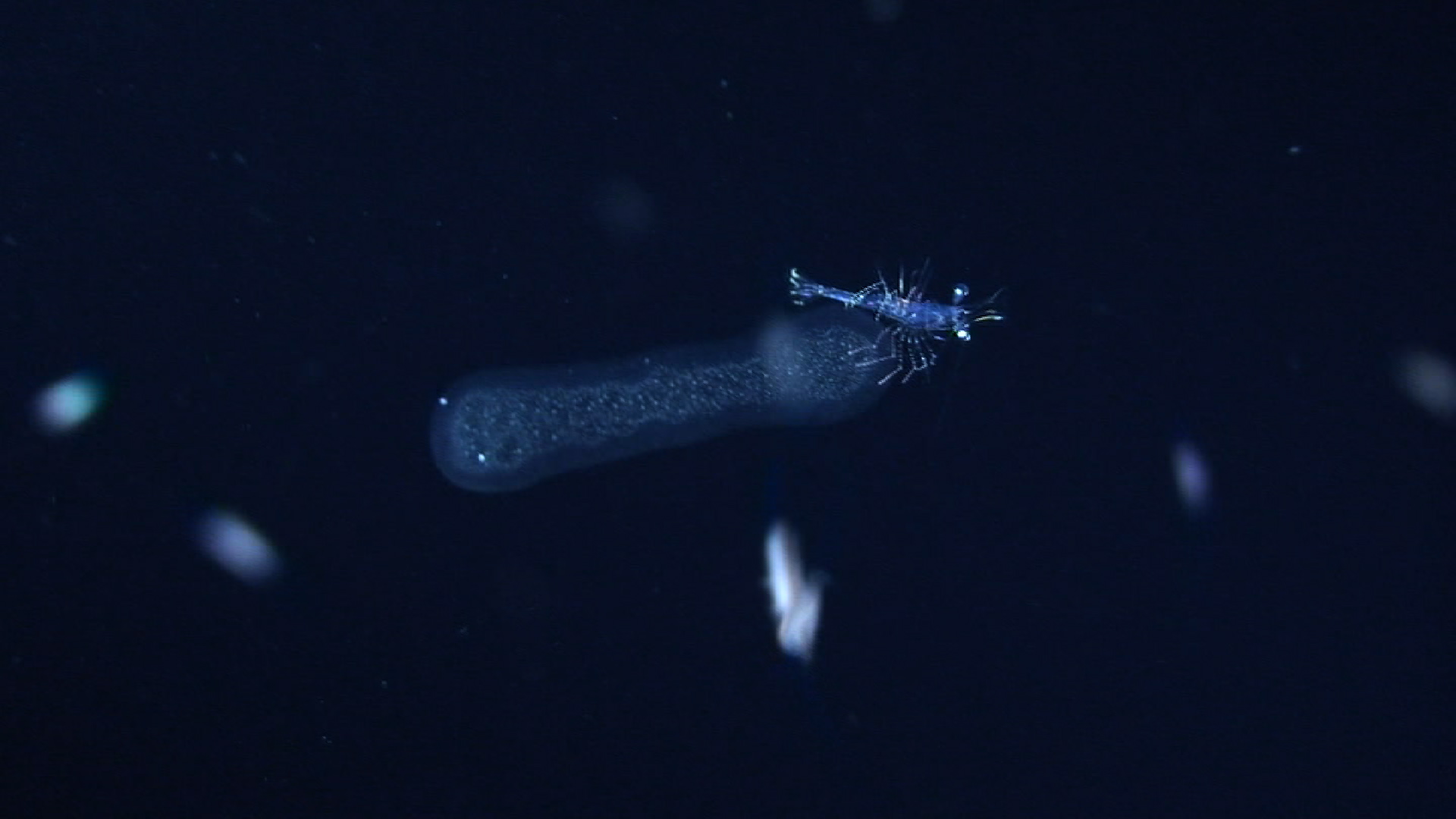
And finally, we have the “alien pelagic peanut creature” whose identity I still have not confirmed (Egg mass? Gummy snack?) with a little shrimp hitching a ride. Still have no idea what the heck these are, but they sure look cool.  Any ideas, readers?

—————————————————————————————————

*”shark-infested” intended humorously only. I love sharks as I love all ocean life — just as long as they’re not actively gnawing on/envenomating/ovipositing into me.

{ 0 comments }

Last Call for Mushrooms

by Jennifer Frazer on May 27, 2010

The delectable (and spiky -- Look Ma! No gills!) Hydnum repandum, or Hedgehog Mushroom.

There are only two or three spots remaining in the “Mushrooms of the Front Range” class I will be teaching in August for the Boulder County Nature Association. If you are interested, email me! Details here. Also, if you cannot make the class and are local, I will be giving a humorous (hopefully) 15-minute lecture on poisonous mushrooms called “Avoiding Death by Mushroom Myth” June 26 at the Colorado Skepticamp in the Duane Physics Building at CU. The focus will be more on the mushrooms than the myths. The bulk will be the short lecture I would have given at Ignite Boulder (“Colorado Mushrooms You Should Not Eat Under Any Circumstance”), should I have been picked. Time TBA.

{ 2 comments }

Killer Yeast from South America(?)

by Jennifer Frazer on May 23, 2010

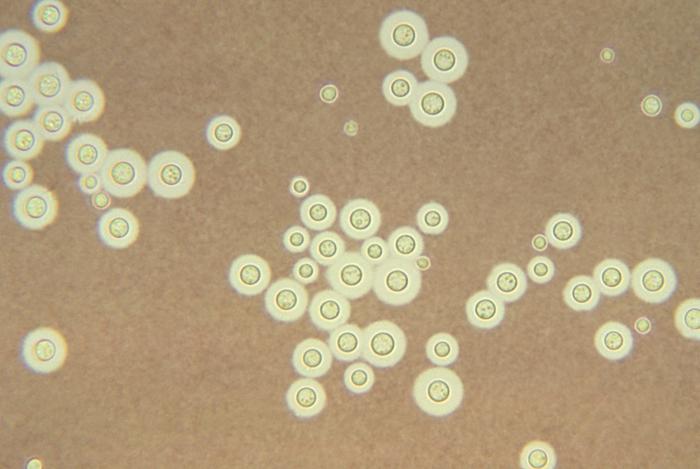
The thick yeasty capsids (coats) of Cryptococcus gattii relative C. neoformans. C. gattii also has a thick capsid. CDC/Dr. Leanor Haley

It’s not every day you read about suggestions for potential health-related travel advisories to U.S. states. But such is the case for the Pacific Northwest, where an emerging fungal infection has — very unusually for fungi — begun felling otherwise healthy people. A growing number of cases of the potentially fatal disease cryptococcosis have been diagnosed in people who merely traveled to Washington, Oregon, or British Columbia.

There are several very scary things about this fungus, but foremost among them is that it a) was introduced somehow from the tropics, most likely South America/Brazil or also possibly Africa and is somehow not finding it a problem to survive in Canada; b) is actively spreading up and down the Pacific Northwest coast; c)hangs out in the environment, where it can get along apparently fine without us (and seems to particularly like the bark of and soil around trees like Eucalyptus); d) is acquired from the environment, that is, you don’t have to have contacted with an infected person or animal; e) doesn’t manifest itself symptomatically for 2-12 months after one picks it up and e) can kill otherwise healthy people.

So let’s review. This means that you can just be hiking along in the woods, minding your own business, and a few months later you’re dead. Now I’m not saying this is *common*. Only 200 people have been seriously affected in 10 years. And let’s face it, there are a lot of other things that can kill you while hiking along minding your own business, much, much quicker and more commonly than these fungi: bears, mountain lions, lightning, exposure, rockfalls, your own stupidity, deranged axe murderers, errant militias, etc. But the very fact that, like anthrax, you can pick it up for no apparent reason from the environment, and much more easily, is disturbing. (Histoplasmosis is also picked up by inhalation but it is well known you must spend time around bird or bat droppings. Aside: can you think of any other diseases that are picked up just by inhalation from the wild?)

This particular organism is Cryptococcus gattii, a relative of the Cryptoccoccus neoformans that gained some fame in infecting AIDS patients when the immune disease emerged in the ’80s. Cryptococcosis begins as a lung infection, but can progress to meningitis. C. gattii, a cousin of C. neoformans, first emerged on Vancouver Island in 1999, but in the last few years, two new strains have emerged that seem to be killing otherwise healthy people in numbers much higher than earlier strains.

There are anti-fungal drugs that can help show C. gattii the door, but the wikipedia article for C. gattii contains this ominous sentence:

Antifungals alone are often insufficient to cure C. gattii infections, and surgery to resect infected lung (lobectomy) or brain is often required.

Resectioning *brain*??! Oh hell no.

Fortunately, infection with this organism remains relatively rare, but that’s no guarantee of safety. Why? This fungus is having sex. And that is one possible origin of the two newly virulent strains that have emerged in the Pacific Northwest — and possibly the source of future, more dangerous strains. It is also possible that the two new strains were newly introduced from their tropical diversity centers. But the scientists *know* there’s a lot of C. gattii hanky-panky going on. They looked at a couple dozen genetic markers in this recent PLoS study, and compared which isolates had which markers and how they were organized in the genome. They also tried to reconstruct the evolutionary and geographic relationships between various North American isolates using these data. They found huge genetic diversity among their isolates, and that at least one north American strain came from Australia. They also that the fungus is bumping up its numbers by quick and easy asexual reproduction.

But the initial creation of the new hyper-virulent types, they concluded, was likely due to sex. Only sexual reproduction provides the opportunity for lots of large-scale genome reorganization; that’s one of sex’s main advantages. When two entire genomes get together, a process called “crossing over” takes place that allows all the various chromosomes to swap corresponding bits. The result is sometimes good, sometimes bad, but whatever the outcome, generation of diversity and evolution often happen a heck of a lot faster per generation with sex than without.

Lest you think that’s the only worrying bit, it turns out that this fungus has a rather kinky sex life. Not only is it having sex with all the other mating types (fungi often have many “genders”, which for convenience scientists refer to as “mating types”), it can also, somewhat unusually for fungi, have sex (and I mean produce viable offspring) with its own type, a process called unisexual mating. Sheesh.

So that’s what was chiefly covered in the news reports. But it turns out there’s more to this story. Because this fungus is actually a yeast — an infectious yeast. Now I know what you may be thinking: yeast are the source of everything good and worthy on Earth: fresh, crusty, heavenly leavened bread, wine, beer, soy sauce, etc. And you’re right. But that doesn’t mean there aren’t evil yeast. Nasty yeast. Parasitic yeast. Because “yeast” is a lifestyle, not a taxonomic group or single species.

The yeast you’re probably most familiar with, Saccharomyces cerevisiae, commonly called baker’s yeast, is but one fungus that has adopted this way of life. And that way of life is: forsaking multicellularity for swingin’ single cellhood. In a way, yeast have devolved (although that’s a bit misleading; it doesn’t mean they’re less adapted or successful than they were before; just that being unicellular is more like their long-ago ancestors). The standard fungal body plan today is a multicellular filament, or tube. The tube branches, and the collection of branched tubes makes up the fungal body, or cottony “mycelium” we are familiar with from the surface of refrigerator contents gone rogue. Yeast are fungi that have given up this form, and have gone back to single celled living, a bit like a protist. It would be as if all your spleen cells decided that they’d rather just go off and live on their own in pond water — they’re sick and tired of cleaning up your bloodstream, thank you very much! — and they want out of the cooperative.

But it gets more complicated than that. Some fungi can go back and forth between their normal, filamentous lifestyle and the yeast lifestyle. Histoplasmosis, mentioned earlier, can do this. In the wild, it is a brownish mycelium that lives in bird droppings and bat guano. Once inhaled and installed in your lungs, it becomes a yeast. Cryptococcus neoformans and Cryptococcus gattii are among this group too. Sometimes they are filamentous. Sometimes not.

And here’s where it gets really weird. Because yeast is a lifestyle, not a taxonomic group (like a genus or family), yeast come from all over the fungal family tree. Baker’s yeast is an ascomycete like morels and truffles. But C. gattii is . . . a yeast evolved from the jelly fungi! Jelly fungi are super-awesome amazing organisms in the basidiomyctes (a major division in the fungi, like ascomycetes, that make their sexual cells on special pronged cells called basidia) that usually decay wood and produce fantastically fun-to-touch-and-play-with fruiting bodies that are gelatinous and sometimes quite colorful.For reference, here is what one looks like:

Ascocoryne sarcoides, Photo by Daryl Thomas, Mushroom Observer. Creative Commons Attribution-Unported 3.0 license

The jelly fungus you might be familiar with, if you are familiar with one at all, is the wood ear mushroom*, Auricularia auricula, commonly used in Asian cuisines — in particular, in hot and sour soup. Again, these fungi are perfectly innocuous. Some fungi produce very different forms when they live asexually or sexually. Because they’re so different, mycologists often give the sexual form a different name from the asexual form (an explanation of whether this is a good idea and why mycologists continue the practice could take up a book). The sexual jelly fungus form of C. gattii is Filobasidiella bacillispora, although it’s not necessarily the case that the jelly form would produce a structure big enough for you to see with your naked eye. I know of no jelly fungi that can hurt you either by touch or consumption. But the yeast form of these particular fungi apparently can. Weird!

A larger question might be: what are these fungi doing in us? Are they only accidental parasites? What are they doing out in the wild when they aren’t infecting us? As they say . . . further studies are needed.

But in the meantime, the weirdness parade goes on. C. gattii has *also* been isolated from a regular menagerie of other mammals, including koalas, llamas and. . . are you ready for this? . . . dolphins. How dolphins managed to spend time frolicking in the woods (or how the fungus managed to spend time frolicking with dolphins) is a subject for another blogger.

_________________________________________________________________

*According to the Wikipedia article, the Japanese name for these jelly fungi is “tree jellyfish”(!) Sometimes literal foreign phrases smack you upside the head with a perfectly obvious insight you never thought of before.

ResearchBlogging.org
Byrnes, E., Li, W., Lewit, Y., Ma, H., Voelz, K., Ren, P., Carter, D., Chaturvedi, V., Bildfell, R., May, R., & Heitman, J. (2010). Emergence and Pathogenicity of Highly Virulent Cryptococcus gattii Genotypes in the Northwest United States PLoS Pathogens, 6 (4) DOI: 10.1371/journal.ppat.1000850

{ 8 comments }

Halfway to Truffle

by Jennifer Frazer on May 20, 2010

So last week I teased you by asking what the unusually shaped morel in the lower left of the group photo reminded you of.

I didn’t get any guessers. But here’s what it reminds me of: another member of the ascomycetes/mycota (which, as you *all* recall, is one of the four or five major groups of fungi, and is distinguished by the way it makes its sexual spores in microscopic sacs called asci), whose contorted cups have become the whole fruiting body and who have gone completely underground —

Tuber melanosporum, dug up and cut in half. This species is not found in the wild in the USA -- but other smaller delicious species are. Haven't invested in a truffle rake yet, though.

Yes, the black truffle. Yours for a mere 1,000-3,000 Euros per kilo in the farmer’s markets and shops of Europe. The labrynthine flesh is hypothesized to represent the final stage in an evolutionary chain that started with a simple cup (see below), morphed into a compound cup like the head of the morel, and finally became twisted and dark and moved underground, relying on its pungent odeur to get itself noticed and propagated, thereby slowly taking over Europe today, tomorrow the world! And thusly a 30’s era radio villain is born:”The Black Truffle!”

So that single crazy morel shows how a mutation or two (should that be the cause of the odd shape, and should it be inheritable by the morel’s offspring) can get you from one form to the other rather quickly, and that evolution needn’t take millions or even thousands of years going about its business.

You can see how Ascomycota fit into the Fungi on a tree here.

{ 2 comments }

An Isopod Named Spot

by Jennifer Frazer on May 18, 2010

I never thought I’d ever hear an isopod described as “precious”, but that day has come.

Who knew they could be spotted like crustacean Holsteins? The video this woman has put together is actually quite sweet. I’m a big fan of sticking up for  and celebrating otherwise unappreciated organisms, as must be apparent to readers of this blog. Though I’m not personally an isopod afficionado, the fact this woman is makes me very happy.

This post was inspired by run-ins I had this week with isopods in my morels. I found several in which the isopods had chewed little entry holes and made themselves cozy little homes inside. They didn’t appear to be eating the morels, so I think they were looking for a high-humidity place to call home. Then I senselessly chopped down their homes like the Once-ler in a grove of Truffula trees. In my defense, I did not chop down the last one — I try to leave one or a few morels each time I hunt, and their homes would have shriveled up in a few days anyway.

As I released them back to the wild to frolic and make little isopods, I hummed the dulcet strains of “Born Free” and reminisced on our many seconds together. Where will they go? What will their lives be like? Will the herd re-accept them now that they’ve had contact with people? Alas. I will never know.

To see how crustaceans fit into Arthropods, click here. To get to isopods, go Crustacea –> Malacostraca –> Paracarida –> Isopoda

{ 0 comments }

Morels: Elusive, Delicious, Really Frickin’ Weird

by Jennifer Frazer on May 12, 2010

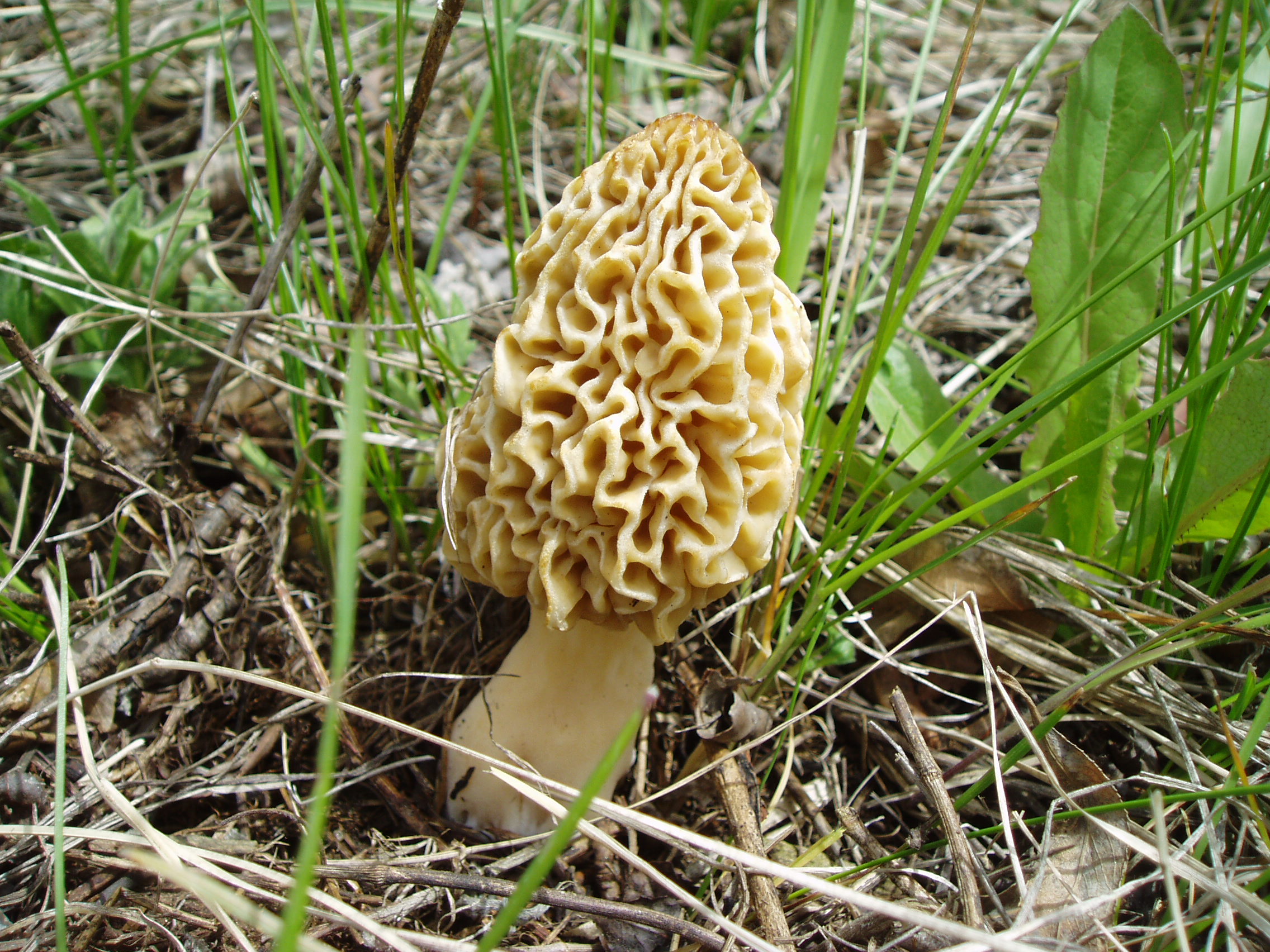
The mushroom fairies (and my buds in the Colorado Mycological Society) were good to me this week. Behold: the elusive Morchella esculenta

I forded a creek in the arms of a burly, bespectacled man to bring you this photo, dear readers. I go the extra mile for you.

These guys are not easy to find, particularly here in Colorado. They come up for about two weeks a year, and only under cottonwoods (and sometimes old apple trees). Finding land on which you can search among cottonwoods is difficult in the highly developed urban corridor, and then there are so many cottonwoods which have . . . nothing. We searched two major areas before we found these in a third. These are the first yellow morels (M. esculenta) I’ve found in Colorado, though you can chase the black morels (M. angusticeps) up the mountains through June.

Morels are in the major fungal group called Ascomycetes, one of four or five major divisions. They are called so because they bear their spores in sacs called asci. (that’s ass-eye, not ask-ee). Each of those fascinating pits on the head of the morel is lined with thousands if not millions of sausage-shaped sacs and other thin sterile fibers called paraphyses (pa-raf’-a-sees). Here’s what morel asci and paraphyses look like:

The asci and ascospores of morels. Image by Peter G. Werner, Creative Commons Attribution License 3.0 Unported. Click for link.

There are eight spores per sac because meiosis, or sexual cell division, produces four spores, and then they all divide again asexually to make eight spores. Some asci have pores at the tip through which the spores are actually shot out like a gun. Others have little lids called opercula (singlular: operculum). Here’s what morels look like when they’re shooting spores like crazy (you only need to watch the first 30 seconds or so to get the idea although there are some nice closeups later on):

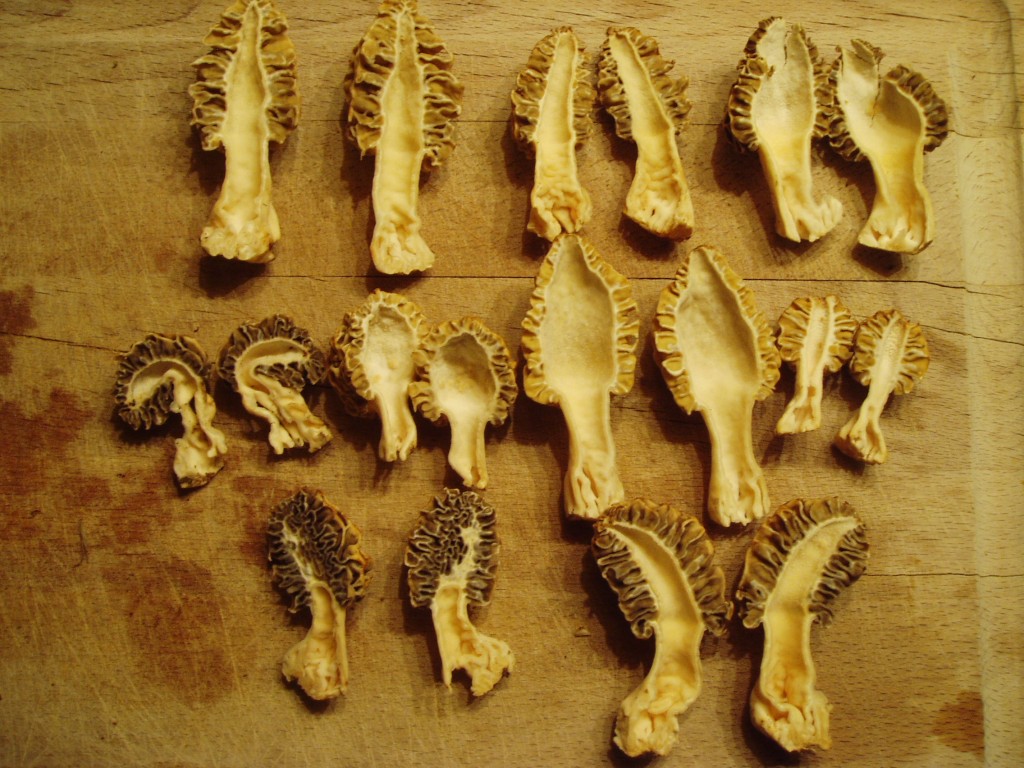
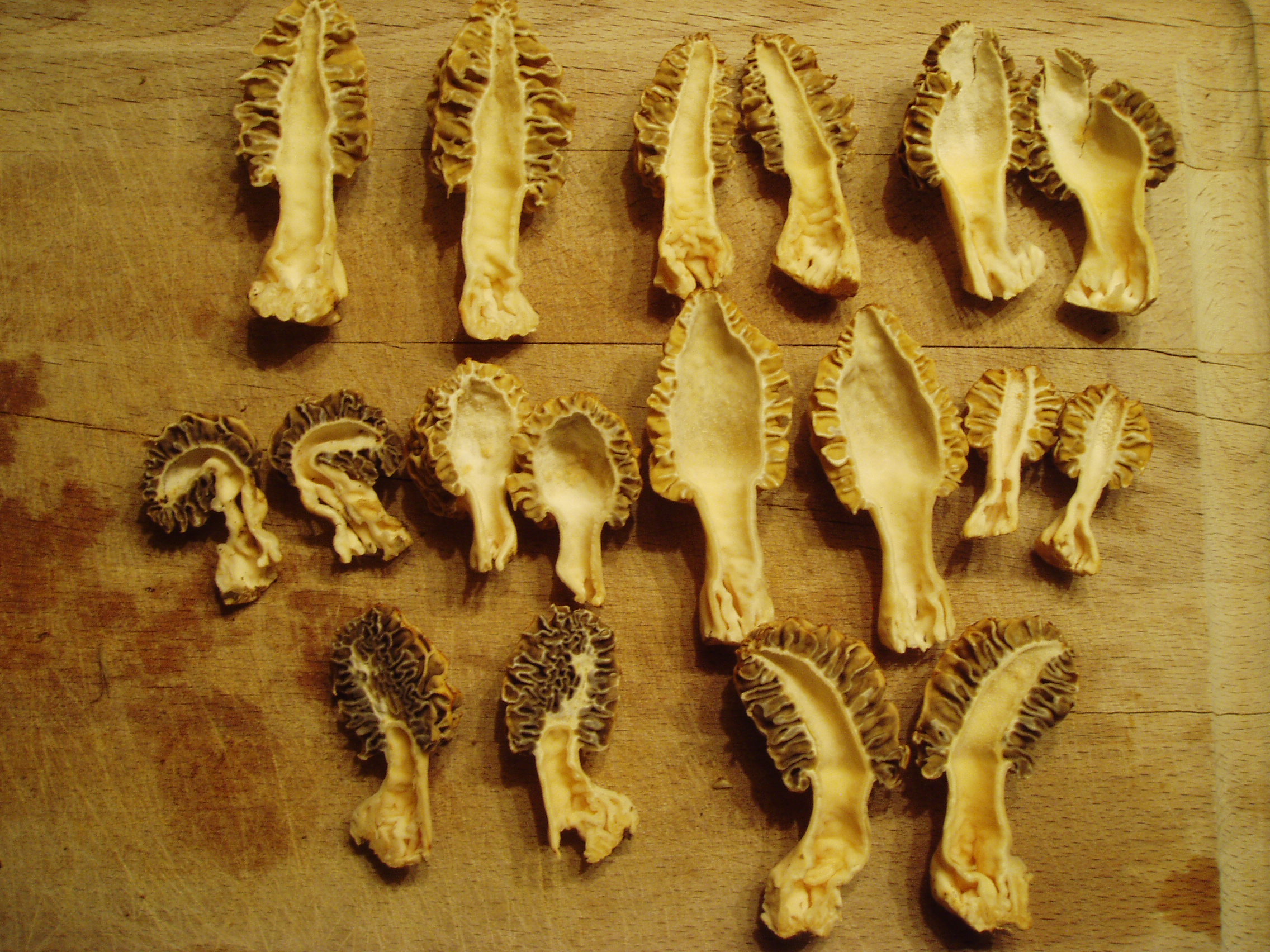
Morels are the most meat-like non-meat object I know of. Cooked in butter, they taste of either steak or bacon to me. This deliciousness is reflected in their price: At Whole Foods in Boulder, you’ll pay $25-50 per pound fresh. I like to cook them with garlic and butter and a little salt, then add a splash of sherry at the last minute. The great thing about morels is they are hollow, which means you can stuff them! And look how beautiful they are in cross section — check out all the different colors and textures — particularly of that little guy in the lower left.

These are also called "land fish" in some parts of Kentucky. Can you see why?

That’s a fairly unusual cross-section for a morel, and it should remind you of something else. More on that soon.

{ 4 comments }