A Filter Feeder Who for Now Shall Remain Nameless . . .

by Jennifer Frazer on July 10, 2010

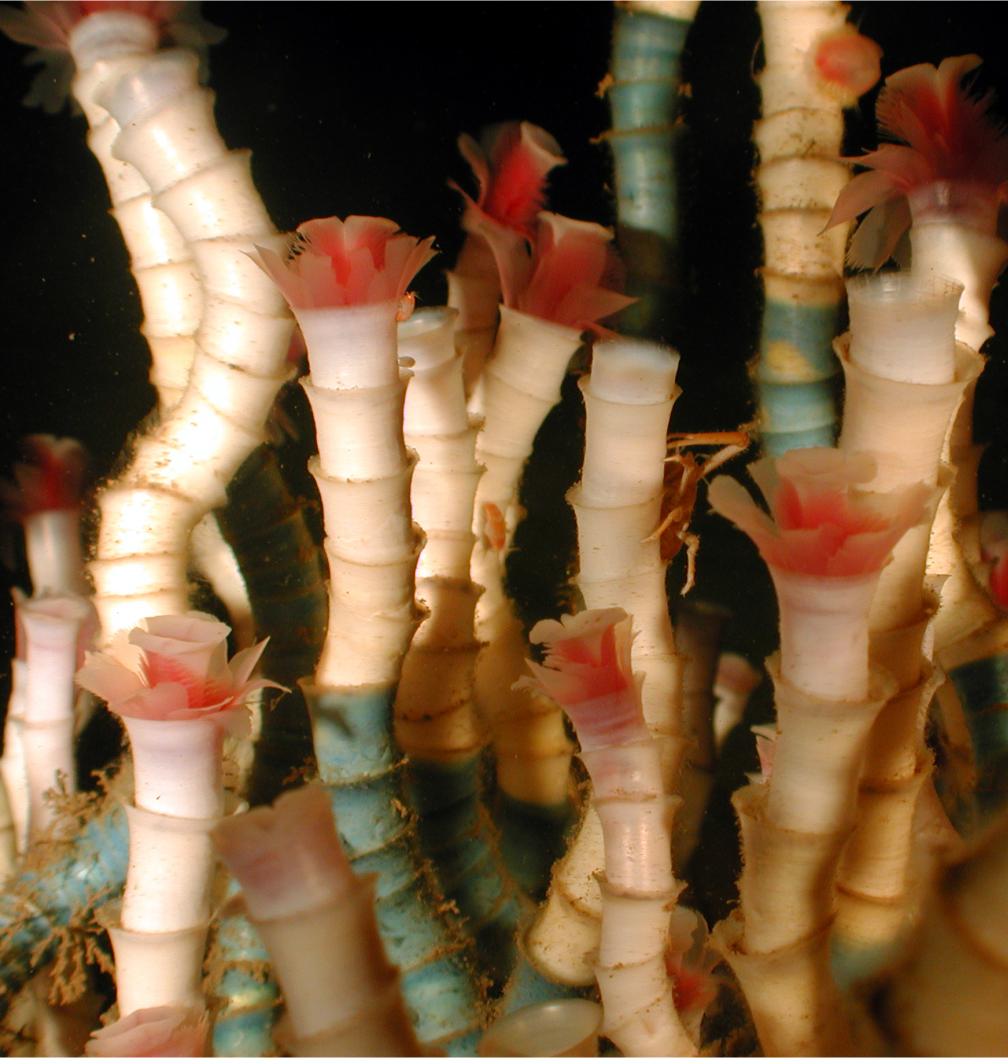
… Annnnd, we’re back. I trust you all enjoyed your respective holidays or lack thereof. Today I offer you a small preview in the form of this little video. Any ideas what this organism’s common name might be? You will probably need to be a biologist or an oceanographer to get this, but here’s a hint: this is visible with the naked eye, and the large structure that comes in from the right is (I believe) a dropper adding a solution of food particles. The “mouth” of the organism is the opening at left, and if you watch carefully, you can see it sucking in the tiny particles as it filter feeds. Those are all the hints you get for now . . . and no cheating by looking it up, at least if you want to make a guess. : )

{ 6 comments }

When Grasshoppers Attack

by Jennifer Frazer on June 28, 2010

My promised guest post is up over at the Beetle Queen blog. Go check it out! It will have to tide you over for a while as I am leaving tomorrow on vacation and won’t return until July 7. Expect a new post sometime in the week after that.

For those of you who are Yanks, Happy Fourth of July! Go topple a statue of King George to celebrate our liberation from the tyranny of tea, crumpets, spotted dick, cricket, landed nobility, and unrepresented taxation*. If only we could declare our liberation from British Petroleum this year too.

Jen

*Represented taxation offer not valid in Washington D.C., Guam, Puerto Rico, American Samoa, or the U.S. Virgin Islands.

{ 2 comments }

Help! Downy Mildews are Nomming My Pesto-to-Be

by Jennifer Frazer on June 27, 2010

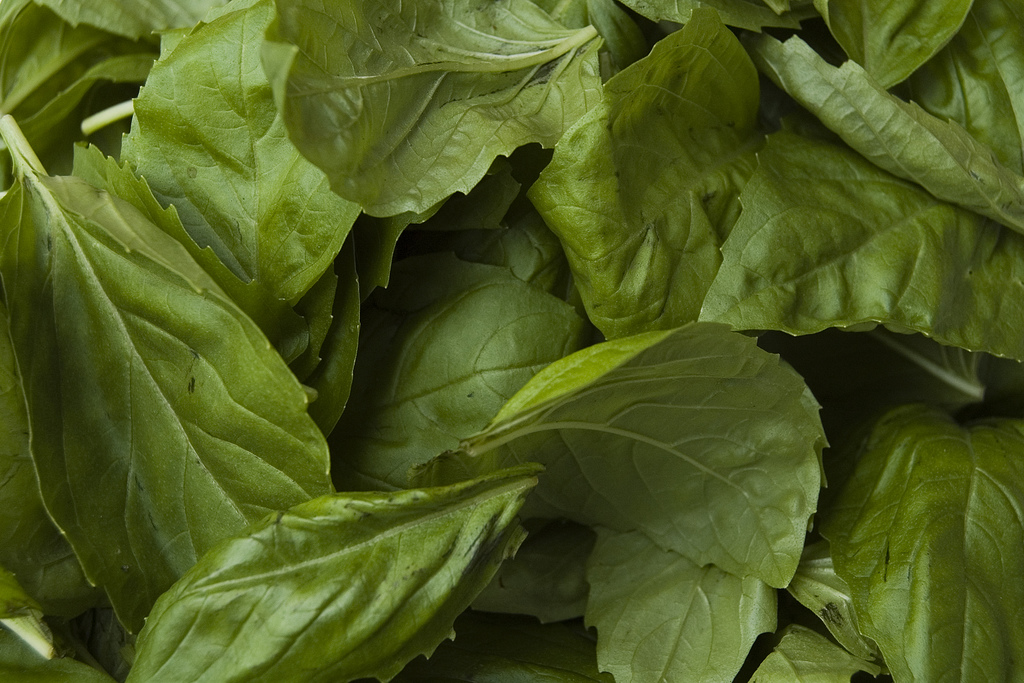
We are no longer the only phylum to discover these leaves are crazy delicious. Creative Commons paul goyette

It’s 1875. You’re a French winemaker. Your vineyards have only recently recovered from the trauma of grafting every single vine to American grape rootstock to avoid the plague of the accidentally-introduced American Phylloxera aphid, which nearly wiped out Europe’s wine industry in the Great French Wine Blight. And now, your vines are withering once more. The leaves are yellowing, the grapes and shoots are wrinkled or distorted, and covering everything is a white, downy fuzz. Congratulations: You’ve just acquired grape downy mildew, Plasmopara viticola, also recently accidentally-introduced from America, and 50 to 75 percent of your crop could be gone in a single season. Sacré bleu!

Several years would pass before the French botany professor Pierre-Marie-Alexis Millardet would walk by a vineyard in France’s renowned Medoc region of Bordeaux and notice a funny thing: the grapes next to the road looked much better than the grapes farther afield. What was up with that?

Now personally, I think that would have been perfect fodder for dial-in to Grape Talk, the 19th Century public radio show about grapes and grape repair. But Professor Millardet did the next best thing: he asked the locals what might be going on. And as it turned out, the growers were spattering their roadside vines with a visibile, poisonous substance like verdigris to deter hungry passersby from sampling their product. Inspired, Millardet went home, got out the chemistry set, played around, and in 1885, cooked up a solution of copper sulfate and calcium hydroxide(quick lime) that he thought worked best. Thus was born Bordeaux Mixture, the world’s first fungicide. France’s grapes were once again saved.

Fast forward to 2010. You’re a vegetable farmer in New York. You have only recently recovered from the 2009 trauma of dealing with late blight spread by big-box-store marketed tomatoes to home growers all over the east. And now, your entire basil crop is yellowing and spotty. Since consumers will not accept leaves with any blemish, it will be a total crop failure. Congratulations: You’ve just acquired the newest downy mildew epidemic to strike the world: basil blight, Peronospora belbahrii. Holy @%$*!

As reported by NPR this week and pointed out by alert reader kati, basil downy mildew is taking the east by storm. And by now you must be wondering, “Just what is this downy mildew stuff?” Good question. Because, in spite of its mildew moniker, it is not a fungus. Or at least not a fungus in the Fungus sense of the word. Lemme ‘splain.

In the ocean there are many things that swim and have fins. But not all are fish. Fish are only distantly related to whales and dolphins. But when the ancestors of whales and dolphins put out to sea, natural selection shaped them into a form quite similar to fish, who had the good sense to stay put all along and not mess around with that highfalutin’ land stuff. We call this convergent evolution.

In the case of what we call “fungi”, there are two distantly related groups who have evolved to look a lot alike. On the one hand, the true (capital-F) Fungi. On the other hand, we have the Oomycetes (oh-oh-MY-seats), or water molds, who may look like fungi and may be called (little-f) fungi, but decidedly are not taxonomically.
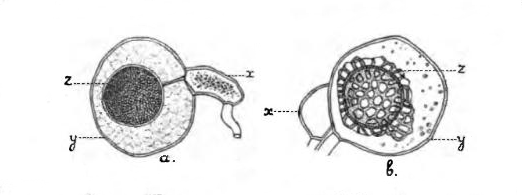
If these were humans, this would be censored. Oomycete sex: the large round oogonium containing the female gamete (egg) is fertilized by the smaller male "antheridium" borne on a separate filament or "hypha".

The funny name provides a clue to how oomycetes differ from true fungi: during sexual reproduction, they make egg-like structures called oogonia, which are fertilized by male structures called antheridia to form oospores. This is but one difference. There are others.

Oomycetes are heterokonts (aka stramenopiles, like brown algae and diatoms . . . remember?) which mean they have two kinds of flagella(propeller tails) for their swimming spores (zoospores). One is called the tinsel: it’s hairy and points forward. The other, the whiplash, points backward and is smooth. Both flagella are attached to the same point on the side of the zoospores, not the front or back.(The only true Fungi that possess flagella, the chytridiomycetes, have only a single, backward-directed flagellum)

Second, the cell walls of oomycetes contain, among other things, cellulose-like material (cellulose also being one of the major components of the cell walls of plants), unlike true fungi, which have chitin in their cell walls (the same stuff insects and crustaceans use to harden their shells). Interesting how the same molecules keep popping up all over life on Earth, isn’t it? It is likely that they evolved independently in all these groups, too. Kinda makes you think!

Finally, most fungi are haploid (contain only one copy of the blueprints) for most of their life. Oomycetes, on the other hand, are more like us: almost as soon as they make their gametes, they fuse them to restore two copies of their chromosomes to their cells.

Oomycetes can be (and often are) called fungi (lowercase f) if it is used as a common name, since they seem to have independently evolved into the same niche as fungi, (filamentous moisture-loving decayers and parasites), the same way that birds and bats, whales and fish, and cacti of America and Euphorbia of Africa have. Still, you wouldn’t call a whale a fish or a bat a bird. : )

Downy mildews are a sub-group within the oomycetes composed of the family Peronosporaceae. They have specialized on parasitizing higher plants. They make special highly developed branched sporangiophores (sporangium bearers) to hold their sporangia (See Fig. 7 here), or cells inside which spores develop. The sporangia make asexual spores, which in many downy mildews can be the zoospores with the tinsel and whiplash flagella that need water to get around. But in Peronospora, the genus killing our friendly basil plants, the sporangium just sends out a hypha (filament) to germinate, just like most true fungi, and calls it good.

What’s more, their sporangia are windborne, and can be blown from plant to plant without need of water. When combined with dense crop monocultures, this is a recipe for destruction, much as it was when early blight of potato (another oomycete but not another downy mildew) arrived in Ireland in the 1840s.

So where did our spunky new downy mildew come from? No one knows. Basil downy mildew was only reported once before the 21st century in Uganda in 1933. So this may be a mutation of a strain from Uganda, or it may be a species that evolved totally independently elsewhere. According to Margaret McGrath at my old Plant Pathology department at Cornell, the first report of this particular species was in Switzerland in 2001. From there it spread across Europe and thence came to Florida in October 2007. It has also spread (back?) to Asia and Africa. And it looks to be here to stay.

Like many fungi, this is a nasty parasite that can be almost impossible to rid yourself of once acquired, short of heavy fungicide application, which most people do not want to do to basil plants they plan to be eating. Cornell’s Margaret McGrath has only one piece of advice for the first time you find it on your basil: make pesto NOW.

To see how the heterokonts (aka stramenopiles) fit in to the rest of the eukaryotes (cells with nuclei), go here. Then click stramenopiles to find the oomycetes among the diatoms, brown algae, and other weird, obscure creatures.
{ 1 comment }

What About the Tube Worms?

by Jennifer Frazer on June 22, 2010

Photo/Charles Fisher, Creative Commons Attribution 2.5 License. Click for link.

The New York Times just published a wonderful look at the thinking of scientists about the fate of the many cold seeps in the Gulf of Mexico, something I’ve been pondering myself a fair bit over recent weeks. I’ve explored the venerable tube worms of cold-seeps before here before, but never in regard to rogue petrochemicals. The communities at these seeps live on oil and other hydrocarbons naturally seeping from the ocean floor, so whether a larger dose will harm them is an interesting question. The consensus for now seems to be probably yes, but we really don’t know.

Whatever you do, don’t miss the beautiful slide show of this fascinating and under-publicized ecosystem. Watch for the orange bacteria, a spectacular black coral, and for brittle stars that put the Lacoön to shame.

{ 2 comments }

Rock Instar Parking: Wyoming

by Jennifer Frazer on June 20, 2010

So you’re a member of a horde of trillions of hungry migratory grasshopper nymphs (aka hoppers) looking for a place to live large. Do I ever have the place for you: eastern Wyoming, where it’s been a Goldilocks year for grasshoppers.

Even as I write, a hungry, hungry swarm of one of America’s legendary scourges is crunching and munching and chewing up hay, wheat, and alfalfa fields in that part of the country. Airborne sprayers dispensing moult-disrupting chemicals are currently getting slimed every time they fly with a film of grasshopper goo. In a normal year, one sprayer said he might tackle 2,000 acres. This year he is looking at flying one million. 

Americans have, I think, a particular trauma about these insects, which may be part of our national aversion to insects in general, a topic I’ll shortly be exploring in a guest post over at the Beetle Queen blog, where I’ve kindly been invited to guest-blog. For now, let’s just say we and grasshoppers have had issues.

Grasshoppers belong to the Orthoptera (Look for and explore them here), an order of insects that also includes the katydids and crickets. The notorious “Mormon crickets” that legendarily nearly wiped out the Mormons’ first crop (they attribute their deliverance to the miraculous intervention of California gulls, which are even now the state bird) in Utah were actually katydids, but still in this order. The members of Orthoptera have enlarged hind legs (the better to hop with), well-developed compound eyes (the better to see you with), and very efficient mandibles (the better to annihilate crops with).

You may think of insects as always developing from squelchy, soft-bodied larval young, but it turns out this is not the case. Many insects, including grasshoppers, use an alternative system involving nymphs, pint-sized (pea sized?) versions of adults. No maggots necessary.

The insects that do this are called hemimetabolous, which means something like partially metamorphic. This distinguishes them from the ancestral form, called ametabolous (“not metamorphic”), found in silverfish (fun fact: one alternate name is “carpet sharks”), bristletails, and other less-derived (aka primitive) insects in which the animal just keeps moulting and growing its whole life, and holometabolous insects like butterflies, in which there is an Extreme Makeover: Insect Edition that usually involves some sort of hideous larva and walled-off pupa.

Hemimetabolous insects like grasshoppers, cockroaches, mantids, true bugs, dragonflies, damselflies, mayflies and stoneflies* hatch looking more or less like their elders.

That’s not to say there’s *no* difference between nymphs and adults. Notice anything odd about this picture?

Creative Commons D. Gordon E. Robertson

Look at the wings — they’re just little flaps. In fact, in grasshopper nymphs, the little flaps have an even stranger behavior. They go from right-side-up to upside-down and back again. Or actually, upside down to right-side-up and back, since the part of the wing with the thickest vein (like the front edge of a fly’s wing) is actually on their stomach side in the adults. Yes, that’s right. They’re flip-flopper hoppers. In the above photo, the wings are in their intermediate position.

Other nymphs undergo sometimes significant changes in color and shape, but the overall form remains the same. The different juvenile stages of insects, whether larval or nymphal, are beautifully called instars (Instar, by the way, is one of my cellar doors).

The reason I mention all this is that the plane-sliming swarms of grasshoppers currently occupying Wyoming were, as of a week and a half ago, still only tiny nymphs. From the NYT:

On Wednesday afternoon, Ms. Mahnke from the county Weed and Pest office drove out to one particular hatching ground that she said was without equal. In recent days, she said she easily counted 40 to 50 or more tiny grasshoppers, many still the size of a grain of rice, per square yard. If multiplied across five million affected acres, they would yield a trillion insects or more.

Walking through the calf-high grass in such a field feels like something out of primordial biology 101. Every step stirs a tiny, nervous crowd, jumping every which direction — up, down, away and onto one’s pants. Adult size in such numbers, vastly larger, jumping and flying — and by the adult phase, eating in volume — would do Alfred Hitchcock’s best nightmare one better in a dozen paces.

Stay tuned.

__________________________________________________________________________

*Nymphal aquatic insects are, for historic and confoundingly confusing reasons, referred to as larvae even though they are technically nymphs. Or, just to make things more confusing, they’re sometimes called naiads, a holdover from the days all biologists (and really, all students), had to master Latin, Greek, and the classics. Is it naughty of me to sometimes wish for those days?

{ 1 comment }

Where is Jen?

by Jennifer Frazer on June 18, 2010

Sorry for the long posting delay . . . I’ve been writing my first two magazine freelance articles! Full new post on Sunday. Have a great weekend!

Jen

{ 2 comments }

What’s Cooking Below Kealakekua Bay

by Jennifer Frazer on June 13, 2010

Here’s a Sunday moment of Zen for you, discovered courtesy the always educational and entertaining Echinoblog. This clip is “a compilation of video clips collected in deepwater by the Little Hercules Remotely Operated Vehicle and camera platform during an ROV shakedown cruise aboard NOAA Ship Okeanos Explorer offshore Kona, Hawaii (March 2010).” No word on the supplier of the groovy music.

LOVE the swimming sea cucumber (first critter). It’s a starfish relative in the Echinoderms — which despite starfish’s radial symmetry are vetebrates’ closest living relatives!

I was especially piqued by this video because it was taken in March in the exact same spot I’d be snorkeling a month later — Kealakekua Bay, the place Captain Cook first came ashore on the Big Island in 1779, and the same spot he was killed later that year. Supposedly you can still see a pock mark on the cliff walls from one of Cook’s cannon balls. Topside, the bay contains the only piece of foreign soil I know of owned outright by a foreign government — a tiny plot given to the UK in the 19th century by the Kingdom of Hawaii. There stands Captain Cook’s obelisk, supposedly repainted every year by the Australian Navy and theoretically providing a tiny no-arrest zone for every Commonwealth or UK citizen running from the cops.

The gorgeous reef there is punctuated with percolating (and cold!) freshwater springs that drops swiftly downward into Pacific Ocean blue. You really feel as if you’re swimming in the ocean. I recall seeing a white-mouthed moray eel, loads of raccoonfish who were not shy about sidling up next to me, a puffer fish, and many other delights. Apparently, it’s also not unknown for the local spinner dolpins to swim in and roust about. Captain Cook’s monument was right next to me, and apparently, several hundred feet down, so were all these critters (you can rewatch the video with the IDs to compare:

The video footage shows a pelagic sea cucumber (apodid holothurian), Venus flytrap sea anemone (actinoscyphiid sea anemone), tipod fish (chlorophthalmid tipod fish), flatfish (pleuronectiform flatfish), eel (bongrid conger eel), shrimp (benthic caridean likely nematocarcinid shrimp), actiniid Bolocera-like sea anemone with a galatheid crab, Glass sponge and demospongid with hermit crab, and hexactinellid (glass) sponge next to a primnoid coral. Video Credit: NOAA Office of Ocean Exploration and Research

Your tax dollars at work, my friends. Don’t say they’re never put to good use.

{ 4 comments }

Tetrapolar Fungal Sex: 50% More Ways to Get Lucky

by Jennifer Frazer on June 8, 2010

Little fungal bundles of joy: the sexual products (basidiospores) of the earthstar Geastrum triplex. The note in the lower left indicates that each increment on the scale bar is equal to one micrometer (the Greek letter mu is the bionerd abreviation for micrometer) -- which is one-thousandth of a millimeter. So each of these spores is 4-5 micrometers -- or 0.004 - 0.005 mm -- across. That's pretty typical for basidiospores, although the spiky spherical shape is not. Creative Commons Amadej Trnkoczy

In Killer Yeast from South America I briefly mentioned the strange sex lives of fungi, who have many different mating types instead of two genders. This, as you can imagine, makes it considerably easier to find a mate, among other advantages. My old mycology professor Kathie Hodge (who taught me just about everything I know about fungi) recently posted a more thorough exploration of the varieties of fungal sex and the implications thereof. She is a fabulous science writer too, and if you’re curious about the subject, check out her explanation “A Fungus Walks into a Singles Bar . . . “ at the Cornell Mushroom Blog. Or you could just go for the gratuitous Mutinus caninus dog stinkhorn video. Your choice. : )

{ 2 comments }

Veni, Vidi, Voti

by Jennifer Frazer on June 7, 2010

Today is the last day for voting over at 3QD — the cutoff is midnight Eastern Daylight Time (i.e., when it’s midnight in New York City). If you haven’t perused the selection and voted, please considering doing so! It’s free and easy. I have two posts up for a nom: Killer Yeast from South America and The Seafaring Killer Bacterium (links are on the noms page lined above). As mentioned in the comments below, I do not, as a rule, put killer in the title of my posts, but so it goes. : )

{ 0 comments }

Beetle Queen Conquers Tokyo!

by Jennifer Frazer on June 6, 2010

Today I was lucky to attend a special screening of the gloriously named “Beetle Queen Conquers Tokyo” in Denver with the film’s maker, Jessica Oreck. She has taken a very artistic approach to natural history filmmaking, one well worth experiencing. Her subject: the Japanese’s almost-unnatural obsession with a very natural subject — insects.

This is an abstract, arty, and contemplative film that, though it takes no overt position on its subjects and never states it explicitly, poses the question: Why are the Japanese, alone among world cultures, so into insects? There is no pat answer. The filmmaker presents clues, and it is up to you, the viewer, to process what you’re given and draw a conclusion. The ordering seems important sometimes; confusing, contradictory, or enigmatic at others. Along the way, there are many scenes that are difficult to fit in — possibly by design — like jigsaw pieces that may or may not belong in the box. Many are beautiful little treats that can be savored visually in their own right. One short shot, possibly my favorite of the film, simply focuses on the soft patter of rain on water and shows an Escheresque and seemingly impossible illusion of the water moving both left and right at the same time. It must be seen to be believed.

It takes some patience, and perhaps repeat viewings, to fully digest Oreck’s film. In addition to the enigmatic scenes, the film is in Japanese with subtitles, and the subtitles sometimes move a bit quickly, making it tricky to take in both the visuals and the narrative at the same time. But the film was creative, original, and unique. Oreck said after the screening that she *had* to make the film — there was no choice about it. No one else had or would tell that story unless she did.  I can relate to and support that kind of vision and passion. I’d rather watch 100 Beetle Queens than 5 McNature documentaries (*cough* Mcgillivray-Freeman *cough*). Oreck opens a window into a beautiful little world of beetles and a culture of insects that you’d probably never stumble upon otherwise. It was so heartening to see Japanese children actually playing with beetles instead of video games, learning to pin butterflies in school, and going along on insect catch-and-release expeditions or firefly appreciation trips with their parents as a fun way to spend a Friday night. If only we should be so lucky here. Recommended.

{ 4 comments }