My First Biodiversity Talk

by Jennifer Frazer on June 14, 2009

The title of this post was inspired by John Cleese (with a dash of Scrubs). When I was in school in Ithaca, Cornell named him an honorary professor and invited him to speak at our interfaith chapel. I showed up on Sunday to find the title of his talk in plastic stick-on letters on the sign outside: “John Cleese — ‘My First Sermon'”.

Back in May, I saw a call by a group of skeptics I belong to for talks at their annual meeting, the Colorado Skepticamp. The talks could be on any sort of skepticism OR on any discipline of science. One of my aims is to speak publicly and frequently on the sorts of things I blog about here, so I jumped at the chance. My idea was to do a quick survey of life on Earth hitting all the major groups in less than 30 minutes, so I called it (with apologies to Mel Brooks), “Life on Earth: The Short, Short Version.” So here you go — My 23 Minutes of Fame.

There are two versions. One has better sound:

And this version has higher resolution:

I made a few mistakes for which I hope you’ll forgive me. . . all I can say is this was my first time giving this presentation and it’s hard when your mouth is moving faster than your brain. I have noted them below. If, after watching it, any of you are interested in having me/hiring me as a speaker, I’d be happy to make it longer or shorter or elaborate on any taxon that interests you. : )

Errata/Clarifications

  • I mentioned that Hennig changed the way we do taxonomy by suggesting evolution as our grounds for classification. What I forgot to mention is the way that evolutionary history has now become largely judged by DNA and not always so much by what the organisms look like, where they live, etc. The byzantine circular taxonomic trees I presented were created using DNA sequences – and molecular taxonomy now dominates classification (it’s not always the last word, but it’s almost always the opening sentence). But for all of our scientific efforts, judging the true evolutionary history — especially when different pieces of evidence conflict — can still be a bit of an art.
  • The slide where I show some differences between bacteria and archaea shows a few of the differences between these groups, but there are many more. Don’t think by any means that these are the only two. I mentioned this earlier but not at this point.
  • Flu viruses are in Orthomyxoviridae, not Paramyxoviridae. It’s the taxon directly above the one I point at. I was in the right neighborhood but again, the mouth was moving too fast for the brain. This is what happens when you try to cram life on Earth into 23 minutes.
  • Operculum is Latin for a little lid or a cover, not Greek for cap. I knew what I meant, I just didn’t say it right.
  • Moss spores are haploid, not diploid. Meiosis occurs in the the sporangium in the top of the sporophyte.
  • I seem to imply all cup fungi shoot their spores in a cloud but that’s not accurate. Many cup fungi don’t. Even the ones that do may not if they’re not in the mood. In this respect, they aren’t so different from. . . er . . . never mind.
  • I got a little confused on jellyfish but remembered soon after the talk what the problem is: jellyfish do not have alternation of generations in the same sense plants do. Both forms are diploid (the sperm and egg fuse before dividing further), but they do alternate between sexual and asexual organisms.
  • And finally, I looked it up and Venus’s Girdles are indeed bioluminescent at night. Sorry.

Muchas gracias to Mile High Skeptics for making generously recording and sharing my lecture!

{ 2 comments }

Weird + Cute³ + Old Spice = ?

by Jennifer Frazer on June 10, 2009

Saw this over at Zooillogix and couldn’t resist.  I cannot believe Jim Henson did not design this creature. I also cannot get over the impression that somehow, this thing looks like a cranky old man with his pants hitched up too high.

According to wikipedia, jerboae are “jumping desert rodents” from North Africa and Asia.  Tasty and bite-sized desert rodents, too, I’d wager. Perfect for kebabs . . .

The jerboa, together with kangaroo rats of North America and hopping mice of Australia, are a great example of convergent evolution. This often happens when organisms from very different lineages evolve to fill similar niches, like whales and fish, or fungi and oomycetes (water molds — an oomycete, for example, caused the Irish Potato Famine).

Two mammal posts in one week! Never thought that would happen. I must be going soft.

{ 0 comments }

Dude, Where's My Cod?

by Jennifer Frazer on June 6, 2009

Anyone who’s spent time fishing can tell you that every so often, after patiently waiting hours for a bite, one will reel in one’s line to discover that somehow, someone has pilfered the bait. Apparently Alaska black cod fishermen have a problem along the same lines(so to speak), although in this case it was the catch that was purloined, and not the lure.

So someone rigged up a camera to capture the thief in flagrante. Take a look at this video that came across the National Geographic newswire a few weeks ago:

Wait for it . . .

No, that is not a sawblade attached to an oven mitt. That, mateys, is a sperm whale. And not just any sperm whale. A sperm whale that has learned to rob lures of bait without hurting itself or using fingers, fins or tail. Pretty slick!

Sperm whales are the largest toothed predators on Earth. They dive deep in search of squid and fish, and judging from the sucker scars sometimes found on their skin . . .

wiki_sperm_whale_sucker_scars

. . . they really do get in battles with colossal squid deep underwater. Their heads contain a massive organ filled with a waxy substance called spermaceti. In the 19th century, this, along with oil from the whale’s blubber, was prized for making candles as affordable as tallow but far less smoky, lamp oil, soap, cosmetics, crayons, and a number of other products. The spermaceti’s actual purpose may be buoyancy control (the whale hardening it to dive and liquefying it to rise), echolocation, or both.

Since these whales aren’t afraid of defending themselves by using their head as a battering ram, a few actually did manage to sink some whaling ships in the Pacific, including the Essex in 1820, which inspired Melville to write Moby Dick, and the Ann Alexander in 1851, which was attacked (after, it should be said, first attacking the whales) about the same time that Moby Dick was published, and probably helped to market the book.

What is really extraordinary, when you think about it, is that these behemoths evolved from a small furry, doglike creature that existed 55 million years ago.

Pakicetus, an ancestor of all modern whales.

An artist's reconstruction of Pakicetus, an ancestor of modern whales. This image by Arthur Weasley is distributed under a Creative Commons-attribution license. Click image for link.

What an amazing world we live in!

In any case, so long as you’re not shooting harpoons at them or swimming around looking tasty at 6,000 feet, sperm whales are probably mostly harmless. Here is a film of a sperm whale calf (who doesn’t seem to have teethed yet) to give you a closer look.

{ 2 comments }

A Stirring and Beautiful Journey Through Time

by Jennifer Frazer on June 4, 2009

wiki_trilobites_heinrich_harderIt’s been 4.5 billion years since Earth formed, and oh, what a long, strange trip it’s been. National Geographic photographer Frans Lanting has created a beautiful slide show set to music about the evolution of life on Earth to help you experience it in considerably less time.

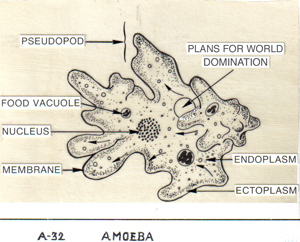
The online version consists of 86 photographs with crisp captions that follow the history-of-life artistic tradition of the Rite of Spring from Fantasia (check out the amoeba!) and any number of other museum murals and books. It’s a pleasing sensory experience, something akin to a brain back rub, if such a thing is possible.

I have only a few quibbles; the Cretaceous seems to have been a particularly groovy era of Earth history based on its inexplicable 70’s-game-show musical interlude, and there are a few inaccuracies (i.e. the spacing of the pictures in the time line is SO not to scale; chlorophyll does not fuel all life). But these are minor and beside the point.

He has also created a live action version featuring music by Philip Glass and “images, dance[ed. note — I’m suddenly envisioning giant isopod be-costumed dancers prancing across the stage], film, and science.” The premiere will be June 10 in New York City, and will include as guest of honor one of my three science heroes — E. O. Wilson (love you E.O.! Wish I could be there to meet you!) — along with a slew of other stars and scientists including Alan Alda, Harrison Ford, and James Watson, the Watson half of Watson and Crick (the guys who along with Rosalind Franklin figured out the structure of DNA).

The online slide show does suffer a bit from the common problems of the genre laid out by Stephen Jay Gould in the preface to his Book of Life; first, the omission of “simple” creatures like microbes, invertebrates, and fungi from the show after vertebrates appear, with the attending implication that they stop evolving after their appearance.

On the contrary. Invertebrates, fungi (actually, fungi never even appear in the show except as lichens), microbes and ferns have all continued evolving and adapting. One diorama at the Denver Museum of Nature and Science featuring conifers from the late Paleozoic/early Mesozoic shows conifers with shockingly (to my eyes) broad leaves. Needles only evolved later.

The second problem is the implication that evolution is a predictable and inevitable march of increasing superiority resulting in the evolution of Homo sapiens, the be-all end-all. It’s hard to get around this problem, though, since it’s nice to highlight major novelties (and let’s face it, flowering plants, mammalian diversification, and humans were indeed major novelties) in chronological order, and humans did arrive very late on the scene.

Finally, there is the problem of time distortion, magnified in this case by the skewed presentation of the time line. For most of Earth’s history (probably the first 3 billion years anyway), life was simple and microbial. But we get only a handful of pictures devoted to that, and dozens of pictures devoted to the last 500 million years. It’d be a pretty boring slideshow if he didn’t present it this way (if for no other reason than we don’t have much information about what that early life looked like), but it’s a distortion nonetheless. Would it be so hard to make the timeline to scale, anyway?

Check out the slideshow first, but when you are done looking at it, check out the timeline. Choosing each image reveals extras including Lanting’s notes on the pictures and often some cool bonuses like video of the geyser or stromatolites. In spite of my (and Gould’s) quibbles, it’s a first rate production!

As always, I, and I’m sure he, hope you will draw inspiration from the beauty of life to help protect it.

Discovered thanks to Carl Zimmer at The Loom.

{ 0 comments }

Voting Opened at 3 Quarks Daily

by Jennifer Frazer on June 3, 2009

Voting is open in the 3 Quarks Daily Science Blog Post Contest I entered last week. There are over 100 entries (including little ol’ mine!), so if you’re interested, take a look and vote for your favorite! You have until midnight on June 8.

{ 0 comments }

Ants Going Nuts

by Jennifer Frazer on June 2, 2009

As I was on my way back from work on Friday, I noticed a strange black mass on the pavement near my house.

ants-003

It was like a soccer riot — ants crawling all over apparently trying to beat the snot out of each other. I half expected to see some broken beer bottles and tiny torn Manchester United T-shirts lying around. Occasionally one would fall off the edge of the curb in a Wilhelm scream-worthy fall.

Check out the video, in which if you look carefully, you’ll see three take a spill:

I’ve seen pile-ons like this once or twice before in my life, and I assume it’s a fight between rival colonies. But I’m not an entomologist. Does anyone here know what these ants are up to?

{ 3 comments }

I’ve entered my first moss post into a science blog post contest over at 3 Quarks Daily judged by Stephen Pinker. If you’re a science blogger, it’s not too late to enter one of your posts either, although you have to hurry. The nominations close at midnight on June 1. Check it out!

{ 0 comments }

Films about Giant Isopods

by Jennifer Frazer on May 31, 2009

Because you can never have too much David Attenborough . . . here is a short clip from Planet Earth that shows our giant isopod friends from my last post in action. It’s kinda like an all-you-can-eat buffet down at the Sizzler.

Mmmmmm. . . carcassy. . . .

Love that crab at the end.

{ 0 comments }

Coming to a Benthic Store Near You . . .

by Jennifer Frazer on May 29, 2009

I couldn’t help but laugh when I saw this one, folks. But I give you the Dave Barry Oath: I Am Not Making This Up. Yes, behold: “Songs About Giant Isopods”.

paganwandererlu_isopodcover

Who needs a rousing sea chanty when you can have a rousing isopod modern rock ballad?

You’ll recognize such hits as, “Isopod Love Song”, “Chitinous Tease”,  “An Isopod is Cute in the Eyes of an Isopod”, (including the immortal lyric, “Just because we’re not as cute as kittens and things, doesn’t mean we deserve to go extinct.”) and “Giant Isopods Ate My Well Known Brand of Corn Chips.”

Does it make you think less of me if I admit I like, “Isopod (I can evolve)”?

So what’s a giant isopod? Well, they’re crustaceans (like shrimp, crabs, and lobsters) in the same taxon with woodlice, aka pill bugs. Yes, they are essentially foot-long, seafaring pill bugs on steroids. The wander through the deep ocean scavenging carcasses or attacking slow-moving prey. Oh, and if you’re ever in North Taiwan, you can apparently have one of them for dinner.

I need a giant isopod bib.

I need a giant isopod bib.

Don't hate me because I'm beautiful.

Discovered thanks to Deep Sea News.

{ 0 comments }

As mentioned in the last post, for some reason (actually quite a good reason we’ll get to soon) scientists at ETH Zurich and the University of Freiburg im Breisgau thought it’d be a great idea to splice some human genes into . . . er, moss . . .  and see what happened. Ordinarily, you’d have to finesse the DNA to get it to work in a plant. But this worked just great the first time.

What’s even better are the AWESOME MOSS BIOREAKTORS they used to do it!

moss_bioreactor

Is that Luke Skywalker in there? The only thing that could possibly make this image more awesome would be some lightning shooting out of the tops of those reaktors (cannot help self -- the Germanic K is too much fun). Eat your hearts out, nuclear physicists! Click image for source.

Now I ask you, does it get any cooler than bionic moss? Although this does beg the question: Why, on God’s Green Earth?

Because this bizarre, dissociated, barely recognizable moss could provide a cheaper, easier and more economical way to produce drugs like insulin. Right now such proteins are produced in relatively costly and difficult-to-maintain mammalian cell cultures with organic vegan-class nutritional and environmental requirements. Only industrial countries can handle the complexities, and demand is outstripping supply.

Moss, on the other hand, makes its own food. All it needs is some light, a few inexpensive salts, water, and room to grow. Have Chlorophyll — Will Transcribe. A simple growth solution also makes purification of the product protein much easier, according to the paper. With such a set-up, even developing nations may one day be able to make insulin for their own diabetics. Yes, better living through biokemistry. : )

{ 0 comments }