The esteemed Tom Levenson, author of the newly released (and well-reviewed) book Newton and the Counterfeiter — and director of the Graduate Program in Science Writing at my alma mater, MIT — has kindly featured my blogs on his with some warm words for yours truly. Thanks for the shout-out, Tom!
I’ll be adding his blog to my blogroll as well, along with a few other new blogs I’ve discovered. I’m trying to keep my blogroll useful for readers of this site by making nearly all of them related to particular groups of organisms. Today I’m adding Skeptic Wonder, a blog about protists (protists being skpetical as well as artful, obviously : ) ), The Echinoblog, which is a great resource for they of the hydrostatic skeletons, virology blog (with domain name inexplicably ending in .ws, the extension for . . . Samoa?), The Other 95%, which seems to be loosely about invertebrates and particularly marine invertebrates, and a plant blog from University of British Columbia Botanical Garden, EtaerioBotany Photo of the Day. There is a Grand Canyon-sized blogging gap in the subject of botany and plant taxonomy(please readers, correct me if I’m wrong) — bloggers who are looking for a niche take heed!
The species, the adorably named patch-nosed salamander (with the slightly less adorable scientific name Urspelerpes brucei), was so different from anything else known that scientists gave it its own new genus (whose name seems to be a cross between Urkel and Purple Nurple). That makes it the first new tetrapod genus in America in 50 years. And there could be more.
There are probably hundreds, if not thousands, of unnamed and unknown *visible* fungi, plants, insects, etc., right here in North America. In your state. In your county. Now when you think of the problem in the ocean or rainforest you can see how many species are biting it before we even get a chance to know they’re there.
But not our little friend here. Thankfully, if he ever goes the way of the leisure suit, we can at least tell our children what he looked like.
I’m so glad you asked! What IS a sea pig? Here’s a hint: a sea pig is an echinoderm. No? Still not picturing it? A sea pig is in a group of echinoderms called sea cucumbers. Like this:
We have cuke sign! Get your cucumber hooks ready! NOT a sea pig, but a close relative in the same group, the sea cucumbers, aka holothurians. Photo credit: National Oceanic and Atmospheric Administration/Department of Commerce
OK, so the short answer is that a sea pig looks like a cross between a star-nosed mole, a naked mole rat, and a hallucinogen-induced, Cthulu-themed nightmare. Except cute. Awwwwwww! Can you get a sea piggy bank? Well, not exactly, but you can get something very close: a sea-through pig.
Wanna sea what I mean? To stop me from making any more bad puns, and to find out JUST WHAT THE HECK A SEA PIG IS, go here and find out all the wonderful details, courtesy the Echinoblog (via Deep Sea News). You’ll be glad you did. Thank you.
Every so often, an organism comes along that has even biologists fighting over what it “is”. Now you’d expect that after several thousand years of scientific inquiry, we’d have a pretty good handle on the terrestrial macrobiota of the world. You’d be wrong.
The background here is that a North Carolina construction company was hired by the city of Raleigh to inspect its sewer lines. They used a flexible periscope to snake their way in and capture video. I’m sure they never expected what they were about to find. This one is not for the faint of heart, kids. Brace yourself and hit play.
Speculation on the identity of these masses has ranged from bryozoans to annelid worms and slime molds to space aliens.
One thing I can say for sure is this is NOT a slime mold. No slime mold is capable of moving that quickly. To see slime molds move, you’d have to time lapse the heck out of a video. This is also not what I’d call slime mold habitat. They like water, but not THAT much water. They tend to prefer a nice soil/dead wood wrap, easy on the sunlight.
Several experts queried by both Deep Sea News (where I found this gem) and ABC News (lots of good reporting here) seem to be agreeing that this is, in fact, a colony of Tubifex tubifex, or sludge worms. Here’s DSN:
Enter stage right Dr. Timothy S. Wood who is an expert on freshwater bryozoa and an officer with the International Bryozoology Association. I sent along the video and this was his reponse…
Thanks for the video – I had not see it before. No, these are not bryozoans! They are clumps of annelid worms, almost certainly tubificids (Naididae, probably genus Tubifex). Normally these occur in soil and sediment, especially at the bottom and edges of polluted streams. In the photo they have apparently entered a pipeline somehow, and in the absence of soil they are coiling around each other. The contractions you see are the result of a single worm contracting and then stimulating all the others to do the same almost simultaneously, so it looks like a single big muscle contracting. Interesting video.
So, for the record, here are what individual Tubifex worms can look like:
Sludge worms are annelid worms, just like tube worms, which means they have . . . wait for it . . . *human-like blood*! Combined with their filamentous form, and synchronous contractions, it really does add up to give these clusters the appearance of a pulsating heart. Or something. If you watch the video carefully (don’t have anything to eat first), you can see the individual worms snaking around in that mass.
According to the all-knowing, all-seeing Wikipedia, T. tubifex lives in lakes and rivers ingesting bacteria and other organic debris. Identifying them is difficult, though, because, inconveniently enough, they dissolve the reproductive organs we use to identify them when they’re finished mating. “[Barry White music in background] Oh honey . . . come on over here and give me some OH WHY DO I EVEN TRY!?” In addition, their physical appearance changes based on water quality, which might explain their, well, extraterrestrial appearance in the above video.
And perhaps not unexpectedly, fish apparently find these guys delicious. Sludge worms: they’re what for dinner. Now with 95% more meaty slime! Hey, don’t knock ’em. They’ll put scales on your chest.
For one last wormy treat, here is a video of the little guys fully submersed in the lab:
So, I ask you: space aliens or sludge worms? You decide.
He had two loves: biology, and his wife Emma. They didn’t always agree.
Yes, sometime this year, we will get to see two talented actors, Paul Bettany (Master and Commander, A Beautiful Mind) and Jennifer Connelly (who was the young girl in Labyrinth, and also in A Beautiful Mind, for which she won a Best Supporting Actress Oscar), portray Darwin and his wife in the new film Creation. As this year marks the 200th anniversary of Charles Darwin’s birth (who, I believe, also shared a birthday with Abraham Lincoln), the producers have impeccable timing.
Also impeccable casting. Bettany and Connelly happen to be married in real life. And I have great faith in Bettany’s ability with this type of material: if you have never seen his turn as Darwin-class naturalist and British naval physician Dr. Stephen Maturin (who happens to get to (briefly) visit the Galapagos where he’s stunned by the diversity) in Master and Commander: The Far Side of the World, Run, Do Not Walk. Ohhhhhh, Dr. Maturin. I’d sort your collection any time.
I am heartened by the above trailer. Finally we will have a movie that maturely deals with some pretty sticky and intersecting subjects: science, faith, and love. These are subjects that many sober-minded people find themselves painfully grappling with even today. If it’s half as good as it looks, I can’t wait.
Release is scheduled for some time this year, though the date has not been named. Together with The Young Victoria (if they’ll ever give it a #$*@! U.S. release date!), I think we are in for a whole lot of Victorian goodness this year.
After experimenting with making the feed a capsule summary, I’ve decided (at the suggestion of Stephanie Chasteen, aka sciencegeekgirl) to go back to a full-text RSS feed. So if you unsubscribed because you were annoyed by that, it’s OK to resubscribe! If you’re already a subscriber, refresh the feed to see the full text of everything that’s been previously published.
. . . and she knows how to use them. The harvestman (daddy long legs) Phalangium opilio. Credit: Dschwen/Creative Commons Attribution Sharealike 2.5 License. Click for link.
Sometimes evolution moves quickly and groups of organisms change radically over very short spans of geologic time. Think of modern horses, which evolved from dog-sized creatures over the course of the last few tens of millions of years. Or take humans — we only evolved about 150,000 years ago, and if you look at our ancestors ca. 3 million years BP, you’d find yourself looking at an unfamiliar face indeed. But sometimes, when a particular organism hits on a successful niche, it changes hardly at all.
I’ve previously mentioned that sharks and mosses fall into this category. But this week I found an interesting story about some amazing harvestman fossils that show they are in the same boat. Harvestmen, also called daddy long legs, are arachnids like spiders or scorpions. Scientists recently found two new species in fossils from north central China that date from 165 million years ago. That’s right — the Jurassic, When Dinosaurs Ruled The Earth.
The two new species, described by Selden and his colleagues in an upcoming Naturwissenschaften, were entombed in fine-grained volcanic ash that fell in what is now north central China about 165 million years ago. The harvestmen — and the ash — either dropped into a lake or were washed there soon after the ash fell, Selden notes. Little is left of those ancient harvestmen: The fossils are, for the most part, 3-D outlines of fragile bodies that disappeared long ago. Those tiny molds, however, preserved even small details of the creatures, including their mouthparts, genitals and the joints of their legs.
You just gotta love German science journal names. Wait . . . genitals? Yes. According to scientist Paul Selden, one of the authors of the paper, the details are so fine and the organism so similar to existing harvestmen, we can tell that if you saw one of the fossilized species wander through your back yard today, you wouldn’t even look at it twice. And this is a creature that once may have scuttled underneath T. rex or Stegasaurus!
The other day I was walking by the coffee table at work and noticed a Science magazine cover that made me do a 180. First, take a look at this. Now examine this:
Credit: George Shepherd. Used with permission; click image for link.
Striking, no? And strange as it may seem, neither one of these creatures was the inspiration for the Boston street “grid”. Those Bostonians thought that one up all on their own.
This would be, I believe, another form of our old friend convergent evolution. So what the heck are these two things? Well, the cover of Science is a closeup of a tropical coral called Favia speciosa. I believe the lacy network (scientists would call it “reticulated” or “reticulate”, which is just a fancy Latin term for “net-like”. Gladiators with tridents and nets were called “retiarii”) is the bony calcite skeleton of the coral, the walls between each individual animal or “polyp”. During the night (or whenever they get peckish), they poke their little heads out and filter feed the water with teeny, finger-like tentacles.
The second image is, of course, one of my favorite — and distinctly terrestrial — creatures: a pretzel slime mold, Hemitrichia serpula. This is one of those plasmodial slime molds I get so excited about that starts out as two individual and microscopic amoebae in the soil who meet, have coffee, realize they share the same values, desire for spores, and that all-important “chemistry”, and decide to fuse and grow into a giant, gelatinous, pulsating bag of cytoplasm that goes on an insane bacteria-eating rampage.
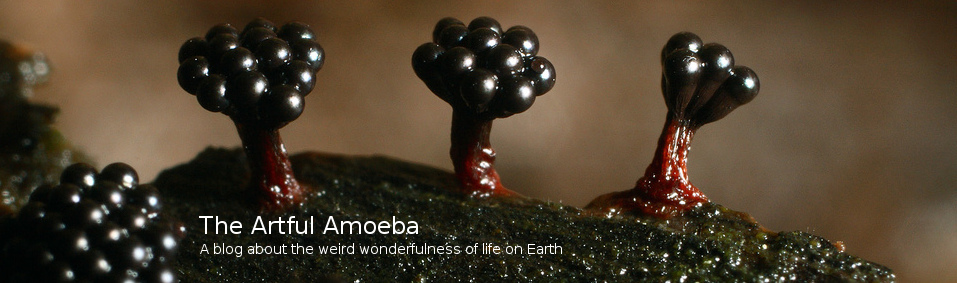
When the time has come for the blessed event, instead of making individual bulbous sporangia (places where spores are made) like the slime mold in the photo at the top of this page, H. serpula simply freezes into a netlike structure and subdivides its entire body into a giant spore mass. I believe this structure goes by the beautiful name “aethalium” (pronounced “ee-THAL-ium”. Should name first-born daughter “Aethalia”).
UPDATE 7/23/09: George Shepherd informs me that this reproductive structure is a plasmodiocarp, not an aethalium. I’m working on figuring out the difference between the two, but when I do I’ll post it here.
After drying out, the structure splits open and a fuzzy mass of spores flies out and blows away in the wind. In the photo above, you can see this is already starting to happen.
Today I give a Pseudopod Salute to ocean explorer Bob Ballard, discoverer of the Titanic, who gave one of the best plain English explanations of tube worms and the importance of ocean research to Stephen Colbert back in February I have ever heard, and seems like a genuinely nice guy to boot:
And what is the most important underwater discovery Ballard’s helped make? Not the Titanic. “The new life forms we found.” Amen, brother!
The life forms in question include the famous Riftia pachyptila, or giant tube worm. Riftia does indeed have “human-like blood” containing hemoglobins similar to ours but also able to bind oxygen in the presence of sulfur (which can be the tube worm bacterial partner’s food), something that would kill most of the rest of the hemoglobin-using world.
Giant tube worms are also among the longest-lived animals on Earth, capable of living over 200 years. They’re in the same phylum as earthworms — Annelida — who also have hemoglobin containing blood. Riftia has tube worm relatives that live shallower in the sea, too. But don’t get the impression these are the only deep-sea worms we’ve found. There are many species adapted to feed on differing parts of the veritable all-you-can-filter buffet of chemicals that ooze, squirt, or jet from the ocean floor.
Take, for instance, Lamellibrachia luymesi, a tube worm that lives in the Gulf of Mexico around cold oil and methane seeps.
Since it lives at colder temperatures (and is less likely than Riftia to get wiped out by a sudden devastating change in the hydrothermal vent plumbing or an underwater eruption), it lives even longer — and may even hold the world animal longevity title at over 250 years of age.
Now I know a lot of my friends are space nuts who love NASA. Who doesn’t love NASA? But I must echo Ballard: NASA’s one year budget to go to places where life doesn’t even exist (most likely) would pay for 1600 years of NOAA research. It just ain’t fair! Think about it: we’d been to the moon for 10 years before we even knew “black smokers” and Riftia communties that live totally independently of the sun existed. What is wrong with that picture? Couldn’t we do a little better for NOAA?
Any lawmakers who might be reading this blog, take note: studying Earth is just as (if not more) important as studying other planets. We live here! And what’s more, weird, wonderful life waits for us in countless crannies, and many of said crannies are under the sea. Let’s go there (and let’s line item one of these for Jen, so she can go there too. : ).
The stinkhorn Phallus impudicus, a species native to Europe and North America, looking happy to see us. Photo credit: Jean-Pol GRANDMONT/Creative Commons Attribution Sharealike 3.0 license. Click for link.
All right, gentlemen. Show of hands. How many of you would be proud to have a two-inch, foul-smelling, penis-shaped fungus named after you? Really?
Well, Robert Drewes, curator of herpetology at the California Academy of Sciences, was certainly pleased as punch. He was the leader of a biodiversity survey to the African islands of Sâo Tomé and Príncipe. When one of his mycologist buddies discovered a new species of stinkhorn, whose genus name, Phallus, pretty much says it all, he decided to name it after Drewes, who already has a snake and frog named after him.
Stinkhorns are basidiomycetes, one of the four major groups of fungi. This group includes mushrooms and boletes (mushrooms with pores underneath instead of gills) and a whole bunch of other interesting fungi we won’t go into right now.
Stinkhorns start out as little eggs, sometimes called “witch’s eggs”, that are considered edible delicacies by many cultures. They don’t stink when they’re little, I’ve been told.
Would you eat this? Me neither. Cross section of a stinkhorn egg of Phallus hadriani, photographed in California. Photo: Nathan Wilson. Published under a Creative Commons Attribution ShareAlike 3.0 license. Click image for link.
But within a few days, the eggs pop open and the “shameless phallus”, as Linneaus called it in Latin, arises from the forest floor. The head is covered in a sticky, carrion or dung-smelling, olive-colored spore mass called the gleba, in which passing flies delight in wallowing. They then spread the spores via the friendly skies.
 The esteemed Tom Levenson, author of the newly released (and well-reviewed) book Newton and the Counterfeiter — and director of the Graduate Program in Science Writing at my alma mater, MIT — has kindly featured my blogs on his with some warm words for yours truly. Thanks for the shout-out, Tom!