The Swimming Green Bomb

by Jennifer Frazer on August 22, 2009

UPDATE: Now with fabulous Swima photos courtesy lead scientist Karen Osborn!

. . . Is not the name of a new DARPA grant project. All over teh intert00bz this week was the story of a newly discovered group of annelid polychaete worms following the publication of a paper describing them in Science. Remember annelids? Segmented (often) worms? The ones with the “human-like” blood? Like tube worms and sludge worms and . . . oh yes, of course, leeches and earthworms. Let’s have a look, courtesy Ed Yong:

Ok, well that’s pretty cool, but not too much to see here. Built like a trireme, moves like a belly dancer, swims in the deep ocea. . . . holy ****! It’s got glowing green sacs of goo on its neck that it launches like floating chinese lanterns when poked!

Swima sp. Used with permission courtesy Karen

Swima sp. Used with permission courtesy Karen Osborn

Wow! According to the scientists who discovered them, the worms are probably using these like submarine countermeasures — the old lure-the predator-towards-the light while you scuttle quietly away. There are four bomb docking points on either side of the neck (the authors call them “bomb bays” in the paper’s supporting material). The worms seem kinda stingy with them, though, and will only release a few at a time if poked. It probably takes them a while to grow back. The authors had the guts to name the genus Swima, and one species Swima bombviridis — the swimming green bomb.

The bomb throwers aren’t rare, either. They are large (a few centimeters long), common organisms that are fairly widely distributed, judging by their pads off both the coast of California and the Phillipines.

And there are many different sorts. Here’s a tree illustrating some relationships between the groups.

A proposed family tree for the genus Swima. Used with permission, courtesy Karen Osborn

A proposed family tree for the genus Swima. Note the bodies are transparent except for the gut. Used with permission, courtesy Karen Osborn.

Inside each bomb are two large and two small compartments that are probably breached when the bomb is ejected to mix chemicals that react to light up the whole sac. At a historic site at Rocky Mountain National Park a few weeks ago I heard about a similar concept in fire extinguisher design from the 1920s. . . break glass to mix chemicals, which react to remove any oxygen, fire, and aerobic life from the room. I’ll stick with my red cylindrical pressurized mace, thank you very much.

Ah-hem. Polychaetes. Right. These worms are polychaetes, which means, roughly, many bristles. The bristles (called setae) are made of a very interesting polysaccharide called chitin, which is found, strangely enough, in hard invertebrate body parts and the cell walls of fungi. Setae extend from parapodia, or foot-like projections from each segment. The parapodia are rife with blood vessels that help the animal exchange oxygen for carbon dioxide.

On the left, a trochophore. Center, metamorphosis. "One day I will be a beeee-utiful chiton". At right, a juvenile.

On the left, a trochophore larva. "One day I will be a beeee-utiful chiton". Center, metamorphosis. At right, a juvenile.

And polychaetes have a very interesting ciliated larval form called a trochophore; that is, they have lots of little filaments that beat back and forth to move it around. Annelids aren’t the only group that has trochophores; mollusks and a few others do too. If you saw one floating in the ocean on its own, you might think it was a protist, or single-celled microbe (hmmm. . . . ). In order to get a big polychaete, the trochophore starts adding segments, and presto chango, you have annelid worm! Above is a picture of the general process for a chiton, a kind of mollusk.

wiki_polychaetes

The variety of known polychaetes, ca. 1800s. I love these 19th century biodiversity prints. Question: Why are they all by Germans? "Borstenwurmer des Meeres". A variety of marine worms. In: "Das Meer" by Matthias Jacob Schleiden, 1804-1881. P. 446. Library Call Number QH91.S23 1888. Image ID: libr0409, Treasures of the NOAA Library Collection

There are some 10,000 known polychaete species in a variety of hallucinatory flavors. Some are free-swimming, like Swima, while others live in tubes or burrows. Many are brightly colored, like christmas tree worms, fan worms, and peacock worms. You can get an idea of the cutting edge knowledge of polychaete diversity (ca. 19th century) from the print at right. Only the freshest and most up-to-the-minute science for you, dear readers.

Yet it is assuredly, despite its intriguing diversity, miserably outdated. We didn’t even know that this major, distinctive polychaete group existed until one swam in front of a submersible in 2001. What else don’t we know about?

For a nice slide show of various Swima species, check out this gallery by National Geographic.

{ 5 comments }

The Biology and Taxonomy of a Second Grade Primer, 1897

by Jennifer Frazer on August 15, 2009

Second Grade Primer, 1897

In my last post I discussed Carol Yoon’s recent article and book on the decline of taxonomy among scientists and the public. Taxonomy, which could easily be a dinner conversation subject and hobby for most of the 19th century (TR had quite extensive collections in his youth, for example), has virtually vanished among the general public today. This was brought to my own attention a few weeks ago, when I discovered a second grade primer published in 1897 on the desk of a colleague who collects old maps.

I opened and began skimming. The inside cover announced in spidery childhood cursive that the book had belonged to one Mildred Pennington, of Cuba, Ohio.

July and early August 2009 061

I looked up Cuba, Ohio on Google Maps and discovered it is nothing but the intersection of  a highway with one or two buildings now.

The first 16 pages were, unfortunately, missing. Here’s the copyright page and the first existing page of the text. The image should be familiar to every American . . .You Know Who is standing in the doorway watching.

July and early August 2009 076

The engravings that illustrated the text were astoundingly beautiful, and stories were an impressive assortment of “modern” tales, fairy tales, and fables. And there were two stories from ancient times, one set in Rome called “Androclus and the Lion”, and another set in Persia, called “Filling a Basket with Water”. Here is an engraving from the Persian story.

July and early August 2009 065

There also seemed to be a fair balance of stories calculated to appeal to either boys or girls.

But what struck me even more was the way natural history permeated the book. There was a story about a boy who nursed the broken wing of a bat he named Bobby, and stories on the natural history of bees and butterflies and the beaks of birds.

July and early August 2009 064

July and early August 2009 066

July and early August 2009 068

Finally, the elusive snipe is found!

And gloriously, On p. 20-22 in the margins were beautiful line engravings and the names of eight different species of oak (scarlet oak on last page not shown).

July and early August 2009 063

At the end of the story, the text asks the student, “Do you know how many kinds of oaks there are? Find as many kinds of acorns as you can. Find as many kinds of oak leaves as you can. Which kind of oak tree grows the tallest? Which kind bears the largest acorns? Which kind has the smoothest bark?”

Remember, this is a reading primer, not a biology or science book.

According to Yoon’s article, a two-year old child of the Tzetzal Maya people of Mexico can name 30 plants, and a four-year old, 100. How many can you name?

At the end of the book is this page. I thought you might like to see it too.

July and early August 2009 069

And being Victorians, they couldn’t help but embellish the back cover as well . . .

July and early August 2009 071

{ 3 comments }

Who Are You Calling a Slime Mold?

by Jennifer Frazer on August 14, 2009

One of my three science heroes: Carolus Linnaeus

The father of taxonomy, one of my three science heroes, and the inventor of the index card: Carolus Linnaeus. In his buttonhole is his favorite flower, the twinflower, subsequently named Linnea borealis in his honor. Note the powder on his coat from his wig. Painting by Alexander Roslin.

That which we call a rose by any other name would smell as sweet, claimed Juliet, but could she say the same for a nameless rose? Perhaps not. In case you missed it this week, fellow Cornell alum and science writer Carol Kaesuk Yoon produced a lovely article in the New York Times adapted from her new book on the decline of taxonomy that is well worth your time.

Taxonomy — the science of naming and classifying organisms — and the study of obscure organisms have been dying long slow deaths, as any taxonomist can tell you. Funding for such projects has often been usurped for molecular, pharmaceutical, or biotechnical work. And of course, these projects are important.

But so is taxonomy, and Yoon argues that the discovery and naming of life is a deep-seated biological urge among humans. Cultures everywhere sort living things into the same basic categories and feel the same urge to give them two-part names. Briar rose, it seems, is even sweeter. This urge is apart from any value we might derive from discovering among new organisms new pharmaceuticals or modes of operating a cell that could inspire us medically or biotechnically (and believe me, the number of crazy ways you can operate a cell is mind-boggling. Click on any group here to get an idea).

More startlingly, she describes research showing it is possible for people to suffer brain injury that makes them unable to recognize anything living, while remaining perfectly capable of recognizing a toaster or stapler. In my conscious mind, I barely remember that something like a carrot is living at all, it’s so far removed from its natural setting. Consciously, I classify it more as food. But people with this disorder cannot look at a carrot and tell you what it is because it is living, regardless of whether you or I or they would consciously think of it that way when naming it. What an amazing finding! Regardless of our difficulty as scientists at deciding on the boundaries of life (see viruses), something deep and innate in human brains does so instantly and unconsciously, and uses it to classify and store new ideas in the index of our minds.

If taxonomy has been declining among scientists, it has virtually disappeared among the general public. Tomorrow I’ll share a small revelation I had in this regard when I stumbled a few weeks ago upon a 19th-century second grade reading primer.

{ 2 comments }

More Bad News for Bats: Marburg Virus Edition

by Jennifer Frazer on August 8, 2009

CDC_marburg_virus_filovirus

The filaments of the Marburg virus, which can be straight or contain a "shepherd's crook", and which gave the filovirus family its name.This photo of the Marburg virus brought to you by the number 11, the letter d, a backwards Egyptian s, and an important (and suggestive) year in US history with a bubble wand on top. Also, by the CDC and Drs. Erskine Palmer, Russell Regnery, and Hermann Rorschach, who in no way support or endorse my interpretation. Magnification 100,000 x.

As if the bats of the world didn’t already have enough to contend with, what with their bad (albeit sometimes deserved) rap for rabies and drinking human blood, numerical decline thanks to habitat loss, and the White Nose Syndrome that is anihilating the bats of eastern North America (and maybe eventually all of North America), last month came news that a reservoir for the deadly Marburg virus had been confirmed: African cave-dwelling fruit bats.

This is big news because scientists have been looking for the natural reservoir species for Marburg and its cousin Ebola for some time. Marburg and Ebola are hemorrhagic fever viruses that are among the deadliest on the planet*. They are sole members of the Filovirus family, and are single-stranded negative-sense RNA viruses. Mortality rates range between a quarter and nine-tenths of those infected. And Marburg is not a pleasant way to go. Here’s how the CDC describes it:

After an incubation period of 5-10 days, the onset of the disease is sudden and is marked by fever, chills, headache, and myalgia. Around the fifth day after the onset of symptoms, a maculopapular rash, most prominent on the trunk (chest, back, stomach), may occur. Nausea, vomiting, chest pain, a sore throat, abdominal pain, and diarrhea then may appear. Symptoms become increasingly severe and may include jaundice, inflammation of the pancreas, severe weight loss, delirium, shock, liver failure, and multi-organ dysfunction.

Sounds fun! Hemorrhagic fevers are so called because they somehow punch holes in capillary walls that allow blood to seep into the body and out of certain external openings you would not wish blood to ever pass through. As recounted in Richard Preston’s gruesome early 90’s bestseller  The Hot Zone , this can cause people to spill or spatter infectious blood all over any unfortunate passersby or airline seatmates (sometimes the little “summon stewardess” button can’t fully convey the depth of your need). It must be said, however, that the bleeding isn’t usually what kills you, and that unlike its cousin Ebola, Marburg is not nearly so inclined to make you bleed from bodily orifices. Whew!

In The Hot Zone, Preston described (at least in my memory) how some cases of Marburg or Ebola were found in people who recently visited mines or caves or who had spent times in rooms or factories where bats roosted. Although some people seemed to acquire the virus from sick apes or bushmeat, scientists already suspected the virus reservoir, or full-time host, was not apes or monkeys, because they die just as we do from the virus. Suspiciously, however, apes and monkeys that transmitted the virus had often fed at fruit trees that bats frequented. But repeated tests of bats and the sticking of unfortunate “sentinel species” in caves to see if they got sick could never produce leads. For decades, scientists were baffled and frustrated. How could such a deadly virus remain so mysteriously hidden?

Then four years ago a survey of more than a thousand small vertebrates Gabon and Democratic Republic of Congo during an Ebola outbreak turned up evidence of asymptomatic Ebola infection in bats, hinting they might be the long-sought reservoir. Inspired, scientists in 2007 finally isolated antibodies and Marburg virus genetic fragments from fruit bats. Then last month an article in PLoS Pathogens contained the damning evidence: the isolation of live infectious viruses from the Egyptian fruit bat (Rousettus aegyptiacus) in Kitaka Cave, Uganda. There can be little doubt now that bats are carriers.

Could you resist this face? No! Bad bat! Don't give me deadly hemorrhagic Marburg fever!

Could you resist this face? No! Bad bat! Don't give me deadly Marburg Hemorrhagic Fever! The Egyptian Fruit Bat, Rousettus aegpitiacus. Courtesy Dawson, Creative Commons Attribution 2.5 License.

The infected bats appeared healthy, and the genetic diversity of the viruses found in Kitaka Cave seems to indicate Marburg has been living with and adapting to the bats for a long time. If the virus had only recently penetrated the bat population from another species, you’d expect there to be only one or a few virus types.

Moreover, a significant share of the bats in the surveyed cave are infected. About 5.1% of their sample hosted the virus, which, if extrapolated, would mean over 5,000 bats out of an estimated 100,000 in the cave are infected. And indeed, two miners infected in Kitaka were sickened by different strains of the virus, implying they picked up their diseases independently and that human transmission is not a rare event. The strains, though different, closely matched the sorts of strains found in the scientists’ fruit bat samples.

Although the viral lineages were highly variable within Kitaka Cave, some strains found in one part of Africa were much more closely related to strains found in caves hundreds of miles away than they were to strains in their bat neighbors. As the bats migrate hundreds of miles and mingle over most of the continent annually, it’s not hard to see why Africa may be one giant Marburg virus melting pot.

I just hope this news doesn’t prompt a bat holocaust in Africa on the part of people, corporations, or authorities. Bats have enough troubles already and [cliche alert] provide valuable ecosystem services[/cliche alert] by hoovering up pesky insects and/or dispersing seeds. The solution, I think, is bat avoidance, though how practical that is in a mine I do not know.

Note to self: scratch caving in Africa off to-do list**.

————————————————————

*In other news, the first-ever case of Marburg in the United States was recorded in February in Colorado . . . wait, what? A deadly Ebola relative made its way to Colorado this year and I didn’t even know it? How they managed to keep the fact that a virus with a 90% mortality rate was in Colorado on the DL I’ll never know, although I did find an article in the Rocky (RIP) about it ex post facto. I need to start keeping closer tabs on our local newsgathering establishment.

**Several of the people who got sick (including the Colorado victim) did so after visiting some sort of “python cave” in Uganda that also is home to thousands of bats (do the snakes just sit on the ground with their mouths open waiting for manna from heaven?). Second note to self: question sanity if *ever* consider visiting something called a “python cave”.

“Snakes. . . . why’d it have to be snakes?”

“Pythons. Very dangerous. You go first.”

{ 2 comments }

Lichen, Take Me Away!

by Jennifer Frazer on August 4, 2009

You may think that if you’ve seen one lichen, you’ve seen them all. Oh, so not so. Yes, many of them do resemble your common leathery grey-green patches plastered on trees like bark band-aids. But there are so many, many more. If you look around, they are everywhere, and they are gorgeous. Today I bring you a delightful seven-minute video with music showcasing some of the diversity of form and color in lichens, and I hope you will wait until you can take a little 10-minute break to relax and savor it.

Lichens are more or less co-ops between fungi and green or blue-green algae, which are photosynthetic microbes. The fungus makes the “house”, protects the alga from dessication, and absorbs minerals from the surface it’s living on, while the algal cells, sandwiched in between thick fungal layers in a cage of filaments, soak up rays to do the cooking. Because many of the algal species found in lichens can live quite happily on their own, (ever seen otherwise bare-looking tree bark glow green on wet days? That’s free living algae) scientists don’t actually agree over what the relationship is, exactly, between the fungus and the alga.

Has the fungus enslaved the alga, purposely keeping it barefoot and pregnant and locked inside its mycelial kitchen? Or are they best buddies homebrewing lichen compounds (the chemicals that make so many brightly colored) in the lichen frat house? Is the nature of the relationship more or less consistent for all algal species, or does it vary? These are fascinating questions which, to the best of my knowledge, are still not fully answered.

I have not forgotton about finishing up the Very High Life series, but life has intervened, and one weekend of busy-ness has turned into three in a row, and on top of that I remodeled my house and am writing a freelance story that is competing for my blog working time. I will not leave you hanging at 17,000 feet forever, I promise. But FYI, I may be posting less frequently and less lengthily for the next week or so.

{ 0 comments }

The Hungry Amoeba

by Jennifer Frazer on August 2, 2009

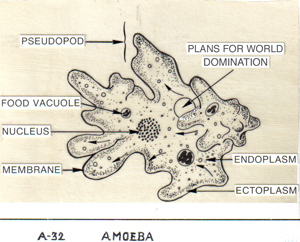
Oh, those wily amoebae. I think we’ve all had days like this at the office. Some sensitive viewers may find this disturbing, although no more disturbing, I suppose, than watching a gazelle get chased down by a cheetah on the Discovery Channel.

The poor little guy who gets it in this video is a little ciliate flagellate(single-celled organism with a long propeller-like propulsive tail) named Chilomonas, according to Psi Wavefunction (thanks Psi!). This little drama is one example of the billions of such daily struggles that go on every day in the soil and water all around you. With our daily lives so full, it’s easy to forget.

This process of eating by engulfment is called “endocytosis” by biologists, which is a fancy term for “into the cell”. Specifically, this is “phagocytosis”, or cellular eating. Many cells can also perform pinocytosis, or cellular drinking, where cells can ingest small bubbles of water. Plasmodial slime molds (oft mentioned and beloved at this blog) start out as single amoebae like this, doing pretty much this the exact same thing in the soil. When they fuse to form a plasmodium, they’re feeding the same way — just at 5 Jillion X.

{ 0 comments }

A Tick in the Family Way

by Jennifer Frazer on July 28, 2009

Today is my birthday (woo hoo! I survived another year!).  In honor of this feat I will take a break from my Very High Life posts to bring you the touching birthday story of . . . several hundred baby ticks. It all began with a very full mama tick . . .

wiki_deer_tick

Not a full tick nor even yet a mama tick. Tick for illustrative purposes only. Do not lick tick. This is Ixodes scapularis -- the deer tick.

. . . which was plucked off a dog and, rather than being flushed, was stashed in a glass vial in a very simple science experiment we could all conduct at home. I cannot decide whether what happened next was more cool or more gross . . . you decide. With pictures!

{ 0 comments }

The Very High Life: Part Two

by Jennifer Frazer on July 23, 2009

Now that I’ve convinced you you probably shouldn’t take your next vacation in the Atacama Desert (unless you’re into that sort of thing, if you know what I mean), let’s look at the organisms that scientists did find living and loving life in the 3 3/4 Mile-High Club.

Living on the moist, warm ground were moss and liverwort gardens 30 feet across. Wait. . . liverwort? Liverworts are amazing moss relatives that can produce leathery lichen-like bodies with an emporium of odd-looking reproductive structures. They’re called liverworts because supposedly, their odd protuberances can resemble livers. In medieval times, people thought that if a plant looked like something, that was God’s way of telling you that it was good for treating it, a philosophy called the “Doctrine of the Signatures”. So if your liver was ailing you, you might get a tincture or powder of liverwort to take. As it turns out, that’s not such a great way to identify potential drug candidates, but I digress. . .

The geeky-cool liverwort. The photographer notes that this one is probably Marchantia of Botany 101 fame. <div xmlns:cc="http://creativecommons.org/ns#" about="http://www.flickr.com/photos/benetd/1173890352/"><a rel="cc:attributionURL" href=

The geeky-cool liverwort, likely Marchantia of Botany 101 fame. http://www.flickr.com/photos/benetd/ / CC BY 2.0

The most well known liverwort — Marchantia — makes fake-palm-tree-like female reproductive stalks and nail-like male ones (not pictured). It’s such a successful little guy that this species has even become weedy. When I worked at a garden center one summer after graduating college (yes, the first job I got with my shiny new bachelor’s degree was weeding and watering plants) it was not uncommon to find liverworts crowding the soil at the base of a plastic pot. Apparently the twice daily (at least) watering routine at plant nurseries agrees with them.

In the wild, these little plants are often found growing near brooks, even here in Colorado, where I have seen them (uncommonly) growing next to streams in Rocky Mountain National Park. In the above picture, you can see another of their crazy reproductive structures, asexual gemma cups. They look like little bird nests. In the cups, little lens-shaped or spherical tissue packets called gemmae are formed asexually. When raindrops land in them the gemmae are splashed out and land on soil elsewhere. If they start growing and take root . . . voila! New liverwort.

The leafy liverwort Jamesoniella autumnalis. Used with permission courtesy of Robert W. Freckmann Herbarium, University of Wisconsin, Stevens Point.

The leafy liverwort Jamesoniella autumnalis. Used with permission courtesy of Robert W. Freckmann Herbarium, University of Wisconsin, Stevens Point.

However, that’s a thalloid liverwort. The leathery projections in the photo above are referred to as a thallus or thalli (pl.), because they are undifferentiated (into leaves, stems, etc.) plant tissue. But there is a second type of liverwort: leafy. That’s probably a bit deceptive because mosses and liverworts (a group referred to as bryophytes) don’t have true leaves, shoots, or stems, a botanical nicety whose explanation I will spare you for now. The liverworts found atop Socompa appear to be of this type. When scientists sequenced part of their DNA, they found they were most closely related to a species called Jamesoniella autumnalis, which can be found in North America. Here is a picture of one found growing in Wisconsin.

And here are its crazy reproductive structures:

Can you get Dish Network with those? The sporophytes (spore making plant) of Jamesoniella autumnalis. Used with permission courtesy of

Can you get PBS with those? The sporophytes (spore making plant) of Jamesoniella autumnalis. Used with permission courtesy of Robert W. Freckmann Herbarium, University of Wisconsin, Stevens Point.

To keep this post from turning book-length, I’ll merely mention that, believe it or not, the pointy-looking things you are looking at in this photo are a completely different organism of the same species as the plant they are growing out of. Plants do an amazing thing called “alternation of generations” in which they alternate between haploid (one copy of genes) and diploid (two copies of genes) organisms. All plants do this — even petunias and apple trees. Where is the second plant of those species? Ahh . . . I’m glad you asked. But that shall have to remain a mystery for another day. : ) In this case, the green thing underneath has single chromosome copies, and the pointy things above have the dual, and their sole purpose, as they parasitically grow out of their parent plant, is to grow tall enough to broadcast the spores they are making inside those little black heads.

The mosses that were found on Socompa were related to the copper moss (love that name!) Mielichhoferia elongata which, as far as I an tell, look pretty much like your standard moss but tend to grow on copper-rich rocks. That’s not surprising, given that a few miles west of Socompa is — the Escondida Copper Mine. Mosses also have alternation of generations and a beautiful but somewhat less eclectic selection of reproductive structures, but I will save that discussion for another day.

It’s unsurprising to find mosses and liverworts at such a spot on Socompa because mosses and liverworts are what biologists would call “ancestral” — that is, they more closely resemble the common ancestors of plants than conifers or flowering plants do. They are of a form that is necessarily tied to water, since those ancestral plants had only recently left the oceans. In fact, mosses and liverworts cannot live without flowing water during at least part of their lives, because to make that pointy thing (called a sporophyte — or spore plant), a sperm has to swim out of the boy-part of the plant through a film of water on the surface of the plant to find the girl part of the plant. How’s that for sperm mountaineering? But aside from their need for water, bryophytes are quite hardy. When the first plants sprouted out of the seas, land was probably a forbidding, empty, UV-drenched place. Sound familiar?

I’m going out of town today, but next week I’ll be back with a look at some other great critters from Socompa.

{ 1 comment }

The Very High Life: Part One

by Jennifer Frazer on July 20, 2009

Even in a wind-blasted, God-forsaken place like the top of Long’s Peak, Colorado — 14,259 feet — moss and lichen grow abundantly among the rocks. I’ve seen them there, snugly hunkered down on the acres-wide summit. This is a place that sees about a month or so of semi-balmy weather per year, followed with 10-11 months of relentless UV, ice, snow, freezing fog, blizzards, climbers, more ice, and the occasional crazed skier. Truly, there are few places on Earth life can’t make it.

What makes the following story (which I discovered here) so amazing, though, is the abundance of life — veritable oases, really — at almost 19,850 feet near the blasted summit of Socompa Volcano in the Andes. Scientists from the University of Colorado at Boulder led by Dr. Steven Schmidt recently traveled there to investigate reports of complex plant communities growing at these extremely high altitudes on volcanic vents. The nearest, albeit sparse, plants growing without the benefit of vents peter out at about 15,100 feet — nearly a mile below. If the scientists confirmed their existence, such plant communities would be the highest known on Earth.

Socompa Volcano straddles Argentina and Chile in the Atacama Desert. 7,200 years ago, it was the site of a volcanic cone collapse ten times bigger than that of Mt. St. Helens, which you can see in this image of Socompa taken from space.

Just be glad you weren't there when this baby collapsed.

Just be glad you weren't there when this baby collapsed. Courtesy NASA.

First, a little perspective on the freezing, arid death-zone that is the top of Socompa, from the paper by the CU scientists in Applied and Environmental Microbiology (subscription required):

Here, along the western slope of the Andes mountains, the hyperarid Atacama Desert extends up to 3,500 m in elevation, above which climate records for the volcanic peaks to the east, including Socompa, are scarce. In this region, summer precipitation generally occurs as transient snow or hail, winters are cold and dry, and vegetation is sparse and limited to between 3,500 and 4,600 m elevation (4, 22). Mean annual temperatures below –5°C and precipitation of <200 mm are likely for Socompa (4, 25), and the absence of glacial features or permanent snowfields on the mountain is indicative of the arid climate (23). The region is cloud-free throughout much of the year, which, along with the high elevation, contributes to extreme solar total and UV irradiances (39, 44). Socompa’s slopes are barren for many square kilometers, as the highest vascular plants in the area are restricted to below 4,600 m elevation.

Let’s review: mean average annual temperatures below -5°C (that’s the mean?!), less than 20 cm (8 inches) of rain or snow for the year, and ~12/7 tanning-bed-turned-up-to-11 conditions. Have they checked for spice deposits?

Yet the fumaroles of the volcano provide warm, moist refugia from the otherwise-forbidding land. Fumaroles are cracks in the earth where gasses let off by magma or by water heated underground reach the surface. The fumaroles on Socompa seep warmth, carbon dioxide, water, and methane.  They are particularly inviting to life, the authors of the new study report, as they are not spewing steam, toxic sulfuric gases, acids, or [Dr. Evil voice] liquid hot magma [/Dr. Evil voice]. Not that a few forms of life wouldn’t find a way to work around or with most of those things, but you do tend to catch more flies with honey than with boiling acid.

So as I said, scientists, who for completely unfathomable reasons had failed to thoroughly investigate this volcanic Club Med previously (they seemed to find places like the Galapagos and the South Pole more inviting) finally ventured up there for a detailed look. What did they find? Wonderful things . . . which I will chronicle for you next time.

Coming in Part Two: Living delights from 2/3 cruising altitude.

{ 0 comments }

Virus as Muse, Cruft as Medium

by Jennifer Frazer on July 16, 2009

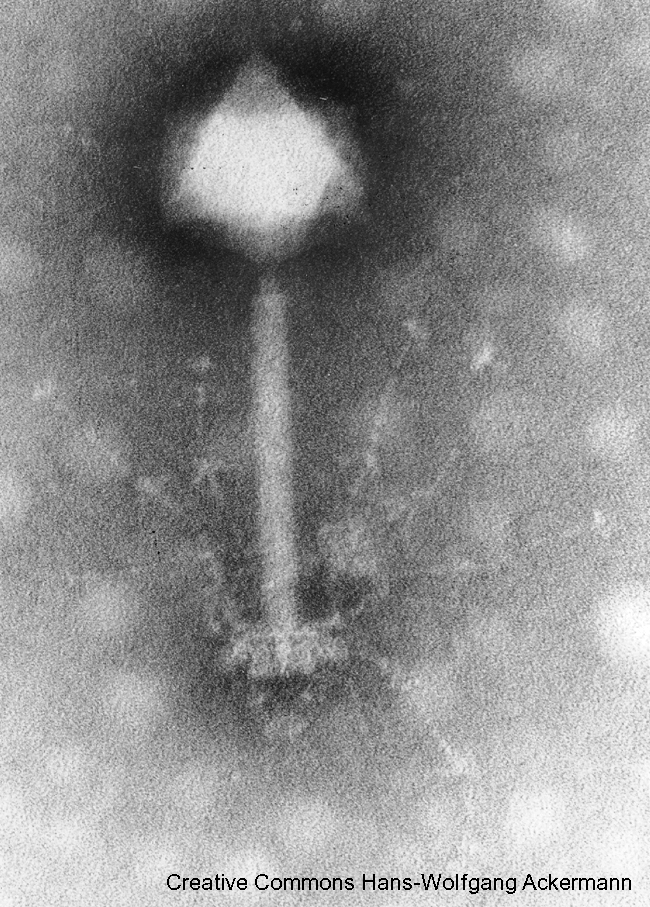
This is a bacteriophage.

Kind of eerie and ghostly, isn’t it?

It’s a virus that infects bacteria, looks like the lunar lander, and was among the first viruses ever discovered. These guys may also be the most ubiquitous biological entities on the planet; you may be swallowing untold millions in every accidental mouthful of fresh or seawater. Did I mention the water’s teeming with the bacteria and archaea they prey on too?

Most viruses are either simple rods, spheres, or polyhedrons (often icosahedrons — 20-sided polyhedra, of course). This baby is both and then some. In the world of virus architecture, this is the fully loaded Corvette with T-tops, all-leather seats, and pre-installed hot chick. It is a natural work of art.

So why didn’t someone think of this sooner?

I have no idea who this guy is but I like how he thinks. There’s a certain delicious irony in using old computers to build models of . . . viruses. My capsid’s off to you, sir. Who needs a lawn gnome when you can have a lawn phage?

{ Comments on this entry are closed }