Marine Census Illustrated

by Jennifer Frazer on January 7, 2011

Myzostoma cirrifera. Upper layer of internal organs on the right, lower level at left. More on this guy below. Creative Commons W. Blaxland Benham (after Lang and von Graf)

As we ended last year with a slide show, so shall we begin this year with another. The Census of Marine Life has been a herculean 10-year mission to seek out new life and new civilizations (OK, maybe just one of those) in the ocean. The hundreds of scientists involved have succeeded spectacularly, though still have likely only scratched the surface.

Last fall scientists disclosed many of their results, and some of the most striking images have been collected by National Geographic into a tome called “Citizens of the Sea“, available since last fall. Cornelia Dean (science reporter and former science editor at the New York Times, who I was fortunate enough to meet in grad school (for science writing)) reviewed the book in the Science Times on Tuesday, and included a spectacular slide show that is above all what I’d like you to look at today.

But before I write more about that, my first impression of the book from flipping through it on Amazon is that it is curiously out-dated graphically. Its chunky photo layout and washed-out art seem like something you’d find in a National Geographic book from the 1980s. It pales in comparison to the stunning layouts and vivid photography of the University of Chicago Press’s “The Deep” and DK Books’ “Reef” and “Prehistoric Life”. The book also seems heavily weighted (as most are) toward metazoans, or, to put in in English, the big stuff in the ocean. As usual, microbes, protists, and larvae are missing out of proportion to their importance.

Of course, that has no bearing on the text, which I have not had time to peruse, and seems it may be more substantial than what you get in those other books since it was penned by Nancy Knowlton, a marine biologist at the Smithsonian. And judging by the nine five-star reviews at Amazon (the book received no ratings less than five), the writing is where the book shines, just as much as it is wanting in those other books.

Still, as Ms. Dean points out, the book is a bit scattershot taxonomically, making it hard for readers to understand biodiversity systematically. That omission — common to many books — is part of why I started this blog. When you can fit new organisms into general taxonomic groups in your head and relate them to other groups, it not only makes organisms easier to remember and their biology more understandable, it helps you understand the path of evolution too.

OK, back to what really matters: the critters. A few comments on the organisms in the slide show: When I was in grad school (for mycology), I studied fungal spores that, while admittedly huge for fungi, were on the order of the same length as the copepod (Ceraqtonotus steinigeri) pictured in the show — 200-300 micrometers (not my spore photo, but take a look here). That’s right: there are fungal spores as big as that copepod, which looks like it could be shrimp-sized if you didn’t have the scale bar to tell you better. Think about that.

You’ll also notice that the show features two — countem, 2! — new Arctic bryozoan species. Remember the bryozoans — the moss animals? I covered them in my first guest blog at Scientific American. The photographs are of their calcareous skeletons only — the little animals you’d find poking their lophophores (crown of feeding tentacles) out of those holes are conspicuously absent, probably due to the preparation method involved in scanning electron microscopy — that is, spraying your sample with a film of gold.

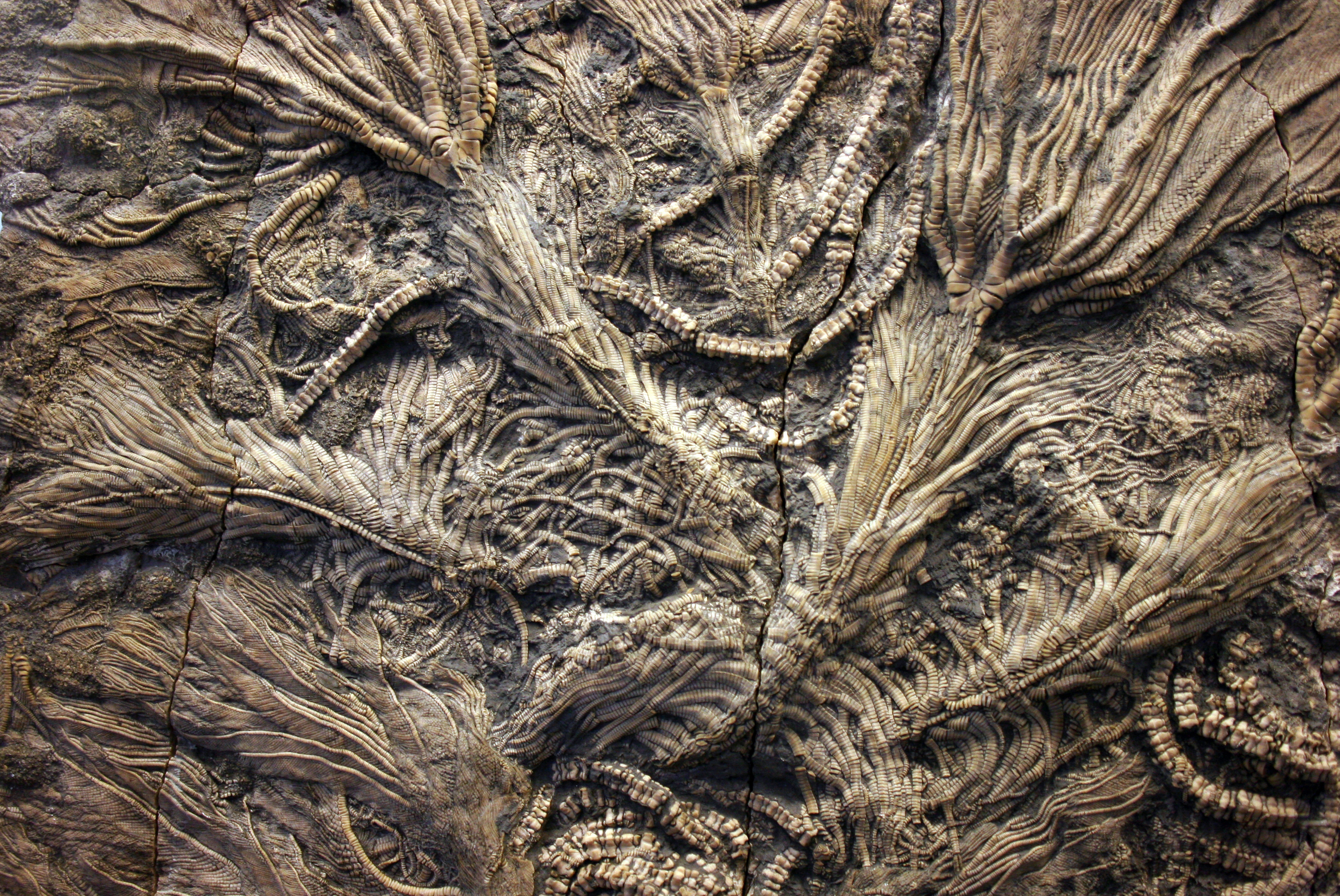
Finally, I want to point out a delightful little organism new to me — the myzostomid, or parasite of crinoids, or sea lillies near the end of the show (see additional illustration at top of this post). I could write a whole book about the sea lillies and their charms (they were super-abundant in former times, and their fossils are still so. You can find little stem pieces in marine rocks all over North America, and the most stunning collections of fossilized sea-lily beds are swirling virtuoso works of Art Nouveau). But this little guy (being unceremoniously trod upon by a limelight-hogging shrimp) is apparently a representative of an entire group that has evolved just to parasitize sea lillies*. The myzostomids, while unrelated taxonomically, seem to be part flatworm (their diverticulated reproductive system resembles the dendritic digestive system of flatworms), part chiton/scale insect (their shield-like bodies). They’ve even adopted the vivid coloration of their hosts.

And here’s the kicker: they’re annelids — the group traditionally known as “segmented worms”, the most famous member being the humble earthworm. You see the segments? Me neither. Evolution: the great aimless wanderer. But oh, what beauties it stumbles into.

___________________________________________________________

*They’re active feeders on sea lillies, so I don’t know why the slide show caption says that it’s “commensal”, or a passive guest. Of course, Cornelia also says that the tubular eyes of the barreleye fish stick up above its head, when, as expertly covered by Steven Colbert two years ago, they are clearly inside its see-through head. Don’t get too mad at Cornelia, though. As a former reporter, I can say we do our best, but we’re on deadline, and sometimes we make mistakes.

{ 2 comments }
Attention Female Slugs: Beware Ninjas Bearing “Gifts”

by Jennifer Frazer on December 30, 2010

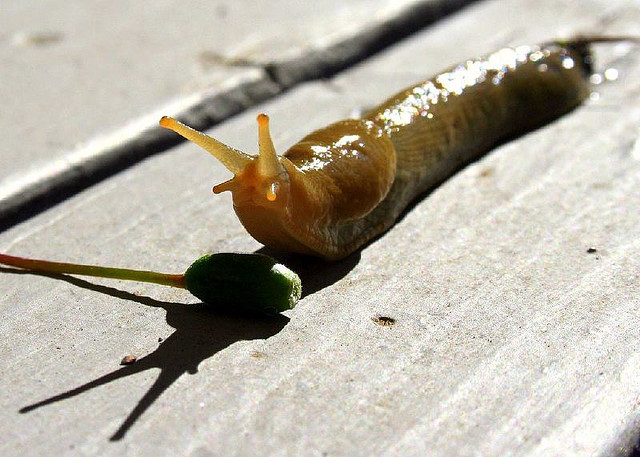
This is *not* the ninja slug, but if you imagine that seedpod is a katana, we're 90% of the way there. OK, maybe not. Creative Commons papalars. Click for link.

As the year rounds down, I wanted to point you in the direction of a nice gallery put together by the editors at National Geographic of 2010’s weirdest new animals.

My fave: the ninja slug of Borneo. Apparently these guys shoot calcium carbonate hormone-soaked “love darts” into their paramours. Somehow this increases reproductive fitness, though whether it does so by helping lady slugs make more eggs or by putting them more “in the mood”, if you know what I mean, Nat Geo does not say. The wikipedia page seems to imply love dart hormones increase sperm survival on the part of the shooter, and that the use of the darts is fairly widespread among land snails and slugs. As with so many invetebrate systems, I’m *really glad* this is not a part of human courtship. Do not miss the gallery of love dart photos and drawings at the bottom of the page — fascinating. On a related note, anyone who has not scene the epic snail love scene (complete with opera music) in “Microcosmos” is greatly missing out. The snails look like they’re having more fun than most humans. Run, do not walk.

Taxonomically, slugs are snails that lost their shells. Like lichenization, this turn of events has taken place many times in unrelated groups, so “slugs” are what taxonomists call “polyphyletic”, or not a true, valid taxonomic group (which should always be based on a single ancestor and its descendants — that is, a monophyletic group). There are even some slugs that are still in the process of losing their shells and carry a tiny shell too small to duck into on their back, rendering them “semi-slugs”. Slugs are gastropods, which are in turn molluscs. You can see how it all fits together and who else they’re related to here. That’s it for 2010! See you in the New Year!

{ 2 comments }

Guaranteed White Christmas for the Albino Redwood

by Jennifer Frazer on December 24, 2010

Creative Commons Cole Shatto. Click for link.

In the murky redwood forests of California and Oregon grows the elusive albino redwood (Sequoia sempervirens). You may remember redwoods from their fame as the tallest trees on Earth. The albino variety grow as sprouts from the base of mature redwoods, a preferred form of reproduction in mature redwood forests where it is too dark for seeds to germinate. When the tree keels over, normal sprouts will be ready to take its place. Unless the sprouts are white — and thus totally incapable of feeding themselves. I’ve seen many a parasitic, achlorophyllous plant in my day, but they are all small and feed off the roots of others. Most trees are free living, and so any albinos they produce — which apparently does happen — won’t make it long (mycorrhizal fungi can’t save them because they need the food from photosynthesis too). But when your mom is 300 feet high, she’s probably making enough food to support a 5-60 foot freeloader.

Here’s a nice video showing from a public television station telling you more about these beauties. The guy at the beginning and end is a little over the top for me, but I love the park docent in the middle.

Mr. Kuty one mistake: he meant to say not that redwoods have six chromosomes instead of two, but that redwoods have six copies of their chromosomes instead of two copies (one from mom, one from dad), like us. That is, they’re hexaploid. Plants are known for their polyploidy; somewhere between 30 and 80% of them are, and they seem able to tolerate a fusion of gametes where meiosis was incomplete in one or both, or to hybridize with related plants in ways that would would devastate development or render offspring sterile in most vertebrates. Suddenly doubling the number of chromosomes also reproductively isolates plants, and seems to be a major source of new species. This can even happen between species. In the plant world, a quadriploid (4x) wheat plus a diploid (2x) rye = hexaploid (6x) triticale. Duplicating sets of chromosomes can have interesting effects. Hexaploid wheat make a much meatier head of grain than diploid wheat.

Here are some other examples:

* Triploid crops: apple, banana, citrus, ginger, watermelon
* Tetraploid crops: apple, durum or macaroni wheat, cotton, potato, cabbage, leek, tobacco, peanut, kinnow, Pelargonium
* Hexaploid crops: chrysanthemum, bread wheat, triticale, oat, kiwifruit
* Octaploid crops: strawberry, dahlia, pansies, sugar cane

Some crops are found in a variety of ploidies: tulips and lilies are commonly found as both diploid and as triploid; daylilies (Hemerocallis cultivars) are available as either diploid or tetraploid; apples and kinnows can be diploid, triploid, or tetraploid.

Scientists aren’t sure about the origin’s of Coast Redwood’s six sets of chromosomes — whether they came from the same species or from a hybridization of two, but there’s evidence it might be from two (AAAABB). Polyploidy is somewhat unusual for conifers. Also unusually for conifers (and for any life in my understanding), its mitochondria are inherited from sperm, not eggs. As you may know, mitochondria are subcellular organelles that produce energy for the cell. They take up space. Eggs are big, and they usually contribute all the mitochondria to a new zygote, which is why in humans, mitochondrial diseases always come from your mother. Yet in redwoods, that doesn’t seem to be the case. Which begs the question: what do redwood sperm (like all gymnosperms and flowering plants, found inside the pollen grain) look like?

Here’s another interesting little coincidence: in addition to being hexaploid (6x), Sequoia sempervirens has exactly 66(!) chromosome, implying the original species had 22. Chromosome number isn’t really meaningful (since chromosomes can have arbitrary lengths), but just for the record, we have 23. : )

Here’s what I still don’t understand: if these things are simply clones that sprout from the base (botanists call them “suckers”), why are they not genetically identical to the parent? Hmmm. . . . In the video and in this story on NPR, they seem to imply that the plant’s hexaploidy is involved . . . but no one gives a mechanism. Without sex, whence the novelty? (if I had a dime for every person who’s asked that question . . . )

Quote of the day: “It’s just that this offspring is the one that sits on the couch rather than going out and getting a job.”
Course, one might still argue that is parasitism. : )

Redwoods, by the way, are in the family Cupressaceae. Their closest relatives are the dawn redwoods (an amazing story of a fossil species presumed long dead discovered alive in a temple in China during World War II) and giant sequoias, the largest trees on Earth. Other relatives include junipers (of gin flavoring fame), cypresses, arborvitae, and the famous southern swamp tree bald cypress.

Merry Christmas, everyone*! For more lovely photos of the albino redwood, click here and enjoy. : )

*In a totally non-sectarian, universal holiday cheer sort of way. Idea for this post brought to my attention by Kati Dimoff. Thanks, Kati!

{ 6 comments }

The Brave New World of Giant Viruses

by Jennifer Frazer on December 22, 2010

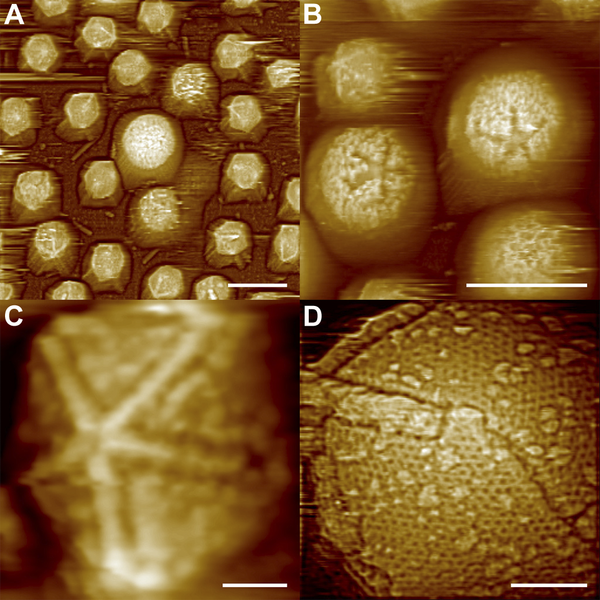
Creative Commons Xiao et al., Public Library of Science. Click image for link.

I’ve got a new post up at the Scientific American Guest Blog: “Pimp My Virus: Ocean Edition” about the fascinating and newly discovered world of giant viruses. You haven’t seen viruses like this before.  Hope you enjoy!

{ 5 comments }

The 12 Days of Plankton

by Jennifer Frazer on December 17, 2010

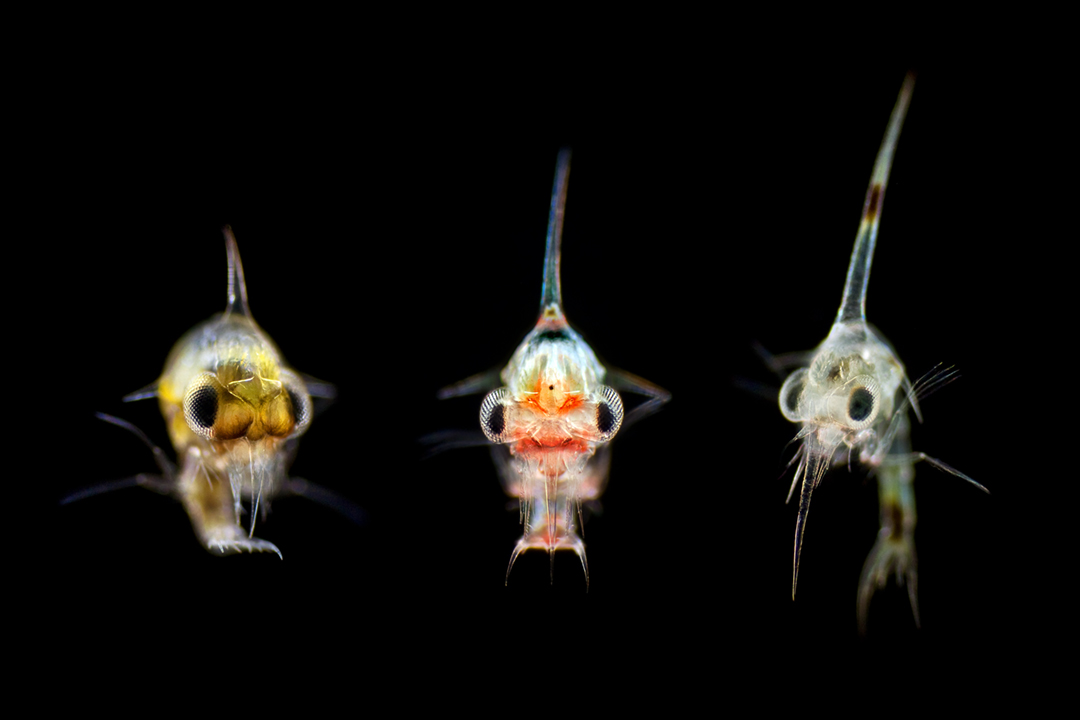
Seawater is a soup of incredibly gorgeous and intricate creatures with sometimes titillating, baroque, or improbable lifestyles. And as it turns out, part of what’s in that soup is these guys. These three cuties are all crab larvae — from left to right, the zoea larva of the spider crab Maja squinado, the angular crab Goneplax rhomboides, and the thumbnail crab Thia scutellata. Mr.(Ms.) Thia looks like the adorable spawn of something you’d find torturing St. Anthony or in a Hieronymus Bosch painting (or both).

Regardless, they are way cute, and if you can believe it, said fellow(gal) at right will one day (predation permitting) turn into this. As Dr. Kirby points out, many crabs, mussels, barnacles and worms that live on the sea floor as adults send their larvae out into the plankton to feed, grow, and drift on currents to new homes. This works great if your offspring are legion and can therefore withstand the blistering assault of predators mining the plankton for food.

These beautiful photographs are the works of Dr. Richard Kirby, whose work I highlighted earlier this year here. He has put together a collection of plankton that reminded him of Christmas. So since I have done zero holiday decorating at home, I’ll spruce up the blog a bit with photographs Dr. Kirby kindly gave me permission to reproduce.

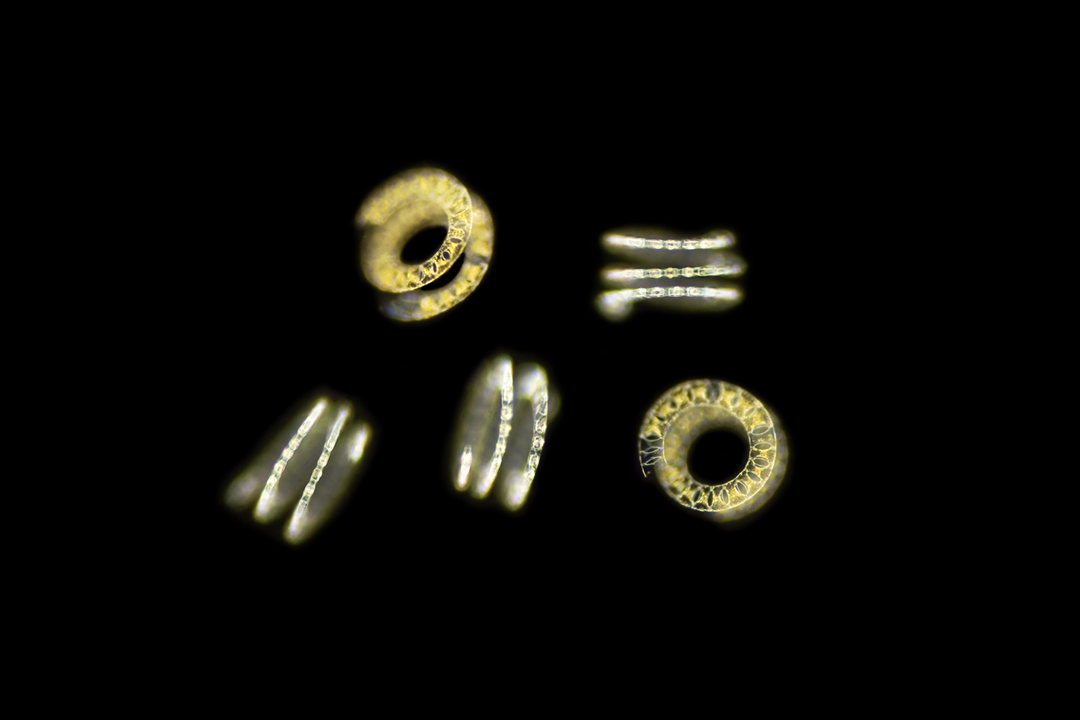
Here are “Five Gold Rings” — spiral chains of the diatom Eucampia zodiacus. Notice the gorgeous, lacy details of the spans, which are gold because there are tiny symbiotic photosynthetic phytoplankton inside called zooxanthellae.


And here’s one other favorite, the protozoan Acantharea.

I have covered diatoms before here, but not Acantharea or their larger group. Though Kirby compares them to fireworks, I see ornaments, which you can see too in Ernst Haeckel’s predictably gorgeous print here. They are radiolarians, amoeboid (yay!) protozoa that make intricate mineral skeletons. Acantharea‘s are somewhat improbably made of strontium sulfate — the mineral celestine, in keeping with our holiday theme — of all things. The acanthareans are currently classifed (probably not for long, as soon as the molecular people get their hands on them*) by their spine arrangement in a complex, and somewhat sadistic fashion that only a geometer could love.

For the full 12 Days of Plankton, go see a nice article with all the photos in the Daily Mail here, or a composite of slides here. He has just published a book of his photographs with descriptions, which I have not laid hands on or looked in yet, so cannot yet vouch for, called “Ocean Drifters: A secret world beneath the waves“. Though I cannot vouch for the book, I can definitely vouch for the subject.

I’ll have a few more posts before the 25th, but until then, early Merry Holidays.

________________________________________________

*Molecular people will classify them based on their relatedness as shown by DNA studies, not their outward appearance. Sometimes outward appearance is an accurate gauge of true relatedness, and sometimes you end up with whale and fish (aka convergent evolution).

{ 3 comments }

When Sperm Whales Get the Munchies

by Jennifer Frazer on December 10, 2010

Produced by the Te Papa Museum in New Zealand (their National Museum) for an exhibit that ended two years ago, this movie is still cool. Displayed here for your weekend viewing enjoyment, and discovered via Deep Sea News.

Come on — isn’t life on Earth amazing? Everyday, all day, nearly two-thirds of the earth is full of those blinking, winking, hungry things in the deep, waiting to snatch something for dinner, not unlike fish-hungry Gollum paddling about in his wormhole at the root of the Earth. Right now. All over the the world. And a creature whose ancestors was once a diminutive furry land mammal that looked like this now plies those waters — masterfully.

For another look at scientists’ encounters with bioluminescent creatures in the world’s most common ecosystem there’s a nice History Channel excerpt at a Smithsonian site here.

For the full length version of the video and a nice explanation of what you just watched, go here. This video was brought to you by the same people that were lucky enough to get their hands on a specimen of colossal squid, which I wrote about toward the end of this post.

{ 0 comments }

Of Arsenic, Slime Molds, and Life on Other Worlds

by Jennifer Frazer on December 9, 2010

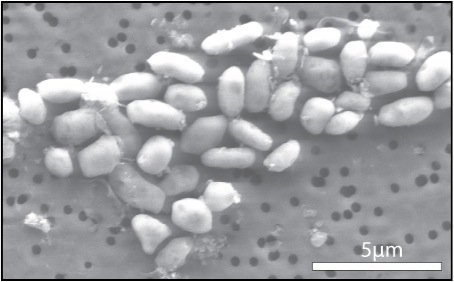
I have kept silent on last week’s announced discovery of bacteria from Mono Lake, California, alleged to be able to grow using arsenic instead of phosphorus — until now. I was reading a news analysis on the subject of the improved odds for life given this and other recent discoveries in biology and astronomy in my morning paper and stumbled on this intriguing allegation:

Another reason not to get too excited is that the search for life starts small – microscopically small – and then looks to evolution for more. The first signs of life elsewhere are more likely to be closer to slime mold than to ET. It can evolve from there.

I’m not sure whether to take that as in insult to an incredibly evolved and highly complex life form or not. Hey — how many protists do *you* know that can learn to anticipate regularly timed stimuli, drive robots, solve mazes, and plan high-speed rail routes? Nonetheless, I do get his point — that if we do find life, it’s not likely to have made it much past the basics of cell, membrane, and genetic code. Which got me thinking about something that’s bothered me for a while.

I have been to Mono Lake (pronounced “moe’-noe”), and it is truly an unearthly place. I can see why one might search there for  — as they put it on Wait, Wait Don’t Tell Me this week — yet another alternative lifestyle in California. I know the basics of the chemistry involved, but I don’t know enough to know — as has been claimed by several critics — whether what the scientists have found is highly dubious. According to Carl Zimmer’s roster of experts, it’s all but impossible the authors of this paper performed good science with valid conclusions, although it’s not impossible arsenic-based life exists. (Aside: One of the authors, Felisa Wolfe-Simon, named the bacterial strain GFAJ-1 for “Give Felisa a Job”. Although I normally 100% support such creative naming efforts (scientists are usually dull as dirt when it comes to naming things, and why not name things creatively? One classic example: a development gene named hedgehog inspired the name of a related gene: “sonic hedgehog“), in light of recent events, Felisa’s probably regretting that now.)

But here’s what bothers me about the leap people make whenever they find bacteria that can eat arsenic or live in boiling acid or leap tall buildings in a single bound: that finding extreme life here on Earth makes finding it on other planets more likely. I’m not an astrobiologist, but claims of this sort have always irritated me. They make similar claims because we find life in all sorts of high-wire places on Earth: miles beneath the surface in microscopic rock crevices and pores, in freezing Antarctica, in salt flats, in hot springs, and in barren wastelands of all sorts that support nothing else.

But to me, that misses the point. As far as we know, Earth has, almost from the beginning, hosted a warm, cushy, UV-shielding, stable-chemistry-and-solvent-providing ocean. Almost from the beginning. Granted, the Late Heavy Bombardment could have boiled the oceans away temporarily, but that was a blip. Our atmosphere has gone through at least two great gas revolutions, and the land, initially unprotected by a thick atmosphere or an ozone layer, was a UV-scorched, life-shriveling place. But deep beneath the waves there was always a place of refuge for life to start, to begin, to evolve. In other words, Earth had a cradle where life could begin in relative safety and consistency.

After life evolved in this watery nursery, in which there was no time pressure and plenty of space to work out the basics, gain strength and, one might even say, genetic confidence, it had plenty of additional time — billions of years — to branch out, explore, and master the extreme environments of Earth. Bacteria and archaea may have even been forced into those extreme niches because of competition for the easy life elsewhere.

But what about planets with extreme chemistry or biology that never had a safe ocean; or, had an ocean, but, probably like Mars, had one only fleetingly? Would life have found it easy to begin or have time to take hold in such a forbidding place? Some planets and moons host methane oceans, and Europa may have its own water ocean beneath its icy crust. In those places I might be convinced life could evolve. And there are some life-origin theories that do not require oceans.

But personally, I put my money on the sea. And for the vast majority of places, evidence of extreme microbes on Earth — whether they bathe in acid baths or can get by on arsenic — will not convince me that life in places that have only ever known such conditions is likely*.

What do you think?

_____________________________________________________

* And I still wish the other bizarro over-the-top microbial life we have on Earth could get half the attention that one little otherwise-relatively-garden-variety bacterium that might be able to survive on a phosphate-free diet gets.

{ 10 comments }

Tentaculate Polychaete Worms Have More Fun

by Jennifer Frazer on December 8, 2010

From the same scientist that gave us Swima bombviridis, we have a new polychaete species: the squidworm, Teuthidodrilis samae. Its slinky dance is hypnotic.

Although I have to admit I was cheering for the worm at the end of this video. Come on, little squidworm! Evade that vacuum tube! I have no idea why. I’m all for science.

As you can see, the key feature of the squidworm are its voluptuous tentacles. You can get a much better look at them here. According to my admittedly scanty sources, the squidworm lives in the deep (ca. 10,000 feet, or nearly two miles down) and feeds on marine snow, a mixture of fish poop and dead plankton. I’m glad I don’t have to eat marine snow. I have to imagine it has the taste and consistency of that gruel from The Matrix . . .

What is unclear is whether they use those tentacles to grab their food, although I would imagine that is the case because most tenatculated organisms do. (UPDATE: According to information here, eight of its tentacles are used for breathing (gas exchange of CO2 and O2 by increasing the surface area for it) and the two that are loosely coiled in this picture are indeed for feeding. I don’t count eight of the other tentacles in the picture, but if the scientists say so. . . )  In any case, recall that polychaetes as  a group are characterized by lateral body extensions called parapodia (what look like their feet) that have bristly extensions called chaete (“kee-tee”), hence the name polychaete for the group. Polychaetes come in a vareity of splendiferous forms, including the christmas tree worm, the Pompeii worm, the recently discovered Osedax whale-bone-boring worm, and the Methuselah-esque (life expectancy: something like 250 years) cold methane seep tube worm Lamellibrachia. Polychaetes, in turn, are annelid (segmented) worms, like our old friend the earthworm. You can see how everyone is related (sort of — science in progress) here.

The squidworm stands out among polychaetes in a few ways: it is free-swimming, while most are tunnelers of the sea floor. It also has six pairs of oppositely branched nuchal organs — cilia-lined structures typically found in pits and used for smelling or sensing things. I’m not sure where those are located in the pictures. And its got those tentacles, which are as long or longer than its body.

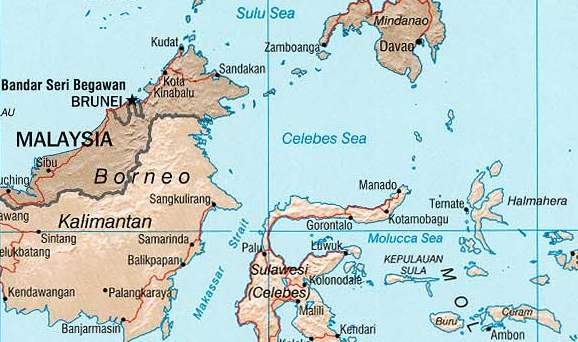
Finally, the squidworm was discovered in the Celebes Sea. Where is the Celebes Sea? you may be wondering. GOOD QUESTION. I did not know either, so I looked it up. It’s in southeast Asia, just to the south of the Philippines and sorta midway between Australia and Vietnam.

And now you know.

{ 5 comments }

The Creature From Newport News

by Jennifer Frazer on December 1, 2010

Want to know what this exciting cilia action is all about? Then head on over to the Scientific American Guest Blog, where (here’s my exciting news) my first invited post was published today! Yay! They even honored my request to allow you to click to embiggen (as fellow Boulderite Phil Plait would say) the art. Hope you enjoy.

{ 4 comments }

Slime Mold Gives Thanks for Mexico-Shaped Oat Flakes

by Jennifer Frazer on November 25, 2010

Remember the researchers who used slime molds to compute the most efficient transportation routes for the Japanese Rail system? Well break out the oat margaritas, because someone sent the slime molds south of the border on the same mission, and this time, they made a movie . . . .

As you can see, some crafty human created a Mexico-shaped coral in a petri dish with oat flakes (Asda’s Smart Price Porridge Oats, the paper notes) located at the major cities. The seed slime was placed at Mexico City. The slime mold, Physarum polycephalum, is like a giant amoeba that is actually eating the bacteria living on the oats, not the oats themselves. After it polishes off a meal, it sends out slime en masse. If it can’t find any food within a reasonable distance, it retreats. If it can find food, it collapses from a spread-out sheet of slime into a single transport conduit. And somehow, the bag of cytoplasm calculates the most efficient routes for the network.

If you look carefully between the oat flakes, you’ll see permanent conduits left behind, optimized for distance. Sometimes their solution for the oat-flake network is different from ours, sometimes the same. In the case of Mexico, the slime mold’s solution matched humans’ solutions pretty closely. Ironically enough, when posed the same problem for Great Britain, the slime mold came up with some alternative routes for one of the world’s most legendarily efficient transportation systems. Read more about this particular study here, or the original research here.

Now if we could only find a way to use Physarum to take back Mexico from its out-of-control drug gangs. You know, like in The Blob. But with more oats.

For those of you in the states, have a Happy Thanksgiving. I am thankful for all you readers — It is nice to know you enjoy hearing my thoughts on the things I love. I’ll be away from North America until next Wednesday on vacation, but I’ll have some very exciting news for you then.

{ 4 comments }