Snowmastodon Village: A Visual Tour of a Remarkable New Find

by Jennifer Frazer on November 23, 2010

On Oct. 14 of this year, as construction crews were clearing ground to expand the Ziegler Reservoir near Snowmass Village to increase snowmaking capacity, bulldozer operator Jesse Steele uncovered the bones of a juvenile female mammoth. What happened next was a minor miracle: he recognized them as fossils, and didn’t doze them.

Instead, he and others got on the horn (as it were) with the Denver Museum of Nature and Science. An emergency paleonotological response team (how many times does that happen?) was dispatched. Just over a month later, stymied, for now, by snow and frozen soil, the museum took a step back, a big breath, and has realized they have stumbled onto the find of a lifetime.

Spake Museum Curator Kirk Johnson to the Denver Post:

“We know almost nothing about what the Rockies were like during the ice age. We have our first clear window into it,” museum curator Kirk Johnson said. “It is one of the most amazing finds in North America.”
It was he who has publicly suggested the town should be redubbed Snowmastodon Village, for here is what they have found, according to the Post:
Museum workers — 67 individuals — recovered more than 500 bones representing eight to 10 American mastodons, four Columbian mammoths, four ice-age bison, two deer, Colorado’s first-ever Jefferson’s ground sloth and several smaller animal species, and hundreds of pounds of plant material. . . Scientists have in house 15 tusks of mammoths and mastodons — one still bone white — plus two tusk tips and 14 bags of tusk fragment.
For those of us who also care about things without fur, the Post was gracious enough to report that the team has also found:

* One tiger salamander

* Distinctly chewed wood that provides evidence of Ice Age beavers

* Insects, including iridescent beetles

* Snails and microscopic crustaceans called ostracods

* Large quantities of well-preserved wood, seeds, cones, and leaves of white spruce, sub-alpine fir, sedges, seeds, and other plants.

Truly, this is The Age of Mammals, the companion mural to the Age of Reptiles at the Yale Peabody Museum, come alive. Age? The final word isn’t in yet, but it’s looking like somewhere between 40,000 and 130,000 years old. To give you a sense of the timing, the last interglacial began about 130,000 years ago, and the last ice age began about 100,000 years ago, ending just 10,000 years ago. You can read more about the discoveries in the Post here and here.


I have to say I do want to know more about the Ice Age beavers. I’m imagining they had some pretty sweet ice age digs — you know, lodge all tricked out with mammoth-fur lined walls and satellite TV. Like these guys.


In any case, on Saturday, the Museum held a Mastodon and Mammoth Madness Day at the Museum to show off a handful of their finds for one day only before everything disappears for a few years to be preserved. Yours truly made sure to attend (I do it all for you, dear readers) so I could be there for those of you who couldn’t. When I arrived I found swarms of children and a variety of non-Snowmass fossils blocking the way to the main event. No matter, I parted the seas to find the proper table. There, volunteers were assiduously misting the unprepared bones with squirt botttles.
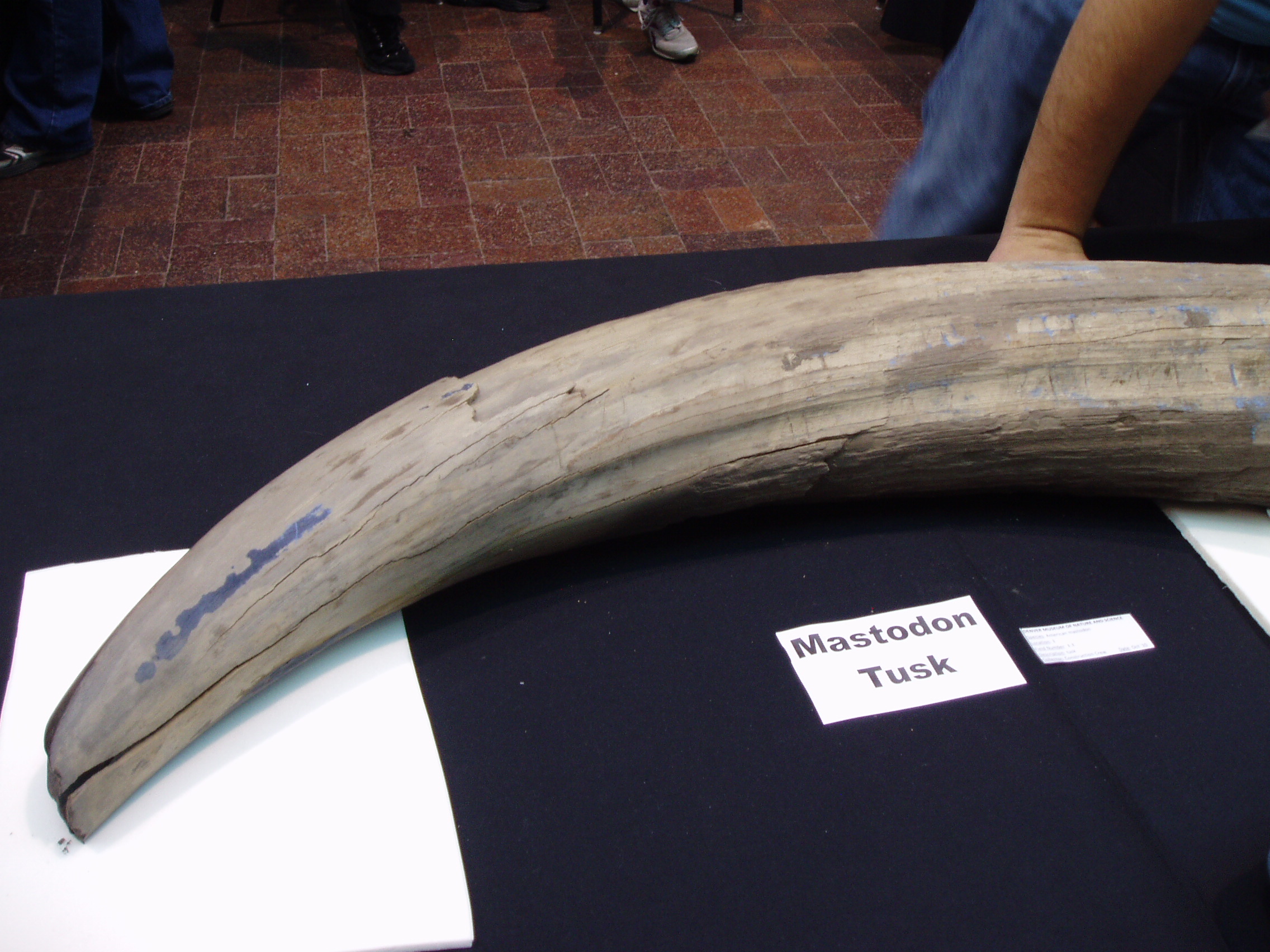
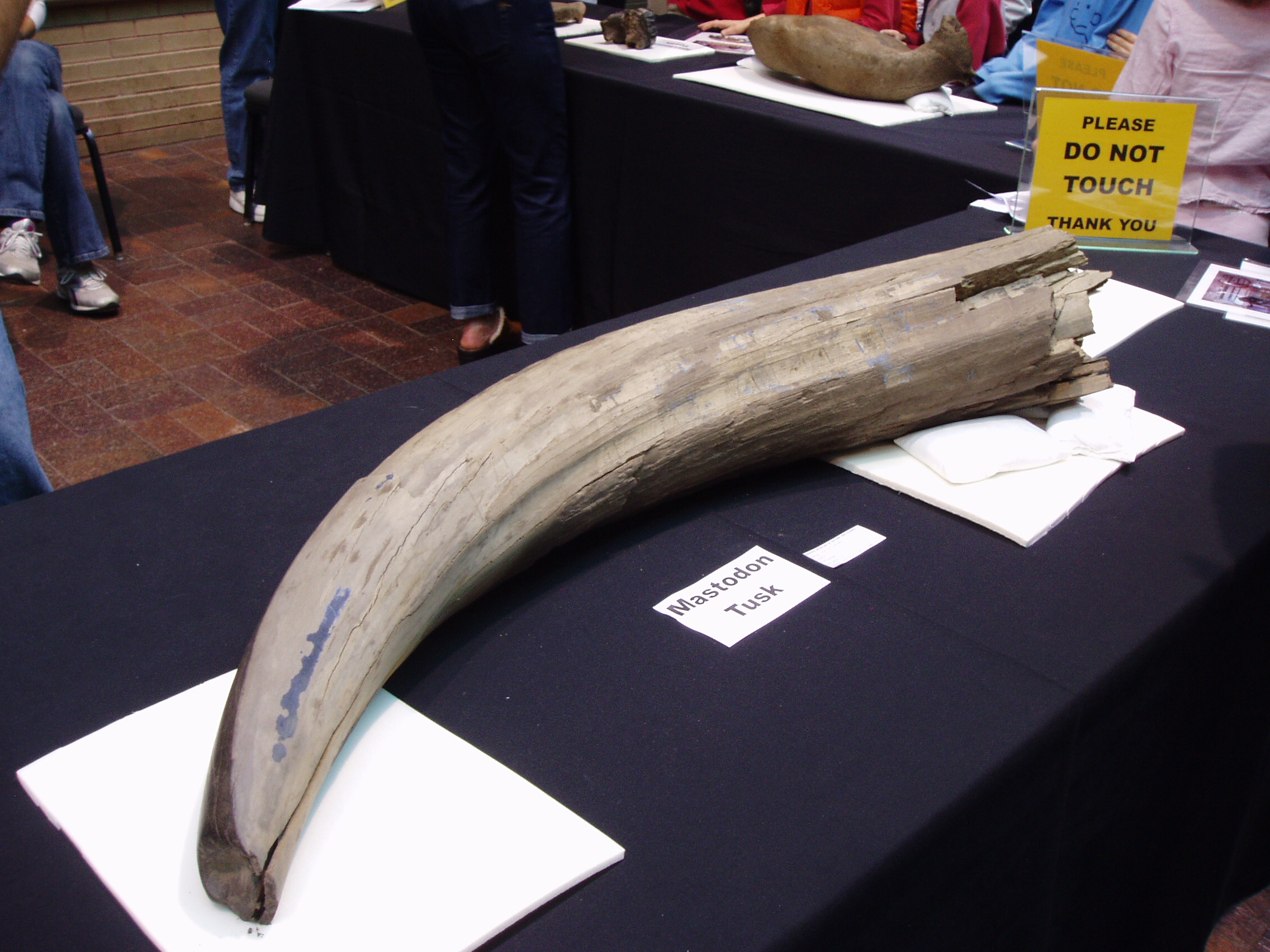
Here was the first bone I looked at — a mastodon tusk. Note the blue stains.
A volunteer informed me those are actually a blue mineral formed from the biological ooze in the bone. The name is escaping me, but I think it was a woman’s name starting with a V + ite (Vanessite?)
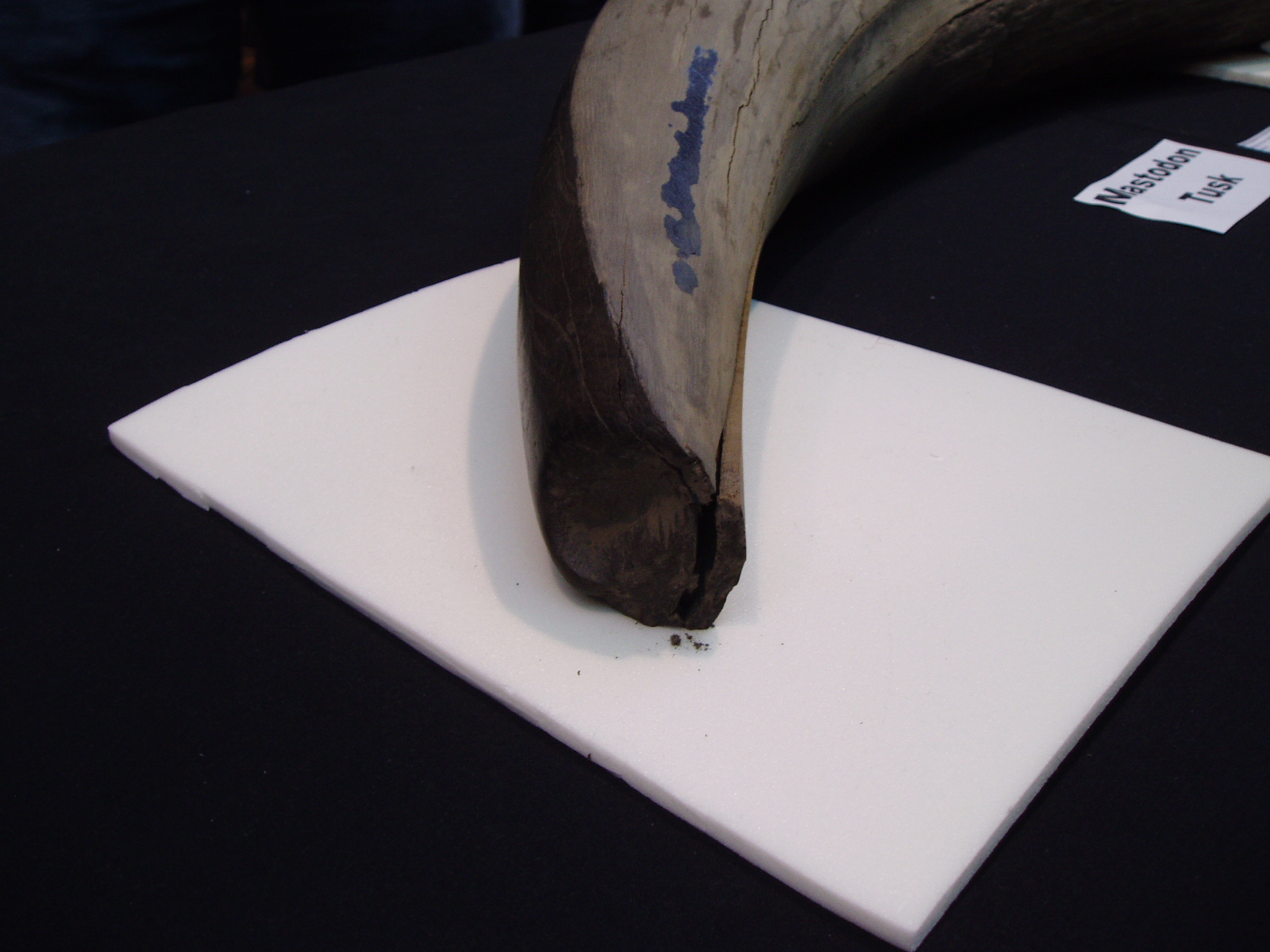
Notice the tip. It’s not broken. Here’s a closer look.
Though it’s a little hard to see in this photo (go look at the photo at the very beginning of this post too), the end is worn smooth, from use in life. Just like the wear and tear on your molars. Speaking of which . . .
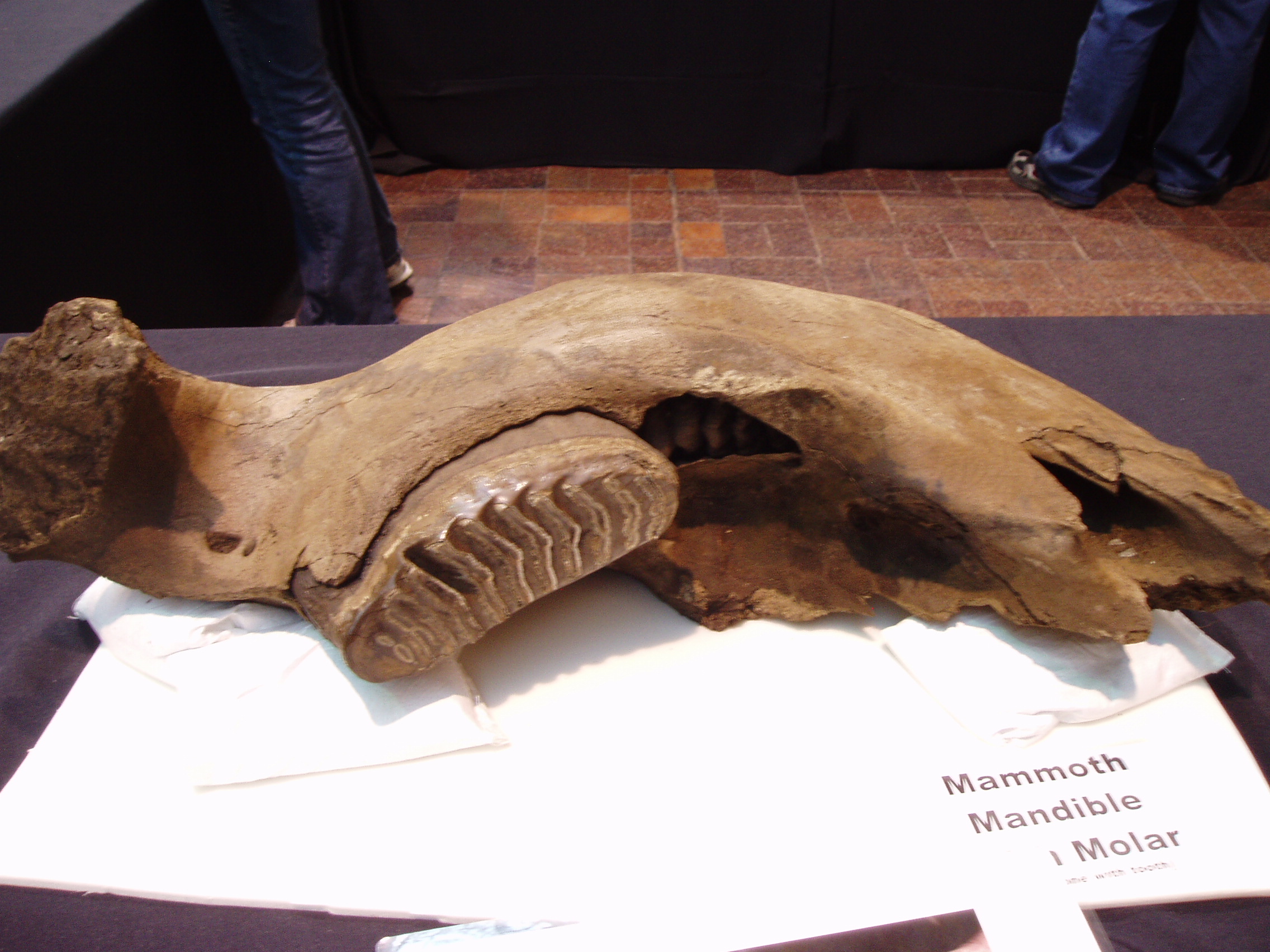
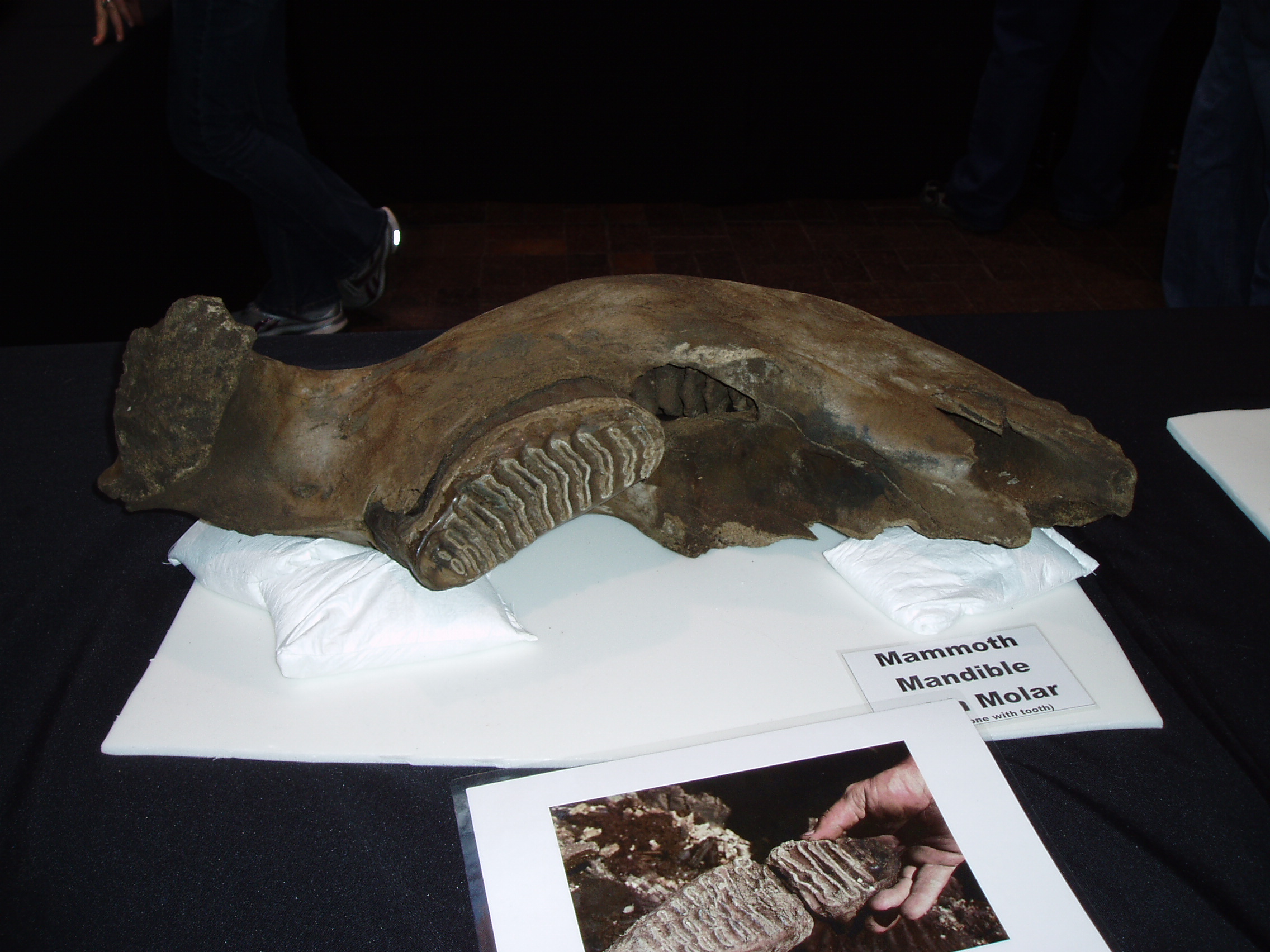
Here is the jawbone of a Columbian mammoth with one of its worn-down and extremely characteristic molars. They look like some sort of funky scrubbing pad, if you ask me. I LOVE the pattern. But even cooler than that is what lurks in that little shadow next to the tooth. See inside? It’s *a new* molar, just waiting to erupt. And unlike the existing molar, its crown is perfectly pointy and unworn.
You might be able to see it a little bit better here:
Mammoth teeth are very distinct from mastodon teeth. For comparison, here’s a mastodon molar, which looks much more like our own:
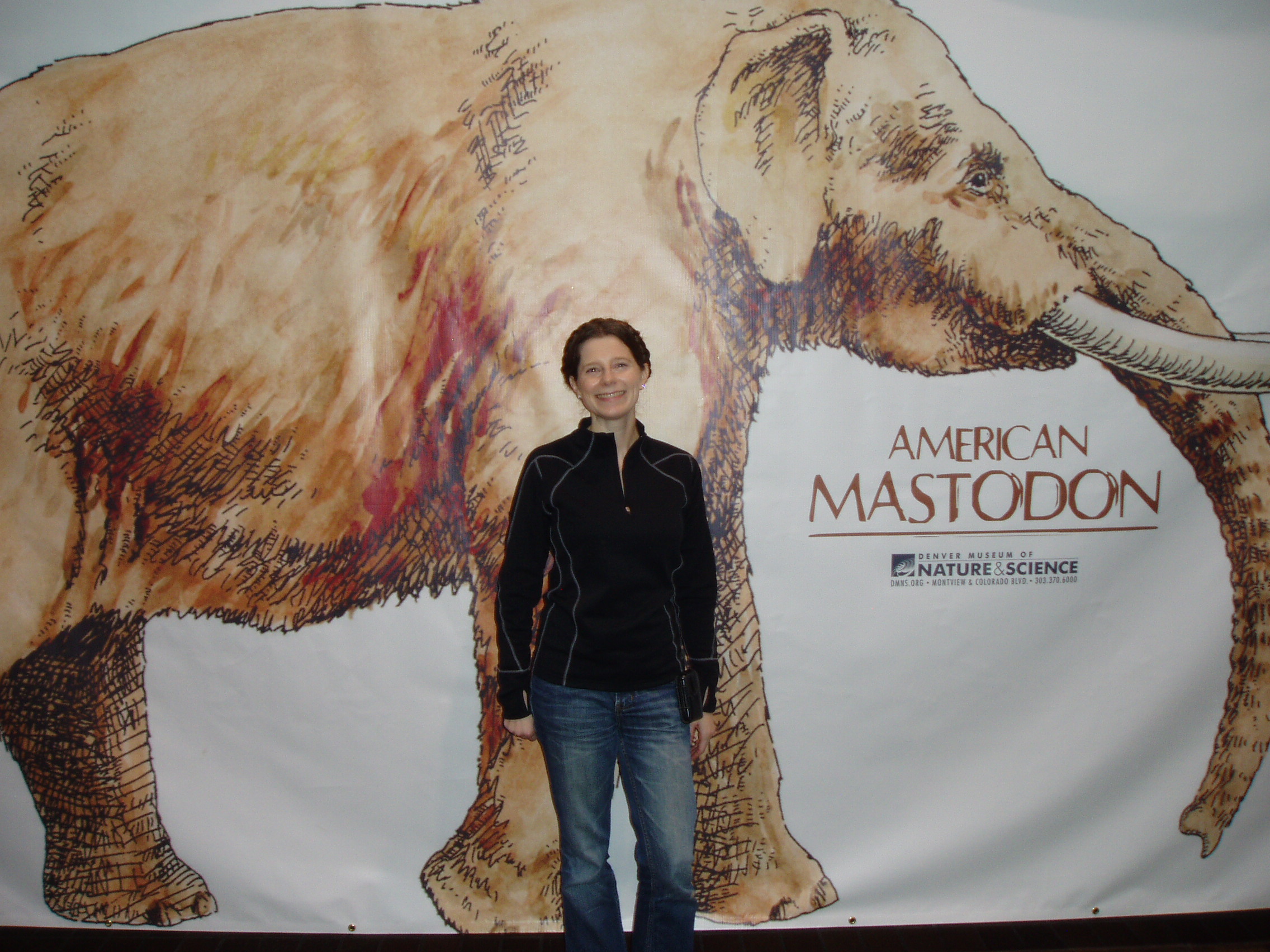
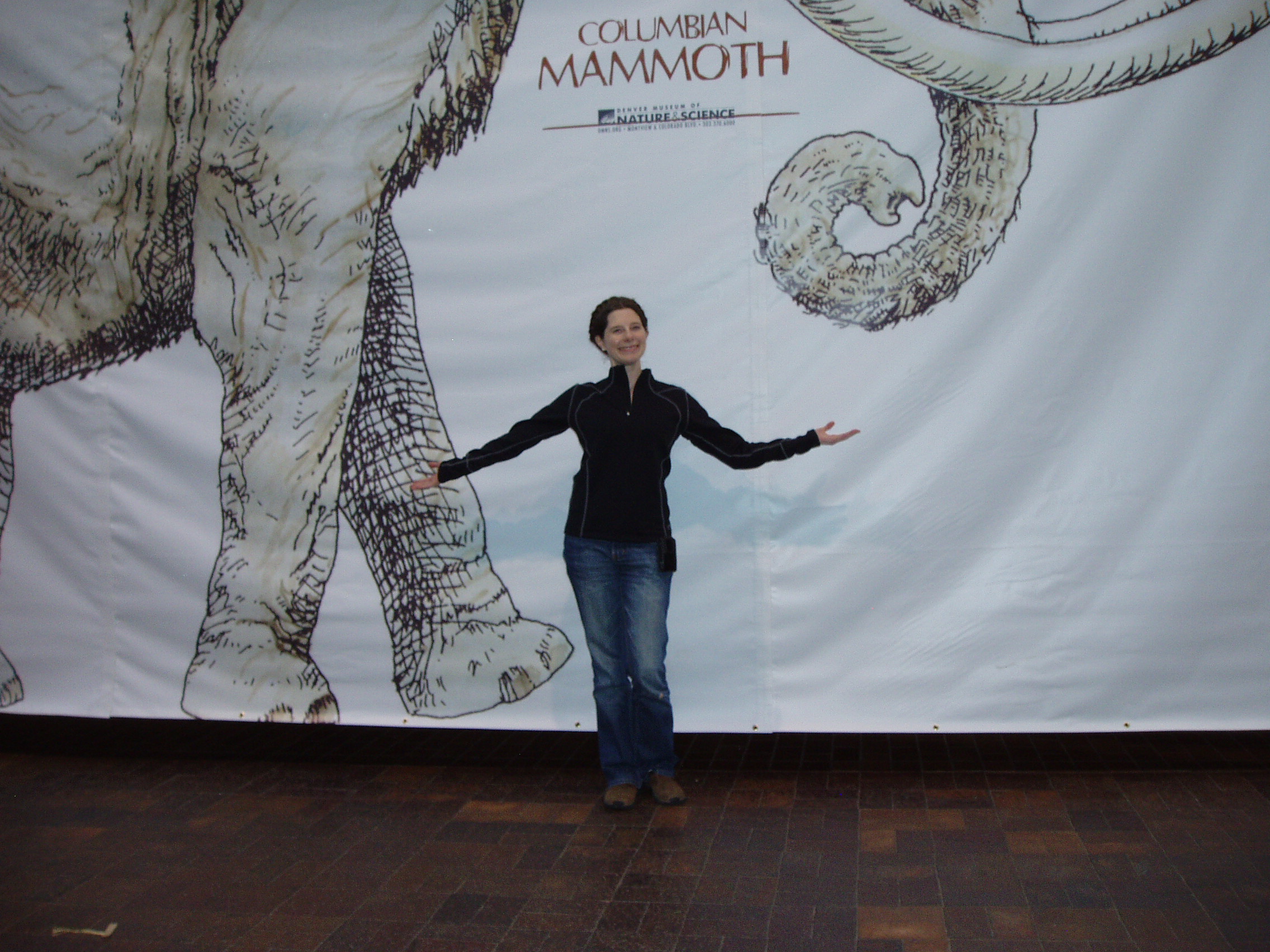
So by now you may be wondering, “Just how big were mastodons and mammoths compared to us and each other?” Well, I’m glad you asked — the museum had handy dandy banners made up, and I inserted myself into the picture as your human scale bar. I am quite a short human, though — only 5’2″ (just over 1.5 m). So bear that in mind. : )
Here’s a mastodon, which as you’ll see, is a little smaller than an elephant:
And here is the Columbian Mammoth — which was much bigger!
Columbian mammoth — or oliphaunt?
The museum also had bits of other fun stuff they found in the peat from which they’ve been excavating the bones, including lots of bits of grass and grass seeds:
Those are tens-of-thousands-of-year old grass seeds and blades, folks. And they look like they just fell yesterday! Would be fun to see if you can get any of them to germinate. They also had a very tiny piece of peat with an irridescent blue beetle butt, but the light was too bad and my camera too poor to capture it well. The beetle was so well preserved they could identify it to family as a Buprestid.
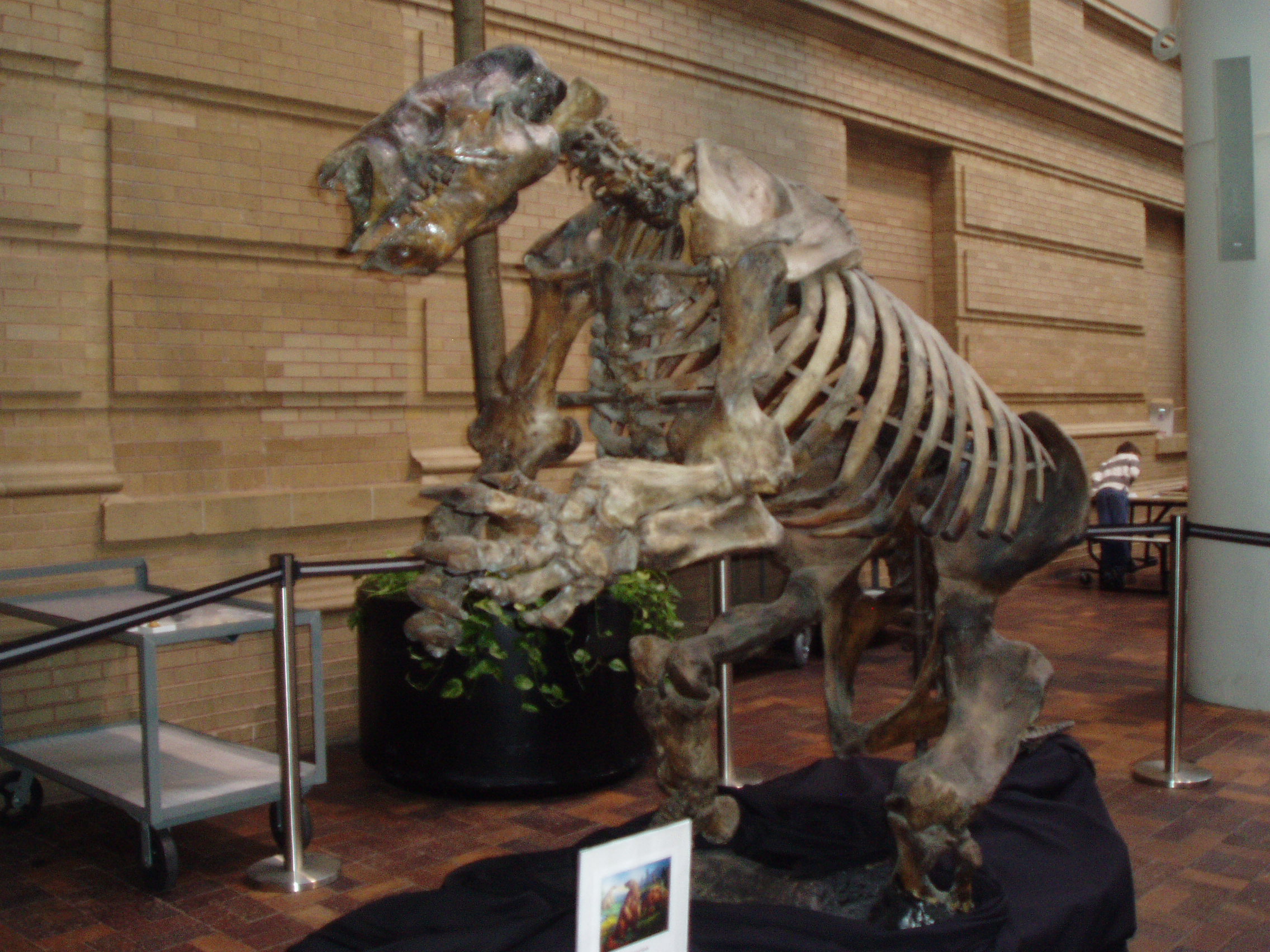
Alas, they didn’t have the sloth bone on display, but they did have a giant sloth skeleton from another site displayed:
Pretty scary looking, eh? And yet, according to the volunteers, those scary claws were used for digging up ant and termite mounds. Here’s some more info and a nice reconstruction.
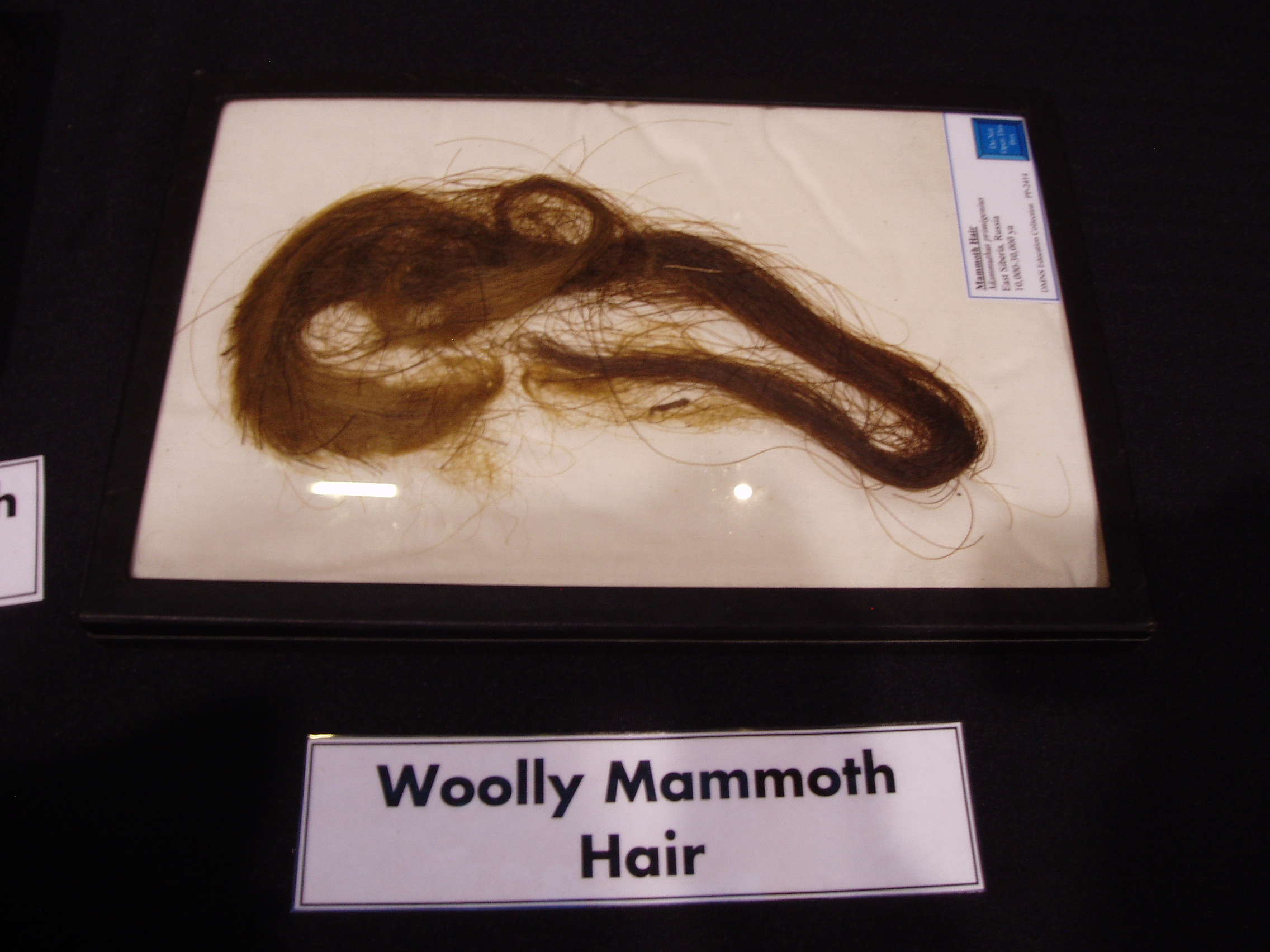
Finally, I happened to notice this inconspicuously laid on a table nearby. Real woolly mammoth hair!!
I’m sure it came from a frozen mammoth somewhere. Though they found Columbian mammoths — not woolly mammoths — at this site, it was still so cool to see. The box had like six different “NEVER OPEN THIS” stickers, but to me, it was so wonderful that, in theory, I could pet the fur of a mammal long extinct from the Earth. The bones at Snowmass seem to have come from a swamp or lake, so the odds of finding fur are slim. But you never know . . . there’s always next season. And I can’t wait to find out what’s still buried out there, high up and lonesome at 8,874 feet.

{ 9 comments }

The Terror of the Cambrian: Not So Terrifying

by Jennifer Frazer on November 18, 2010

Part praying mantis, part flatworm, part geminating snuffleupagus: Model of Anomalocaris from the Natural History Museum, London. Creative Commons Gaetan Lee.

On the list of hallucinatory animals, the Cambrian creation known as Anomalocaris has held a particular grasp on natural history buffs’ imagination. Its name (essentially “weirdo shrimp”), its fascinating path to discovery, and its use as a Cambrian fall guy in Burgess Shale recreations have all contributed to this. Natural history documentaries, in particular, have tended to portray this thing patrolling the Cambrian oceans and harassing helpless trilobites with the cool assurance of a Great White Shark. In my copy of “Prehistoric Life: The Definitive Visual History of Life on Earth” published by DK just last year (and highly recommended), the caption of the beautiful full-color page describing Anomalocaris declares “3 ft 3 in The length of the largest Anolmalocaris specimens. Its size and formidable mouthparts made it a top predator of the Cambrian seas.”

Before I come to the current study, it’s worth knowing something about the history of this thing. In the world of Cambrian paleontology, Anomalocaris is a superstar. Life’s first big multicellular experiment (that we know about) — the Ediacaran — was mostly about soft-bodied life. Its second great multicellular experiment is the one that gave rise to most of the major groups we recognize today. This was the community of organisms famously discovered in the Canadian Burgess Shale, and it is the one in which Anomalocaris was found. The only problem was that when scientists first found it, they thought they had three separate living things — a real life enactment of the story of the blind men and the elephant.

First found was a shrimp’s tail — but only the tail. It was this that was named Anomalocaris.

A proboscis of Anomalocaris. On first glance, they thought it was a weird shrimp because its little "appendages" were not jointed, unlike modern shrimp. As it turns out, it was a weirdo shrimp because it wasn't a shrimp.

Next found was a pineapple ring — or what looked like a pineapple ring. Captain Morgan notwithstanding, scientists interpreted this as a squashed jellyfish and named it Peytoia. Finally, scientists found a fossil they judged to be a sponge, and named it Laggania. The pineapple ring was attached, but was interpreted as a jelly fish that had just happened to settle on top of the sponge and got squashed into place. Finally, the scientist Harry Whittington at last found a fossil in which the shrimp hinder was attached to the pineapple ring. No, really? What the heck was this thing? A few years later, they put it all together: the sponge was the body, the pineapple ring the mouth, and the cocktail shrimp was one of a pair of probosci of this titanically large (for the Cambrian) animal. Anomalocaris, they called it, since earliest taxonomic names have precedence, and judged it to be the terror of the Burgess Shale fauna.

For the Cambrian, this thing was big. At about one meter (three feet) it dwarfed the other species we typically find in the ecosystem. But it turns out that titanism may have been the size enhancement that comes with being a whale shark, not a white shark. Scientists at the Denver Museum of Nature and Science conducted computer studies of Anomalocaris‘s bizarre mouthparts and found that it was extremely unlikely it was capable of crushing much more than a gummy bear, much less an armor-plated trilobite. Supporting their study, they examined some 400 fossil Anomalocaris mouthparts — and found nary a chip or scratch. Considering how soft our fingernails are and how frequently they get chipped or scratched, I’m afraid it appears Anomalocaris must have been chowing down on something either very soft or tiny indeed. Soft worms, they suggest — or plankton.

So the vicious predator may have been a gentle, harmless (unless you happen to be a plankter) filter feeder. At least — that’s the tale now! With as many twists and turns as this story has taken, I wouldn’t be surprised if another surprise lies in wait. For instance . . . scientists have actually found and identified fecal pellets of this thing. That’s one study I, for one, will be glad not to have to do . . .

{ 3 comments }

Photosynthesis in the Deep?

by Jennifer Frazer on November 15, 2010

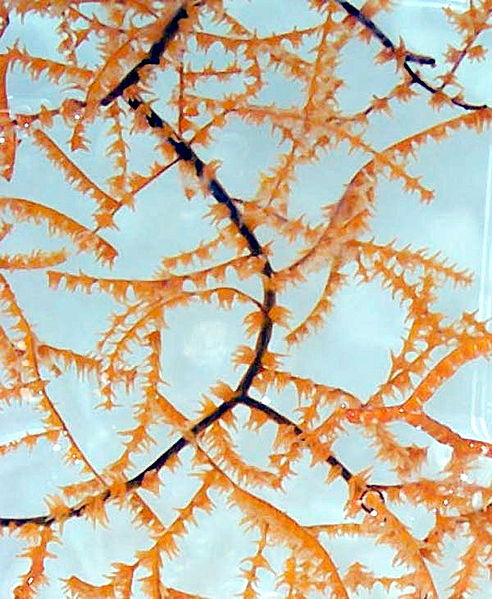
Away down deep in Hawaii, far from the reach of light you or I could see, lie spiny black corals. By deep, I’m talking deep — on the business end of 1000 feet. For a long time, no one thought these corals could host symbiotic algae, as most corals do, because there is so little light at those depths.

Yet that is precisely what scientists have found. In 71 percent of the black coral species examined at up to 1,300 feet beneath the surface, scientists found symbiotic algae either identical to or nearly identical to that found in surface corals. That’s amazing! What the heck are they doing there? Is the tiny amount of light that makes it enough to sustain them? Or do they retain their photosynthetic apparatus in spite of not using it? Do the corals simply keep algae because there’s no great cost to *not* doing so, and it’s already programmed into their genes?

Black corals, like all coral, are actually cnidarians like jellyfish, anemones, and sea pens. In essence, they are animals that have taken up underwater lichenization: primary colonizers that slowly build up the infrastructure (lichens: soil, coral: calcium carbonate high-rises and sand) that will support other life. But instead of fungi trapping eukaryotic (nucleated) green algae or cyanobacteria (as in lichens), we have colonial cnidarians trapping dinoflagellates called zooxanthellae. Each little coral individual, or polyp, is like an upside down, anchored jellyfish (complete with little particle-trapping, retractable tentacles) with photosynthetic dinoflagellate tenants inside. Black coral polyps aren’t black, but their skeletons are. Black corals also have tiny spines on their skeletons, lending them the name “spiny thorn coral”.

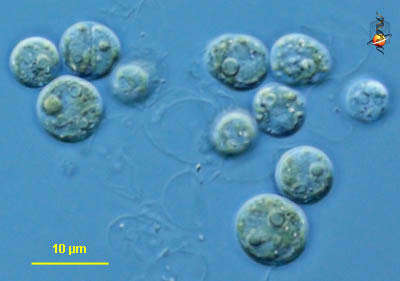
Let’s have a closer look at the renters:

Symbiodinium -- the dinoflagellate zooxanthellae of black corals too. Creative Commons David Patterson and Mark Farmer. Non-Commercial Use Only.

Look carefully: you will see little brown spots, which are the symbionts inside the symbionts; that is, their own endosymbiotic chloroplasts, which were once photosynthetic bacteria. At some point long ago, they themselves were sucked in by an ancestral dinoflagellate and co-opted for its own personal use.

Corals aren’t the only ones that keep dinoflagellate food replicators right inside them (“Cellulose. Earl Grey. Hot.”): Other organisms that can host zooxanthellae — several of which, unless you’re a biologist, you’ve probably never heard of —  include jellyfish, clams, foraminifera, sea slugs, ciliates, and radiolaria. Depending on how you look at it, these algae are either getting free stays and all-you-can-make buffets left and right in the ocean, or they are getting bullied by half the kids in school. The relationship between the dinoflagellate and its coral hosts, in particular, seems ambiguous as best right now; while some scientists argue they benefit from the association, others say the coral is holding them captive and forcing them to do its bidding (in support, they point out that the algae can reproduce perfectly fine — and many times faster — on their own. The same is not true for the coral). The same arguments have been made for the lichen association, and I think the jury is still out on that one too.

Not all dinoflagellates are zooxanthellae, or photosynthetic symbionts. Nor are they even all photosynthetic. About half are not. They’re called dinoflagellates (supposedly) due to their whirling (dinos) whips (flagella), or tails. In the photo above, you should be able to see the trailing, or longitudinal flagellum which the dinoflagellate uses to propel itself, and the transverse flagellum, which wraps around the equator of the cell. Both of these flagella may come with their own ridged, groovy wrap-around exterior storage compartments, delightfully called the cingulum and sulcus. The transverse flagellum mostly stays in its groove and is believed to function as a rudder. Here are some pictures that might give you a better feel for how all this fits*.

But the chloroplasts of these creatures tell an amazing story. In most plants, chloroplasts (and mitochondria) have two membranes, which scientists believe is evidence that chloroplasts and mitochondria use to be free-living bacteria before they were tamed and fused with ancestral eukaryotic cells like our own (presumably, by one ancient cell trying to eat another and failing, with the indigestion-causing bacterium going on to start working for the cell. You know what they say . . . if you can’t beat ’em . . . ). But they’ve also long known that some marine algae have an even cooler situation: three or more membranes. What could be the explanation? Well, they seem to be evidence of multiple endosymbioses, or failed eating attempts that resulted in a cooperative relationship. And some of them were of algae, not just bacteria. In some zooxanthellae, there’s still a vestigial nucleus of one of those ancient algal victims wedged between some of the plastid membranes! So in essence, black corals are symbionts inside symbionts inside symbionts inside symbionts . . . you get the idea. Amazing!

A few final details about dinoflagellates — some of them also possess light-sensing eyespots, and one species has the smallest known eye. When corals bleach in water that is too hot (an increasingly common occurrence these days), they expel their zooxanthellae and die — and the loss of the algae’s colored pigments is responsible for the sudden whitening. And finally, a separate, free living group of dinoflagellates are the organisms responsible for the annoying and neurotoxic phenomenon you may know as a red tide.

But, while interesting, none of this helps explain why corals at extreme depths would retain the same or nearly same algae as corals found within feet of the surface. Here’s the conventional wisdom:

Hermatypic (reef-building) corals largely depend on zooxanthellae, which limits that coral’s growth to the photic zone.

I’m not an oceanographer, but it seems to me that below 1,000 feet deep is not the photic (light) zone. Perhaps the algae are the equivalent of cave fish: blind and pale but still fish in every other way. Sounds like a job for a dissecting scope . . . or are they eking by on the .0000001% (aprox.) of light that makes it that deep? Given that some black corals have been judged over 4,000 years old, with growth rates as low as 4 micrometers per year, perhaps that’s not out of the realm of possibility . . .

________________________________________________

*Tron dinoflagellate courtesy of Kennesaw State University.

{ 7 comments }

Indy . . . Why Does the Floor Move?

by Jennifer Frazer on November 6, 2010

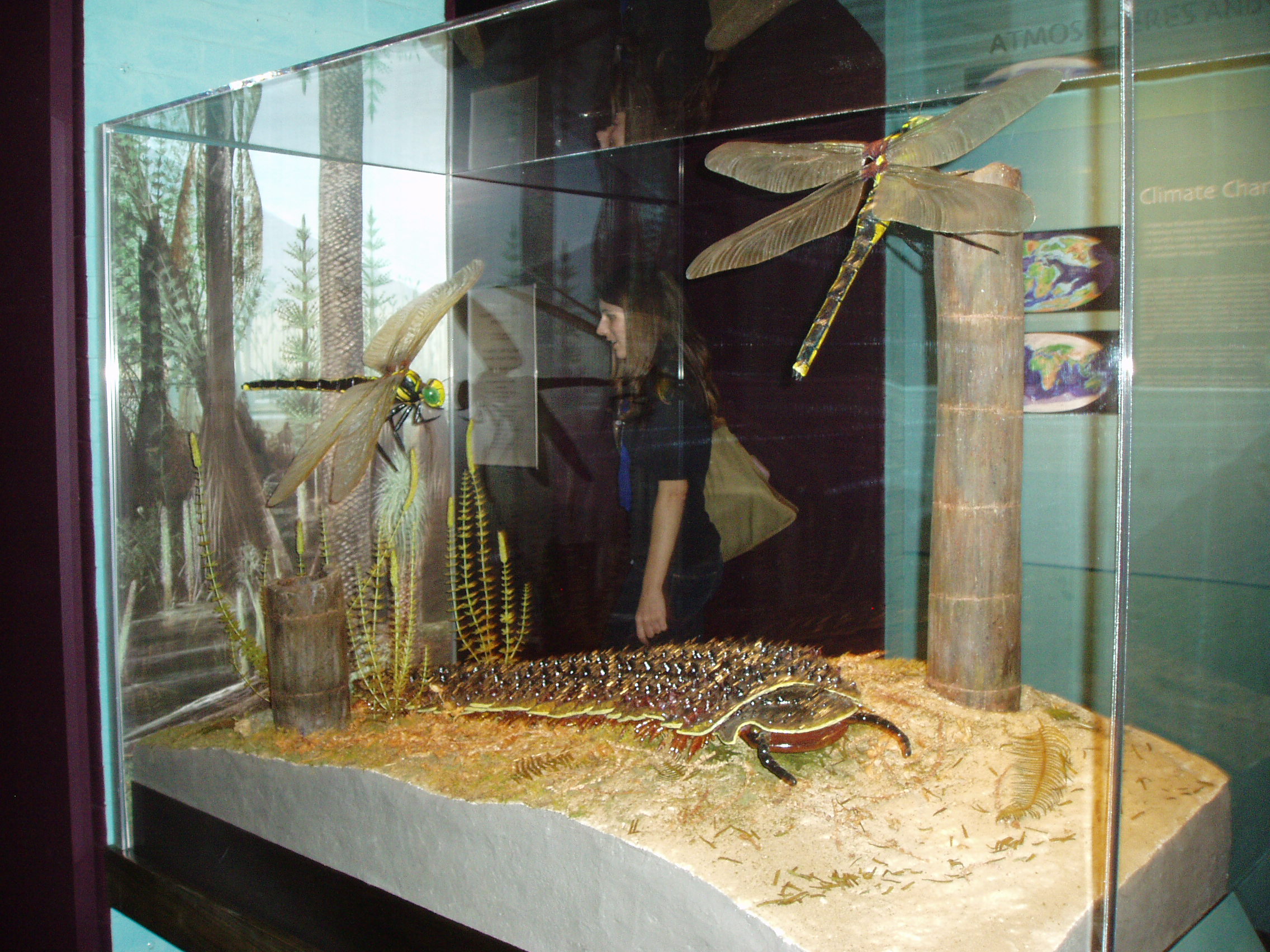
I am in New Haven for the 2010 meeting of the National Association of Science Writers. At the schmoozing soiree tonight at the Yale-Peabody Natural History Museum, I encountered two wonderful things. 1: the famous Age of Reptiles Mural* that imprinted the image of a stiffly lumbering yet truly frightening (the eye! the horrible eye!) T. rex into many an eight-year-old’s mind, and this:

To give you a better feel for the size of this thing, here is a version with a person in it:

This amazing millipede relative is likely the largest land invertebrate ever found on Earth (or rather, fossilized and found by humans on Earth, since without records we’d never know if there were bigger). It evolved during the Carboniferous period 300 million years ago, the era of rampant plant growth long before the age of the dinosaurs (250 mya) or even of reasonably efficient herbivores of any sort, which resulted in the vast deposits of coal that are powering our economy (and filling up our atmosphere with carbon dioxide) now.

In that time, without roving herds of plant-obliterating machines, and with the help of nice, wet, monsoon-on-steroids conditions, plants went crazy, and grew so fast they were buried in swamps faster than they could decay. Without a good rot, the carbon locked inside plants by photosynthesis as cellulose and friends never made it back into the atmosphere as carbon dioxide (it ended up getting pressed into coal), and oxygen’s share in the atmosphere increased to 25-30% (it is 21% now). Because most land invertebrates are encased in a gas-impermeable shell and don’t possess gills or big baggy, lacy lungs, many must breathe by simple diffusion through little tubes or pores in their bodies. They are very limited by the lack of surface area and circulation in this system of gas exchange, and simply can’t get any bigger than diffusion rates allow.

With waaaay more oxygen in the air, diffusion worked better and they could get bigger. How big? Well, this millipede relative, Arthropleura, could reach eight and a half feet. Eight and a half feet of undulating, creepy-crawly, armor-plated, and possibly envenomated goodness. Think about that. And now think about what it might have been like at night.

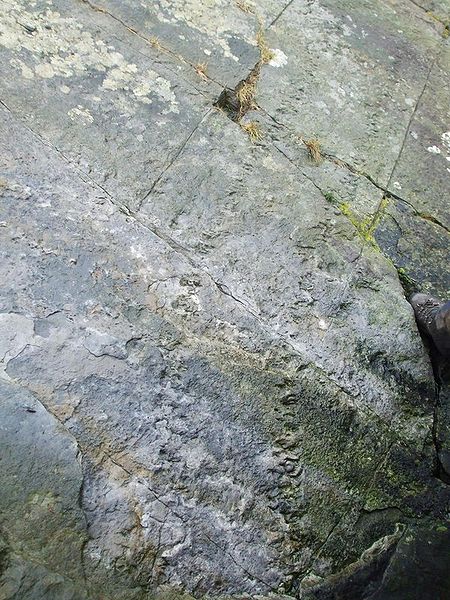
Arthropleura is a myriapod, a kind of arthropod, but not an insect — see this post for a nice graphic showing relative position in the tree of life. No one has ever found the fossilized jaws of this thing (Am divided on whether this is good or bad). Scientists originally supposed it was a vicious predator, but the discovery of fern spores in its fossilized gut may indicate it was a big dumb plant eater. As with tootsie pops, the world may never know. Perhaps even more astoundingly, like many dinosaurs, we actually have fossil trackwaves of Arthropleura feet. Here’s one from Britain:

Carboniferous Tank Tracks? No. Arthrop13ura Wuz H3r3. Creative Commons Ashley Dace

[Pause for reflection] I, for one, am glad 100% of land invertebrates are theoretically squishable by me, a 105-pound human, today. That is all.

__________________________________

*I also grew up with images of stiff, upright dinosaurs, yet most current youngsters, raised (or born into) the Jurassic Park era, must see this painting as unimaginably (and ironically, considering they are of extinct animals) archaic. I stepped back to take wider look at the immense mural — and though it was outdated, I must say it is still beautiful beyond belief. It glows with a dewey freshness even after 60 years. And though its vertebrate subject matter seems patently fake now, the plants, the cliffs, and the sunset glow in the sky and water at far right seem like they could have been captured somewhere in Utah just yesterday. This probably reflects the artist’s choice of the renaissance fresco secco technique, which lends the same still-bright-after-500-years jewel-toned glow to many Italian renaissance egg-tempera paintings found in art museums around the world today.

{ 5 comments }

More Weird, Wild Colorado: Halloween Edition

by Jennifer Frazer on October 31, 2010

Behold: My Halloween costume this year! Yes, for all you alert bionerds, I am indeed dressed as a giant Golgi Apparatus.

And thusly, I have done my part to add to the Weird, Wild Wonderfulness of our state. I’ll be repeating my lecture on that topic (“Weird, Wild Colorado: Life Forms that May Surprise you From Field, Forest, and Bloodstream”) that I gave initially last September at the CU Natural History Museum this Thursday, Nov. 4 at the Longmont Public Library, 7 p.m. This time it will be much easier to find! (I hope). Hope to see you there.

{ 4 comments }

The Ciliated Oceanic Conveyor Belt of Doom

by Jennifer Frazer on October 31, 2010

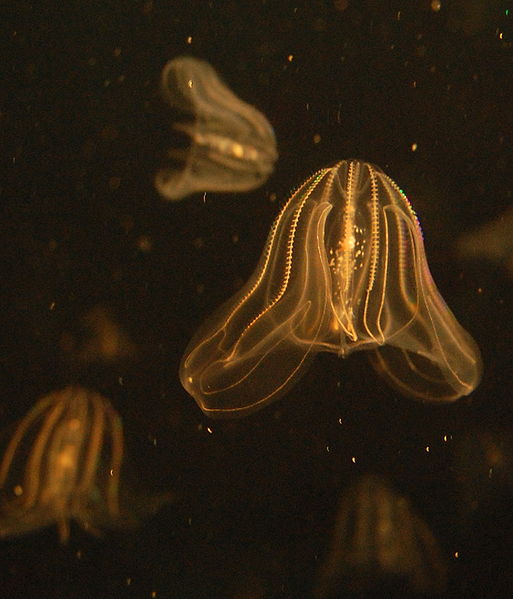
I've used this joke before but I just can't resist. . . "Luke, I am your father!" The ctenophore (comb jelly) Mnemiopsis leidyi. Creative Commons Steven G. Johnson

Remember comb jellies? The awesomely awesome spacecraft-shaped transparent oceanic stealth predators? I did a post about their general biology for Halloween last year.

When I was in Hawaii last April on my amazing pelagic night dive, I observed two comb jelly behaviors that totally startled me: just as I turned to look at one, it abruptly sucked a pink krill into its transparent stomach. (I’m glad I can’t watch *you* digest your lunch) And shortly after, it swam off under its own jet power, sucking in water and shooting it out through its muscular lobes. From watching the docile specimens found in aquaria — which never so much as lifted a lobe to exert themselves under their own power — I falsely assumed they were incapable of moving anything other than their cilia. But as it turns out, moving their cilia may be more than enough to lure the unsuspecting microscopic contents of entire seas to their doom. And “stealth predators” seems to be an understatement.

The species Mnemiopsis leidyi, originally native to the western Atlantic, but coming to a soon-to-be formerly pristine body of water near you (courtesy ship ballast water), is able to use its cilia to create a current of water fast enough to deliver its food to its mouth, but not so fast as to alert the unsuspecting foodstuff that it is . . . well. . . future foodstuff. Sneaky. Very sneaky. This according to a recent paper in the Proceedings of the National Academy of Sciences.

Understanding this ability may be greatly helpful in understanding how M. leidyi nearly emptied out the krill and small fish populations of the Black and Caspian Seas in the late 1980s and is well on its way to repeating the feat in the Baltic. Mnemiopsis was introduced into an overfished and polluted Black Sea in the 1980s, where it capitalized on struggling fish stocks to reach more than 10 animals per cubic foot in some places by 1989. The comb jelly ate the small fry of commercial fish like anchovy, causing a further drop in fish populations. Since then, the collapse of Black Sea fisheries, the decrease in pollution caused by the collapse of the Soviet Union, and the accidental introduction of another invasive comb jelly that preys on Mnemiopsis have curtailed its numbers somewhat. But lately the hardy jelly has also wreaked havoc in Israel, where gelatinous blooms gummed up the filters of a desalination plant, stanching a third of its 100 million liter daily flow; in the Caspian Sea, where it was introduced in 1999 and depleted 75% of the zooplankton;in the North Sea and western Baltic, which the comb jelly found its way into by hook or crook in 2006; and in the Mediterranean waters off Italy where it was first sighted just last year, causing local fisteries experts to fear for their stocks.

Though, as wikipedia calls it, this tentaculate ctenophore (say that 10 times fast) seems to be slowly taking over world waters (as are many jellies in the vacuum left by overfishing), that does not take away from its extraordinary ability to earn its daily bread in the same way you can cook a frog human(see comments : ) ) not by throwing it in a pot of boiling water, but by putting it in cold water and slowly turning up the heat. And though I’ve never seen one do its stuff in person (I was in the North Pacific when I saw my comb jelly, where this ctenophore species does not yet seem to have reached), I’m sure I’d still be excited if I did. Just as rock snot is destructive and ugly macroscopically but gorgeous up close, were one to look up close at the teeming ctenophore hordes that are doing so much damage to the fish stocks of Europe, one would find their cilia twinkle in the light, and, delightfully, glow blue green in the dark when disturbed. Coooooool.

{ 4 comments }

Slippery Hagfish Elude Grasp in Life’s Tree

by Jennifer Frazer on October 23, 2010

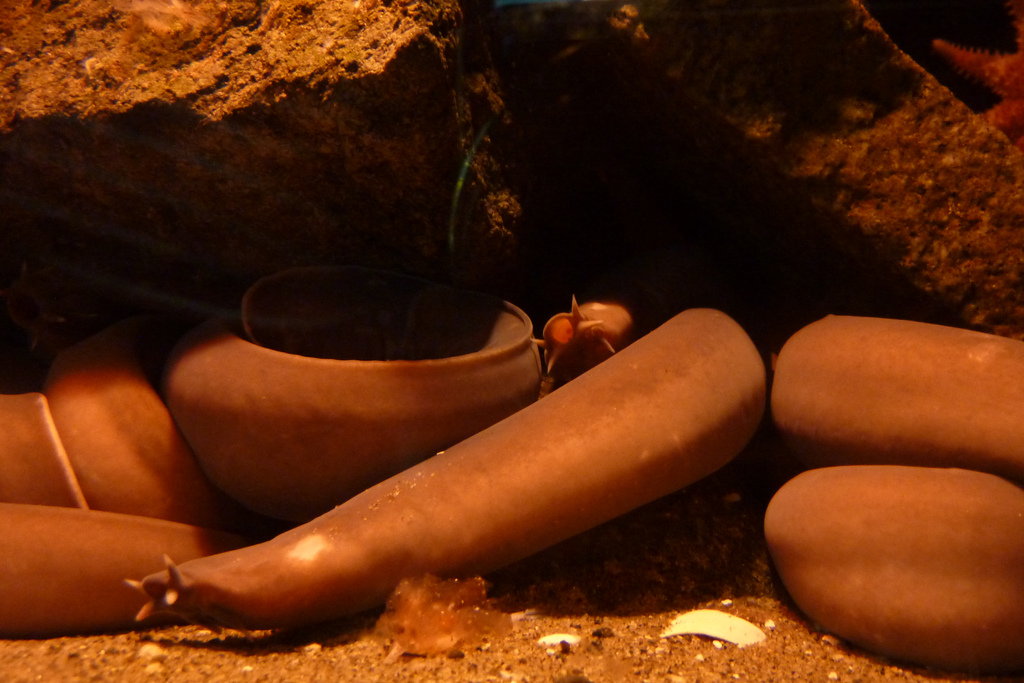
Is it just me or do these guys' snouts have a bit of a star-nosed mole feel? Creative Commons wondoroo

A bit of interesting news this week: the humble and much-reviled hagfish (“disgusting” seems to be its most common moniker) was knocked off its podium at the evolutionary junction between vertebrates and invertebrates.

Perhaps we should begin at the beginning: what is a hagfish? Glad you asked: it’s a serpentine, sea-dwelling, knot-tying, slime making scavenger that lacks vertebrae (a bony spinal column that protects the dorsal nerve cord), compound eyes, or true teeth. It does have a rudimentary skull, but it lacks compound eyes, having instead only simple eyespots. And about that slime: there’s a lot of it, and it’s really noxious. Grabbing a hagfish by the tail will result in a veritable deluge of the sticky, gill-clogging stuff, which may be why hagfish’s only predators are birds and mammals, not fish, and why after sliming themselves, the hagfish has to tie itself in a knot that it works down its body to wipe its own slime off. Some theorize that even the *hagfish* can’t breath through the stuff if they leave it on too long.

Wikipedia drily notes:

An adult hagfish can secrete enough slime to turn a 20 litre (5 gallon) bucket of water into slime in a matter of minutes.

‘Atsa lotta slime.

In any case, for a long time hagfish were apprently classified with the jawless lampreys on the big ‘ol tree of life. They were considered to be the earliest representatives of the vertebrates, from the time before jaws had evolved.

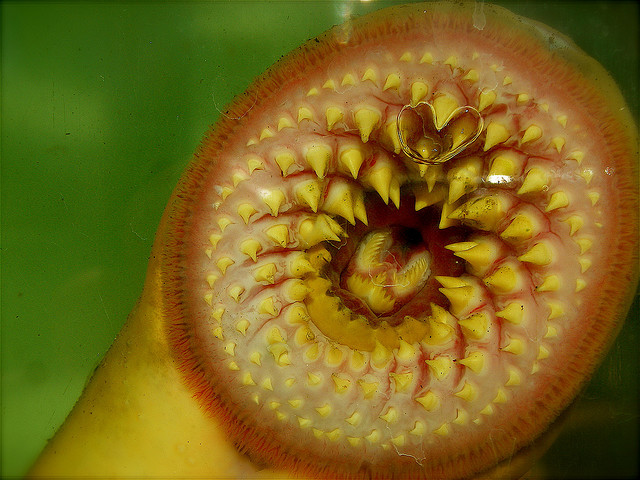
For those of you who might have difficult remembering from high school biology or who have never had the pleasure of seeing one up close, here is a view into the mouth of a lamprey:

A sarlacc? No, a lamprey. Creative Commons edans

Is it just me or does this somewhat horrifying angle resemble this? Lampreys are famous for their parasitic lifestyle: they latch onto the side of fish with their horrible, horrible rows of teeth and suck until they can suck no more. (Possible bionerd bumper sticker idea: Lampreys Suck)

In any case, DNA studies eventually seemed to show that the hagfish actually were more primitive than lampreys, providing the “missing link” between the most complex invertebrates and the most primitive vertebrates — the lampreys. Now new studies of snippets of RNA called microRNA seem to show they are actually as they first seemed: closely related to the much more easy-for-scientists-to-work-with lampreys*.

In all the time scientists were working on hagfish, they were only able to find *three* embryos in the entire 20th century. And if I had to choose between the horrible rows of teeth or the suffocating slime? Teeth. Fo’ sho. Although I have to say the hagfish are cuter. Though admittedly, we’re talking about a pretty low bar here.

———————————————————————————

* For the biologists in the room: microRNAs date me; I cannot recall learning about them in the late 1990s when I was in college, but they are big, apparently, now: very short segments of RNA that latch onto messenger RNAs in the short, untranslated section at their tail ends and turn them off. They are also strongly conserved among species, making them, like ribosomal RNA, great for looking at large-scale evolutionary relationships.

{ 4 comments }

The Fungus and Virus that Rot Bee Brains

by Jennifer Frazer on October 17, 2010

A microsporidian like this is one-half of the perp identified as the cause of Honeybee Colony Collapse Disorder. This isn't the exact species, but is instead another microsporidian called Fibrillanosema that infects amphipods. Neat rows of polar filament cross sections line either side like cannon on a British Man o' War. In 3D, these coil around in a big spiral. Creative Commons Leon White

For the last several years, honeybee colonies have been emptying out like keggers at which the cops have arrived — and the bees show every sign of being just as out of it as drunk college kids. They abandon their hives to die alone and cold in the wild, striking a huge blow to North American apiculture and, until now, anyway, leaving everyone scratching their heads.

Well, no longer. Though early reports identified an Israeli virus as one possible cause, a serendipitous bioinformatics project taken on by, of all people, the military, along with Montana researchers, has identified a dual cause of colony collapse: a previously unidentified DNA-virus, and a fungus called Nosema ceranae.

For those who’ve been paying attention, a Nosema parasite of bees has been around quite a long time — Nosema apis. But the new species, Nosema ceranae, appears to have come from Asia. Is this yet another introduced species decimation story? ( See Elm, American; Chestnut, American; and White Pine, Western) Or did we just never notice it here before? (the species can only be separated by DNA or scanning electron microscope — not by light microscope) Too early to tell. And still, no one knows what the fungus and virus combo is doing to make the bees lose it:

Still unsolved is what makes the bees fly off into the wild yonder at the point of death. One theory, Dr. Bromenshenk said, is that the viral-fungal combination disrupts memory or navigating skills and the bees simply get lost. Another possibility, he said, is a kind of insect insanity.

Translation: Zombification, a well known problem for insects under the influence of parasites (see Parasitoid wasps, and Cordyceps fungi)

Here’s the critical bit from the NYT article announcing the discovery:

Dr. Bromenshenk’s team at the University of Montana and Montana State University in Bozeman, working with the Army’s Edgewood Chemical Biological Center northeast of Baltimore, said in their jointly written paper that the virus-fungus one-two punch was found in every killed colony the group studied. Neither agent alone seems able to devastate; together, the research suggests, they are 100 percent fatal.

Since a 100 percent correlation seems pretty convincing, so let’s go with the assumption these guys are right for now. And since the virus is as yet unidentified and undescribed, let’s take a bit of a closer look at Nosema. Because Nosema is interesting. Really interesting. As recently as 10 years ago this group of organisms — colloquially known as microsporidia — was classified with next to Giardia, the most ancestral (aka primitive) nucleated (aka eukaryotic) organism known. Seriously. This would be like putting Homo sapiens at the base of the eukaryotic family tree*, because it turns out Nosema is a seriously evolved fungus.   And in this case, as you’ll see, that crucial bit of taxonomic information makes a big practical difference in attacking this problem.

Microsporidians are all single-celled parasites that can infect nearly any eukaryotic host, but most have specialized on insects. They have a bunch of crazy standard features. First off, Nosema has no mitochondria, which is usually a requirement for self-respecting nucleated cells. Such nucleated cells, called the eukaryotes — or all life that isn’t bacteria or the similar looking archaea — employ tiny intra-cellular organelles called mitochondria to make energy using food and oxygen in the air. For the purposes of this post, we will ignore mitochondria’s fascinating origin story and incredible biochemical gymnastics and simply focus on the utter necessity of these organelles to the business of being alive for air-breathing eukaryotes (cyanide is fatal because it stops up the energy-producing works inside mitochondria), and how utterly strange it is that the otherwise unrelated groups of microsporidia, the parasite Giardia, and the amoebic parasite Entamoeba histolytica all lack them.

Instead, they possess an organelle called a mitosome, which seems to be a vestigial mitochondrion — that is, what’s left after the mitochondria are no longer necessary for cell upkeep and they start to degenerate to save the organism energy. Another example of vestigial and remnant structures might be the tiny leg bones still produced inside some snakes and whales — though these creatures’ ancestors stopped using their legs millennia ago, there is still a part a part of their genome that makes a much reduced and apparently energetically inconsequential vestige of them.

The reason parasites like these can get away with dispensing with their mitochondria is that  precisely because they are parasites, they bathe in nutrients inside their host. They don’t need to breathe; their host does it for them. This seems to have happened several times in unrelated parasite groups. But because single-celled organisms possess few morphological characters, these groups were originally all placed together because they shared what few traits we could see: degenerate mitochondria (mitosomes), a double nucleus (microsporidia often have this, and Giardia always does — why is this adaptive for a parasite? No clue.), and a parasitic lifestyle. So a bunch of these funky parasites were thrown together into a classification called “archezoa“.

But someone must have studied these organisms’ DNA and found a very different story: microsporidia aren’t primitive protists, and aren’t related to Giardia and Entamoeba at all. They’re highly evolved fungi called zygomycetes — the same group that produces the bread mold Mucor and most snow molds that live at the foot of melting snowbanks that I wrote about in an August issue of High Country News. As recently as just 10 years ago, as printed in my copy of “The Variety of Life”, by Colin Tudge, they were still placed firmly at the base of the eukaryotic family tree — not near the tips of the branches, embedded in the fungi. It seems that the “archezoa” was really more of a niche than a true taxonomic grouping based on relatedness — these things evolved to occupy the same parasitic niches, and in the process, evolved similar adaptations, much as whales and fish look alike but come from very different sides of the tracks.

Zygomycetes are so called from the greek for “yoke” because they make a special sexual reproductive structure called a zygosporangium that yokes together two fungi of different mating types (=gender). As fungi, they follow the typical fungal body plan of being a bunch of thin filaments (aka mold). To look at a zygomycete, you would definitely think “fungus”. Not so with microsporidia! They tend to be single celled spores. But they also have cell walls made in part of chitin — another trait that unites the fungi.

But here’s the *really* weird thing about microsporidia. They are parasitic fungi that have evolved to look like protists and *act* like nematocytes (the stinging cells of jellyfish and anemones): Inside the spore is a coiled harpoon-like injection apparatus (go here to see it in 3D, rather than the 2D view at the top of this post) they use to get themselves into host cells. Just like nematocytes (covered in this post), the coiled “rope” of the harpoon turns inside out when the cell is triggered — and does so in less than 2 seconds. Once deployed, this long narrow filament (common size: .1-.2 micrometers in diameter by 50-500 micrometers long — click here to see one whose spring has sprung) inserts itself in a host cell and pumps the contents of the microsporidian inside. Pretty soon, the now zombified cell gets busy making little microsporidia.

Here’s the final important point, from the NYT:

They said that combination attacks in nature, like the virus and fungus involved in bee deaths, are quite common, and that one answer in protecting bee colonies might be to focus on the fungus — controllable with antifungal agents — especially when the virus is detected.

So without the taxonomic work to know these little jobbies are actually fungi and not protists, we wouldn’t know that we might have a chance of tackling the major threat to bees today with existing fungicides. Who says taxonomy is pointless?

____________________________________________________________________

* OK, maybe not quite. Since Nosema is a severely reduced parasite, it’s more like putting mistletoes — severely reduced parasitic plants — down there.
{ 13 comments }

World’s Horniest Dinosaur Discovered

by Jennifer Frazer on October 9, 2010

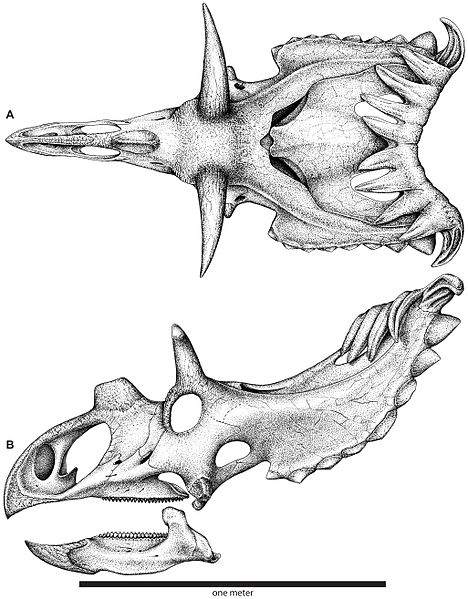
The Gothic Cathedral of the Triceratops family: Kosmoceratops. Creative Commons Sampson SD, Loewen MA, Farke AA, Roberts EM, Forster CA, et al. "New Horned Dinosaurs from Utah Provide Evidence for Intracontinental Dinosaur Endemism". PLoS ONE 5 (9): e12292. DOI:10.1371/journal.pone.0012292.

Note: Clarifications/corrections added below. See comments section.

Ya know, some headlines write themselves. This past month an article in PLoS One announced the discovery of this new, vaguely-late-’80s-esque addition to the ceratopsian oeuvre (let’s face it: dude’s got bangs). What a startling and beautiful structure atop this dinosaur’s head! — like a shark-tooth necklace, or a very ambitious sea star. But the real news here seems to be that dinosaurs were no different than modern animals: they were subject to the whims of sexual selection as well as natural selection. And oh, what a harsh mistress sexual selection can be to the poor males of the species.

You see, what females really desire is an honest indicator of fitness. Males will try to fake their way to reproductive success (aka gettin’ some) in any way they can. It’s in their genes’ best interest, since they can generally impregnate as many females as they like with little cost. Females, on the other hand generally incur great cost in reproducing. Eggs and pPregnancies and raising offspring (*see Ben’s astutue comment below) are expensive energetically, while sperm and a father’s contribution to child-rearing are usually cheap. If you’re a female member of a few unlucky species, you could be stuck looking after your young for days, even months(!) before they leave the nest. Bummer.

So if you’re female, you want to be choosy. Not just any old male will do. You want a male who has demonstrated his fitness in a way that can’t be faked or cheated. This selection pressure, incurred by females, has led to the evolution of energetically expensive (and often ridiculous but strikingly beautiful) or cerebrally-demanding male traits. Witness peacock tails, bower bird bowers, sage grouse struts, mockingbird songs, and Shakespearean sonnets. Intelligence or fluorescent feathers can’t be faked; one must genuinely be bright to sing snippets of 30 songs or construct an elaborate love nest. One must genuinely be healthy and strong to grow the avian equivalent of a day-glo Persian Rug and nonetheless escape the clutches of hungry predators. Thus females can make informed decisions about whom to let sire their offspring*.

Well, no matter how long ago they lived, dinosaurs were still subject to the same cruel female whims, it seems. Enter Kosmoceratops, the elaborately frilled dinosaur. For once, biologists gave the bony crown atop ceratopsian dinosaurs (the frill) a beautiful, apt name. But what’s the deal with all those horns? Well, scientists suspect (according to the article in Time) that the horns were probably useless in taking on predators and may have even made it harder for the animals to move around. They suggest they were either used to intimidate other males of the species, or attract females. To me, they have sexual selection (i.e. useless, borderline dangerous, but unspeakably sexy to females**) written all over them.

Strangely, it seems these ornately-horned dinosaurs evolved *before* the simpler (and perhaps more elegant) frills of Triceratops, Nedoceratops, and a few other species, so Kosmoceratops or one of its close relatives was thus in fact the *ancestor* of Triceratops, not the other way around. Here is an example of evolution operating in the direction of complex to simple, or baroque –> neoclassical, if you will. So take note: evolution doesn’t always mean simple –> complex. All that matters is that the trait is changing in a way that leads to more offspring. Perhaps the gnarly frills proved too unwieldy, difficult to clean and maintain, or less tasteful to females than they at first seemed. Maybe the ladies decided that scarlet chest crests were the new sexy of the early 70’s million B.C.

To explore how the ceratopsian dinosaurs fit into the rest of their thundering kin, see here, and click on “Ornithischia”.

And just a quick note — I did hear about the discovery of the possible culprits in Honeybee Colony Collapse Disorder, and you will be hearing my thoughts on that (and description of the perpetrators) here soon. : )

________________________________________________________

*Oddly, and for reasons I don’t entirely understand (except that the predator-free islands of the tropical birds of paradise (from which many of my examples are drawn) has allowed sexual selection to run amok), much research into the world of sexual selection has been done in birds. In one experiment involving birds whose females evidently found extremely long tail feathers erotic beyond belief, sadistic biologists clipped or gave tail feather extensions to variously naturally-endowed males. They found the birds’ reproductive success depended only on the length of those tail feathers, whether honestly come by or not: artificially-lengthened males suddenly found themselves getting much luckier than their better naturally-endowed but snipped brethren. Presumably, in nature, the birds can’t cheat the system by ordering a Swedish Tail Feather Enlarger.

** there are any number of human analogs that suggest themselves here

{ 7 comments }

Eight Legs? Check. Microscopic? Check. Cuddly? Check.

by Jennifer Frazer on October 4, 2010

If you had to name one multi-cellular organism that has survived both the vacuum of space and the full onslaught of solar radiation, could you? There is, in fact, one creature that has done this, and it has done so while accomplishing the (apparently) unrelated feat of being incredibly cute. Tell me this video doesn’t make you want to pick one up and give it a belly rub.


This is a little animal called a water bear, or tardigrade. On the mosses, lichens, forest litter, ponds, beaches, snowbanks (and even hot springs) of the world, this little guy plods along, oblivious to the larger world. At just 100 micrometers (.1 mm) to 1.5 mm long, they are cute on paws. Did you notice the little fingers?

Hug me! The caterpillar from Alice in Wonderland meets Heimlich from A Bug's Life? Creative Commons Rpgch

Discovered in the 18th century, these little guys were named water bears for their trundling, bear-like gait — that is, if can you imagine a bear with *four* pairs of legs and a penchant for shriveling up in winter rather than curling up in a cave. Tardigrade, in fact, just means “slow walker”.

Water bears exist at a strange junction between the world of the large and the world of the small. They are multicellular organisms with intestines, brains, eyes, fingers, and a chitinous cuticle that they shed, but in many ways they behave like protists, which are also microorganisms but not animals at all. Some tardigrades don’t defecate until they moult. Others don’t mate until that happens. The fertilized eggs stay behind in the moulted skin and incubate there, or sometimes adhere to a nearby surface. They are also eutelic (you-tell-ik), which just means that every water bear grows exactly the same number of cells, and once that number is reached, they can grow larger only by growing those cells. This isn’t uncommon for microbial life. Their mouths are armed with stylets with which they pierce and suck the delicious contents of plant cells, algae, and small invertebrates.

Creative Commons Rpgch

As for their bizarre survivalism streak, withstanding the vacuum and scorching solar radiation of space seems to be a byproduct of their ability to survive dry spells (they can go for a decade without water), just as it is for the bdelloid rotifers, whom I’ve also covered here. They can reversibly enter a state of suspended animation called cryptobiosis, in which their metabolism screeches to a halt and their water content plunges to a hundredth of normal. This helps protect their DNA, and a sugar called trehalose helps protect their membranes. For further information, see here. In 1997, they were launched into low-earth orbit and survived the vacuum of space for 10 days. Yes, Tardigrades . . . in . . . Space! Several went on to lay and hatch eggs normally. Interestingly, there is even a sci-fi sounding word for their state of suspended animation: when so ensconced, they are called a “tun”.

Taxonomically, water bears are most closely related to arthropods, or all the crustaceans and insects of the world, and onychophorans, the velvet worms. Biologists would say they are one of the bilaterian crown groups, or one of the earliest lineages to split into their own group after animals developed mirror-image symmetry. Other early-diverging animals either had no symmetry (sponges) or were radially symmetrical (jellyfish et al.) You can check out their neighborhood of the life family tree here (look for tardigrada). You may notice they’re also in a group called “ecdysozoa”, which is just a code word for “all the organisms that moult exoskeletons”, which actually does seem to be a true, historical, one-time evolutionary inovation (i.e., synapomorphy in bio-speak), and thus make it a taxonomically valid group.

Final cool factoid: few tardigrades have fossilized, but of those that have, one was named Beorn leggi, which will be delightful to those of you who have read The Hobbit. And in case you were wondering if someone actually had the chutzpah to do it, yes, yes someone did. It was screaming to be done. Behold the plush tardigrade.

{ 6 comments }